

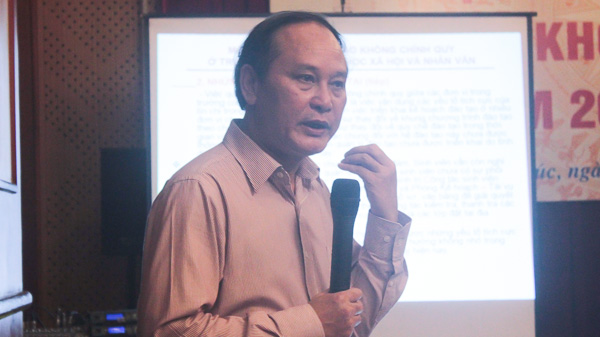
The conference was attended by Assoc. Prof. Dr. Nguyen Van Kim – Vice Rector of the University, leaders of Faculties/Departments, functional departments, and training assistants of the Faculties.
The conference aimed to evaluate and summarize the non-formal training activities in 2011-2012, and to discuss the draft guidelines for organizing non-formal training in the future.
The discussions at the conference particularly emphasized the important role of non-formal training in certain fields to meet the societal demand for human resources in social sciences and humanities. Collaborative training with partners in many provinces and cities across the country has contributed to promoting the image of the university and training human resources to serve the socio-economic development of the country in various localities.

Dr. Tran Ngoc Lieu (Head of Training Department) presented the summary report on non-formal training during the 2011-2012 period.
Next, the discussions focused on the following topics: the organization of general subjects, foreign languages, information technology, and national defense and security education; the application of positive aspects of credit-based training in part-time study programs; the organization and implementation of part-time study programs according to the credit-based training framework; tuition fee collection; and the implementation of short-term certificate training…
Other participants shared experiences in organizing and managing part-time training programs in their localities, while also proposing recommendations to improve the quality and effectiveness of non-formal training programs.
In summary, the school achieved outstanding results in non-formal training activities in 2011-2012: in coordination with units inside and outside the school, it successfully enrolled over 1,500 students in various programs including part-time study, college-to-university transfer programs, second degree programs, short-term certificate training, and university-level knowledge enhancement for postgraduate entrance exams.
Particularly based on formal training programs, units have applied positive elements in organizing part-time teaching such as: applying a credit-based training framework, increasing self-study time, guided practical training, flexible mechanisms for accumulating credits in different classes, etc.
In addition, training processes such as semester-by-semester teaching plans, organization of tests, and end-of-course exams are carried out in accordance with regulations; close coordination with partners in managing and organizing classes is maintained.
However, non-formal training programs in recent years still face some shortcomings in their organization and training process: enrollment quotas are decreasing, training management software has not been implemented, inspections and audits of classes are not conducted regularly, and there are still many difficulties in collecting tuition fees.
In his concluding remarks at the conference, Associate Professor Dr. Nguyen Van Kim – Vice Rector of the University – highly appreciated the role and achievements of non-formal training. He also affirmed that many non-formal training programs of the University have been organized in provinces and cities nationwide, from Ha Giang to Ca Mau. The societal demand for human resources in social sciences and humanities is very high, and many partners have expressed their desire to collaborate with the University in training.
The Vice Rector emphasized that in the coming period, non-formal training needs to focus primarily on key objectives: continuously improving the quality of training, closely integrating research and training, designing training programs that meet the needs of society, and opening new majors and specializations. In particular, non-formal training must integrate with formal training and meet the standards of formal training.