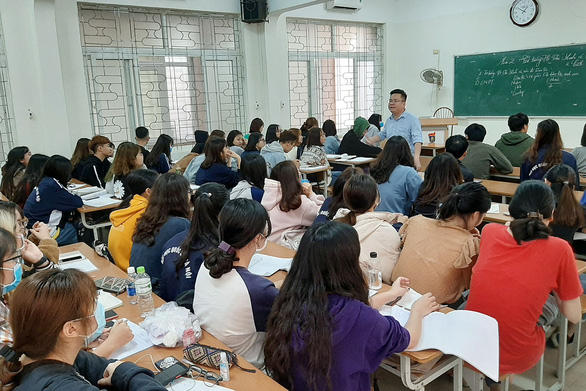

Lecture halls at the University of Social Sciences and Humanities, Vietnam National University, Hanoi, during the first days of returning to school.
The weather in Hanoi since Tet has been humid and cold, and my chronic sinusitis has caused me to cough, have difficulty breathing, and require daily doctor visits. The doctor said my condition isn't contagious, but I should avoid crowded gatherings because my coughing might worry others.
Remembering the "youthful spirit" of university life
Except for mandatory meetings at school, I work from home. Reviewing students' papers, researching, preparing lectures... these are tasks I can do well without going to school. I miss my students and long for the cheerful, vibrant atmosphere of university life that I'm used to. But right now, thinking about the dynamism of students, I feel a little apprehensive, and my imagination is running wild, conjuring up frightening scenarios.
Under the credit-based system, each student has their own timetable, meaning they don't study together in all subjects on the same day. A student might take 3-4 subjects in a single day, in classes with completely different classmates. Each class could have up to 100, or even 120 students. Their mobility and contact levels are therefore very high. If, unfortunately, one student is infected with COVID-19, the risk of spreading this terrible disease is very wide and rapid.
My eldest son is preparing for his high school final exams, the most important exam of his student life. My youngest child is only 9 years old. We live in an apartment building. What if I get infected or come into contact with someone who is sick and have to quarantine? What will happen to my family, the other people living in my building...? A series of questions I can't answer myself and can't find any official guidance anywhere.
If each individual is responsible, the community will be safe.
After more than a month of post-Tet holiday break due to the COVID-19 pandemic, filled with anxiety and worry, my daily routine and work schedule were disrupted. My body craved a change of state because of the sluggish feeling, while my mind was constantly preoccupied with worries; it was truly exhausting.
I think sitting here worrying won't solve anything, while the tasks assigned by the school still need to be completed. So, I need to encourage the students to raise their individual awareness of disease prevention. If each person is conscious of their actions, then we will have a safe classroom, a safe school, and a safe community.
So I posted a message on my Facebook page for the students about things to keep in mind when they return to school next week. I announced my own health status and suggested ways for them to protect themselves. I also reminded them to let me know if they suspected they had any symptoms of illness, so I could help them find solutions while trying to ensure their academic interests in my course were prioritized.
Unexpectedly, many students responded to my words positively. I felt a warmth in my heart and increased my confidence. Having students who share my anxieties for myself and my responsibilities towards others gives us all more hope of safely navigating this challenging semester.
Life goes on.
During the first few days of classes, both teachers and students came to school with an indescribable feeling of nervousness. The school had prepared plenty of hand sanitizer, posted notices on epidemic prevention guidelines in each lecture hall and on bulletin boards; and disinfected all lecture halls, campus grounds, corridors, and restrooms.
Students are advised to avoid close contact, temporarily abandon the habit of shaking hands, and are required to wear masks at all times in the classroom. Microphones are disinfected and wrapped in cloth bags, replaced after each use...
In many lecture halls, the attendance rate was only around 70%, as many students were waiting and hoping for updates from those who had already arrived, and some reported being sick. I asked a few students about their feelings upon returning to school; all seemed not overly worried, but they were no longer as carefree and cheerful as before. Not all students wore masks throughout the entire session because they felt suffocated and uncomfortable.
I stood in the school hallway looking down at the deserted schoolyard. Here and there, a few students wearing masks huddled together, chatting after a long period of separation. In the study room, only a few people, also wearing masks, sat quietly with their books.
I hope the schoolyard will soon be bustling and vibrant again, filled with enthusiastic faces, lively dance groups, and especially bright, youthful smiles like in the old days. Yes, the schoolyard lacks music and smiles. Tomorrow, I'll suggest that the school play cheerful music during break times... Life must go on.
|
A very different scene In the faculty waiting area, most teachers sign the register to receive their microphones and then return to their lecture halls, rarely lingering for drinks and socializing like before the pandemic. Some of my colleagues, who used to chat so enthusiastically every day, have been leaving the school quickly after teaching these past few days. One woman, a mother with a young child, teared up as she said that when she got home, her child ran to hug her, but she had to stop her immediately to change clothes and disinfect herself... making the little one feel sad and sob. Before returning to teaching, Ms. Thanh Huyen wrote on her Facebook page, sharing with students how to come to school safely during the pandemic. In it, she wrote: “You should also proactively monitor your health. If you experience symptoms such as coughing, fever, chest pain, shortness of breath, etc., please inform me so we can work together to protect your personal health, avoid infecting your classmates and teachers, and still ensure you complete your studies. Don't worry, I have already prepared a plan…” |
According to Tuoi Tre Online
Author:Thanh Huyen

