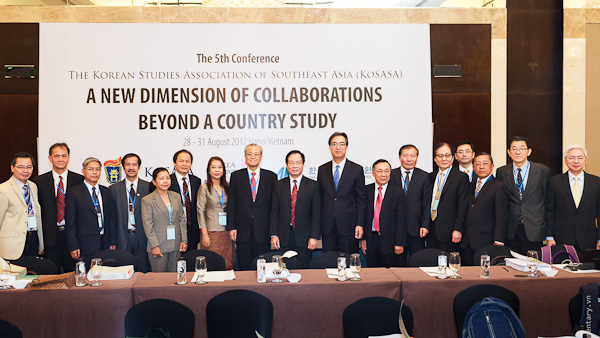
This morning, August 29, 2012, the University of Social Sciences and Humanities organized the seminar "Korean Studies: New Aspects in Cooperation in Southeast Asia".This is the 5th annual conference of the Association for Korean Studies in Southeast Asia (KoSASA), of which the University of Social Sciences and Humanities (VNU Hanoi) is a key member. The conference was sponsored by the Korea Foundation, the Korea Research Institute (AKS), and the Korea Research Institute - University of New South Wales (KRI). Attendees included Dr. Le Dinh Tien (Deputy Minister of Science and Technology of Vietnam), Assoc. Prof. Dr. Nguyen Kim Son (Vice Director of VNU Hanoi), Dr. Woosang Kim (Chairman of the Korea Foundation), Prof. Dr. Nguyen Van Khanh (Rector of the University of Social Sciences and Humanities), along with nearly 80 domestic and international scientists from leading universities and research institutes in Korea, Australia, and Southeast Asian countries such as Thailand, Malaysia, Indonesia, the Philippines, Cambodia, and Laos.

In his opening remarks, Professor Nguyen Van Khanh emphasized the strong trend of cooperation between nations in the era of globalization and international integration. As a dynamic region with significant development potential, Southeast Asian countries have established early economic, cultural, and political relationships with South Korea. In this context, Korean studies in Southeast Asia have produced influential research, making important contributions to academic cooperation between these countries.

As one of Vietnam's leading centers for research, training, and international cooperation, the University of Social Sciences and Humanities (VNU-Hanoi) has played a pioneering role in Korean Studies research and training in recent years, particularly focusing on studying and learning from the successful development model of South Korea – a country with cultural characteristics quite similar to those of Southeast Asian countries in general. Since 2005, the University of Social Sciences and Humanities, along with other Southeast Asian universities, has established a relationship with KRI to develop Korean Studies and expand the network of Korean Studies research in Southeast Asia through international conferences and transnational research projects. Since 2007, the two sides have conducted research evaluating the role of governments in Southeast Asian countries such as Vietnam, Thailand, Malaysia, and Indonesia in domestic economic development in comparison with South Korea – a successful economic development model in East Asia. Phase 2 (2011-2012) of this research has been and continues to be carried out by the University of Social Sciences and Humanities and KRI, focusing on comparative research between Southeast Asian countries and South Korea in three areas: economic growth and public sector restructuring; e-government improvement; and culture and cultural industries. Professor Nguyen Van Khanh stated that the research results of the project will be published at this conference. He also believes that this is a valuable opportunity to exchange development experiences between Southeast Asian countries and South Korea, not only in the field of Korean studies but also in many other fields such as economics, politics, culture, and anthropology.

Since its establishment, KoSASA has been very successful in organizing four international conferences on the theme of Korean Studies in Southeast Asia. Between 2010 and 2012, KoSASA member universities conducted several studies, including new trends in Korean Studies research and training from different academic approaches. This conference aims to further strengthen the collaboration among key institutions and KoSASA members by sharing and exploring more diverse and in-depth approaches to developing Korean Studies in Southeast Asia in the next phase.
Evaluating the development of Korean Studies in Vietnam, Dr. Le Dinh Tien (Deputy Minister of Science and Technology) stated: “Korean Studies research in Vietnam has made significant progress, and the policy of expanding research and training programs in Korean Studies in Vietnam has received a positive response from society.” Currently, Vietnam has 10 universities and 1 research institute that conduct research and training on Korean Studies, of which 6 universities focus on research and training in Korean language and culture, and 4 universities and 1 institute research and train in Korean Studies as a separate discipline with knowledge of Korean economics, politics, culture, education, etc. Among them, the University of Social Sciences and Humanities, Vietnam National University, Hanoi, is one of the leading institutions in Korean Studies research and training, where Korean language training is considered an indispensable linguistic tool in the training of experts in various fields of Korean social life and people. Associate Professor Dr. Nguyen Kim Son (Vice Director of Vietnam National University, Hanoi) commented: "This is a comprehensive conference on Korean Studies - a good opportunity for Korean researchers in Vietnam to interact with experts in the region, exchange research and teaching experiences in Korean Studies, and further develop the field of Korean Studies in Vietnam."

In tomorrow's session, August 30th, numerous research findings on Korean studies will be presented across four subcommittees: Korean Studies and Training in Southeast Asia; Language Teaching and Linguistics; Political Economy and Public Sector Reform; and Culture, Industrialization, and Humanities. Additionally, there will be a special discussion on "National Development and Experience Sharing" with three subtopics: export policy, national innovation policy, and policies for small and medium-sized enterprises.