
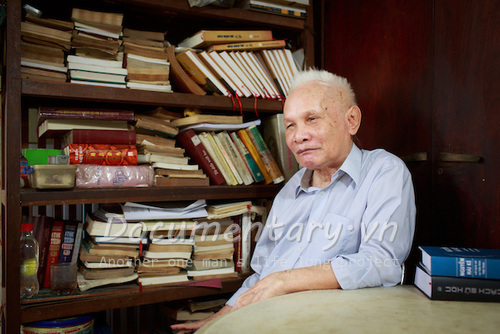
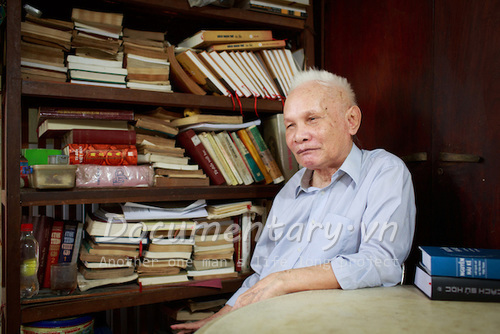
The late Professor and People's Teacher Phan Dai Doan (1936-2019). Photo: Thanh Long
Professor Phan Dai Doan was born on November 18, 1936, in Dien Quang commune, Dien Chau district, Nghe An province, in the year of the Rat (Bính Tý). According to him, his family wasn't poor, but his village – or rather, his entire rural area – was very poor. He spent his childhood surrounded by peers, mostly from poor families, which instilled in him a deep empathy and compassion. Perhaps this is why, later in life, even as a university lecturer facing the same poverty and hardships of the subsidy era, he was still willing to share even his last grain of rice and coin with his students. Memories of his impoverished hometown haunted him, leading him to write these moving lines in the preface to his book.Vietnamese Villages: Some Socio-Economic Issues.
In 1956, after completing high school, he became a student in the first cohort of the History Department at Hanoi University. In 1959, graduating with honors, he was retained as a lecturer in the Department of Ancient and Medieval Vietnamese History. From there, began his tireless struggle until his retirement: to be a scientist, to be an educator – teaching for over forty years (1959-2003). Nearly half a century, he seemed to have experienced all the bitterness and sweetness, the gains and losses, the advantages and disadvantages of life. In this world, everyone is different, each with their own perspective. All that is known is that he dedicated himself wholeheartedly to humanity, living up to his simple name: the scientist and educator Phan Dai Doan.
The 1960s and early 1970s, the initial period of his scientific career, coincided with the country's resistance war against the American imperialist invasion. Directly contributing to this struggle, historians focused their research on national traditions, with particular emphasis on the tradition of resistance against foreign invaders, aiming to motivate and encourage patriotism, national pride, and the determination to defeat the American invaders. Many works on the history of resistance against foreign invaders during the ancient and medieval periods were published during this time. He co-authored these works with Professor Phan Huy Le.Lam Son Uprising(first published in 1965, reprinted many times), along withThe resistance war against the Mongol invasion in the 13th centuryThe works of Ha Van Tan and Pham Thi Tam are considered representative books of modern Vietnamese historiography on this topic. Then he co-authored...Some strategic decisive battles in the nation's history.(First published 1976, reprinted 2004), writtenThe Battle of Bạch Đằng in 1288(First published in 1976, reprinted in 1979). In the late 1980s, he and the Department "cultivated" the land of Nghia Binh to survey the Tay Son rebellion, and subsequently became the author and co-author of a four-volume book series.Documents about the Tay Son Dynasty and Nguyen HueBesides his scholarly books, he also had a series of essays on the history of resistance against foreign invaders published in specialized journals. Among the achievements of the Faculty of History, and of the Department of Ancient and Medieval Vietnamese History, the topic of resistance against foreign invaders can be considered a typical achievement, in which Professor Phan Dai Doan made a great contribution.
After the reunification of the country, he began to pay more attention to socio-economic and ideological-cultural issues. His writing output also increased steadily from then on (by 2006, when the History Department celebrated its half-century anniversary, he had published 151 works, of which 140 were published after 1975). He wrote broadly, addressing all fields. Besides the continuing theme of resistance against foreign invaders, the area he focused on most, and which made Phan Dai Doan famous both domestically and internationally, was village life. Not confined to traditional research, he connected tradition with modernity – using tradition to illuminate and decipher modernity. Therefore, his works possess profound scientific and practical value.
From the early 1960s to the mid-1970s, he devoted himself to learning, exploring, navigating, and defining his own path amidst the vast sea of villages in the East, West, South, North, Thanh Hoa, and Nghe An regions. His writings in 1977 and 1978 only focused on villages that fought in the resistance against the Ming, pottery villages in the North, and the pioneering villages of Kim Son and Tien Hai. It wasn't until the early 1980s that he began to emerge as a true expert on Vietnamese villages. He poured his heart and soul into experimenting, reflecting, and searching for his own unique path—a path that was rustic, simple, yet surprisingly profound and original. These were also the years when he perfected his theoretical models with scientific concepts and terminology, some of which have become common knowledge among researchers of Vietnamese and international villages, yet still retain the distinctive style of Phan Dai Doan. From the late 1980s and 1990s, he wrote relentlessly, as if racing against time to express himself fully. He covered everything from general theoretical issues and model generalizations of traditional Vietnamese villages to specific problems. He was passionate about the organizational structure, management, economy, and culture of villages, but he didn't neglect even a small part of his field. Initially, he intended to limit his research to traditional Vietnamese villages in the North, but later he expanded it to include ethnic minority areas in the mountains, villages in the modern and contemporary periods, and villages in the Central and Southern regions. He was deeply concerned with pressing issues in rural areas and agriculture, such as labor, employment, wealth inequality, social justice, and democratic institutions. He was particularly interested in rural economic and social institutions, village-level structures, the power apparatus at the commune level, and rural management in ethnic minority areas.
Since the 1990s, many of Professor Phan Dai Doan's works have not only possessed high scientific value but also the ability to guide applied research serving the needs of practical life... He was the initiator, promoter, and contributor to the remarkable development of the study of Vietnamese villages and communities both domestically and in many countries around the world, from the early 1990s onwards.
He also wrote extensively about philosophical ideas – issues concerning Confucianism, Buddhism, Taoism, and folk beliefs – but whether directly or indirectly, they were all connected to the village community. And it is precisely because of this village-based perspective that his interpretations of these philosophical issues are more insightful and reach the core of the matter.
The sheer number of works and those valuable contributions are enough to establish Phan Dai Doan's name as a renowned scientist.Vietnamese Villages: Some Economic, Cultural, and Social IssuesHis work was awarded the State Prize for Science and Technology.
But the scientist Phan Dai Doan was inseparable from the educator Phan Dai Doan. For as many years as he was a scientist, he was also a teacher – meaning until his dying day, even though his health had declined considerably. As a teacher, he wasn't one of those eloquent orators. He simply said what he thought, like a farmer from Nghe An province, yet he captivated his listeners and students because of the depth of his knowledge and, especially, the various facets of the issues he always pondered and analyzed. Therefore, he had many students, from first and second-year university students just starting to write scientific reports and dissertations, to final-year students working on their graduation theses, and those pursuing master's and doctoral degrees. Even on the day of his serious illness, he had supervised (mostly as the main and independent supervisor) 20 doctoral candidates who successfully defended their dissertations. These weren't just students of Vietnamese History or Ancient and Medieval Vietnamese History, but also from many fields of social sciences and humanities. Many of them have now become renowned scientists, holding important positions in scientific research institutions. He trained over 20 PhDs, a quality few scientists and teachers can achieve in their lifetime. This is the result of his intellectual charisma – but equally important – the charisma of Phan Dai Doan's character. He was awarded the title of People's Teacher, and he truly deserves all the meaning of this title.
The Department of Ancient and Medieval Vietnamese History, where he worked from the day he graduated from university until his retirement, was one of the departments established shortly after the founding of the Faculty of History and the establishment of Hanoi University. As a lecturer, he was diligent and responsible in all his duties, including those related to "organizations"—such as the trade union. Even at the age of 60 (in 1996), he readily accepted the position of Head of Department when his predecessor—a former student—was promoted to a higher position. He gave his all. Throughout his entire working life, he dedicated himself completely to the development of the Department, the Faculty of History, and the University.
|
PROFESSOR, PEOPLE'S TEACHER PHAN DAI DOAN
+ Workplace: Department of Ancient and Medieval Vietnamese History, Faculty of History (1959 - 2003). + Management position: Head of the Department of Ancient and Medieval Vietnamese History (1996-2000).
The Lam Son Uprising and the national liberation movement in the early 15th century(co-authored), Social Sciences Publishing House, 1965; 2nd edition, 1969; 3rd edition, 1977. History of the feudal system in Vietnam(co-authored), Volume III. Education Publishing House, 1965. Some strategic decisive battles in the nation's history.(co-authored). People's Army Publishing House, 1976. Experiences in organizing and managing rural areas in Vietnam throughout history.(Co-editor). National Political Publishing House, Hanoi, 1994. Exploring the experiences of rural organization and management in several regions of East Asia and Southeast Asia.(Co-editor). National Political Publishing House, Hanoi, 1995. Rural management in Vietnam today: Some issues and solutions(Editor). National Political Publishing House, Hanoi, 1996. Vietnamese Villages: Some Economic, Cultural, and Social IssuesNational Political Publishing House, Hanoi, 2002
+ State Award for Science and Technology in 2005 for the workVietnamese Villages - Some Economic, Cultural, and Social Issues2001). |
Author:Assoc. Prof. Dr. Vu Van Quan
Newer news
Older news

