

Brett Blackshaw emphasized that change is inevitable in any power transition and that we need to embrace those changes. Regarding US-Asia Pacific relations, including relations with ASEAN and Vietnam, he affirmed that these remain essential relationships in the national interests of the United States under the new administration. Specifically concerning the US and Vietnam, Brett Blackshaw expressed optimism about bilateral relations. Over the past 20 years, Vietnam-US relations have made significant progress. Economically, US-Vietnam trade reached over $41.43 billion, a 187-fold increase compared to 1994. The United States remains Vietnam's largest export market. In education, the US and Vietnam continue to maintain close ties through student exchanges. In 2016, there were 21,403 Vietnamese students studying in the United States, making Vietnam the sixth largest source of international students in the US. In May 2016, the Fulbright University of America was established in Vietnam, contributing to the spread of American educational philosophy and style in our country. In terms of diplomacy, Vietnam-US relations have also progressed significantly. Twenty years ago, the lingering effects of the war still heavily hampered bilateral relations between the two countries.
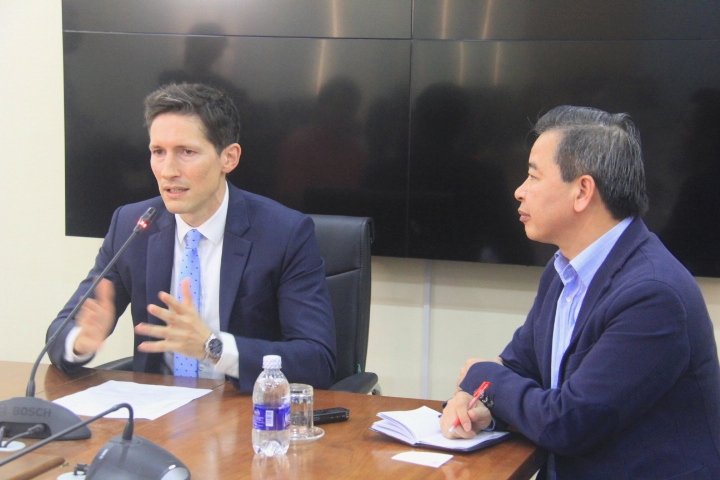
Brett Blackshaw shared insights into the achievements of the Vietnam-US bilateral relationship over the past 20 years.
Today, the United States is working with Vietnam to strengthen ASEAN unity and solidarity, contributing to maintaining security and peacefully resolving disputes in the South China Sea, as well as addressing tensions on the Korean Peninsula. Regarding security, 20 years ago, Vietnam-US relations began with the search for missing American soldiers in Vietnam; in return, the United States helped Vietnam remove unexploded ordnance left over from the war and mitigate the impact of Agent Orange/dioxin. Today, the US military assists in training Vietnamese soldiers in search and rescue operations and peacekeeping. Politically, Vietnam and the United States officially elevated their relationship to a comprehensive partnership in 2013. In July 2015, during an official visit to the United States, General Secretary Nguyen Phu Trong and US leaders issued a Joint Vision Statement. In May 2016, then-President Barack Obama paid an official visit to Vietnam, which, according to Brett Blackshaw, was one of the most successful visits of his presidency. In short, he expressed confidence in the future of Vietnam-US relations, as well as Vietnam's path of international integration, strengthening cooperation with the United States while maintaining its independence. The policies and actions of the administration of President-elect Donald Trump will build upon the foundations laid during 20 years of bilateral relations, albeit with certain modifications.
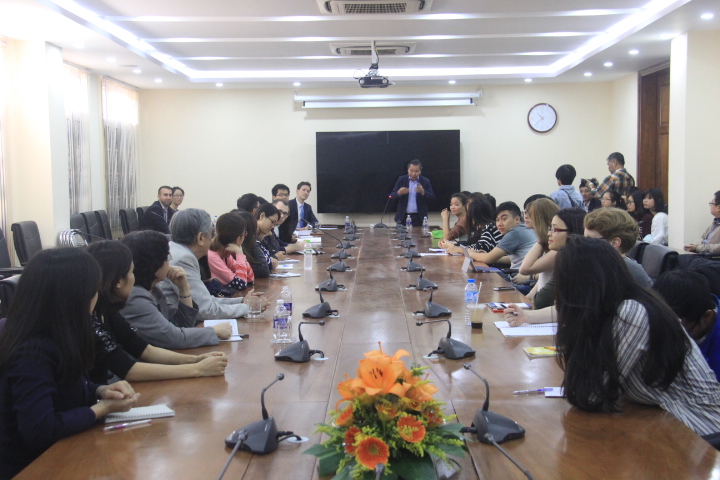
Overview of the seminar
Brett Blackshaw's presentation received questions and comments from faculty and students of the Department of International Studies on issues such as the implications of the Donald Trump administration's decision to withdraw from the TPP on Vietnam-US trade relations, the importance of the South China Sea issue in President-elect Donald Trump's policy, the solutions the new government will offer to climate change, new obstacles in Vietnam-US bilateral relations, the decision to lift the US arms embargo on Vietnam, the influence of China on Vietnam-US relations, etc.
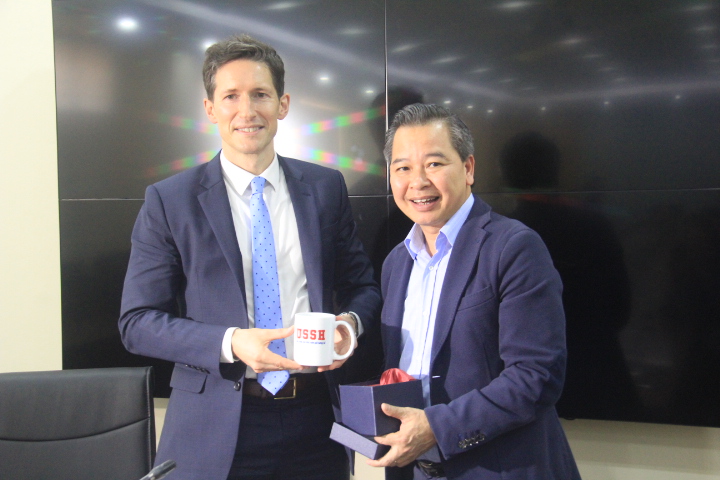
Professor Pham Quang Minh (Rector of the University of Social Sciences and Humanities) presents a commemorative gift to Mr. Brett Blackshaw.
Brett Blackshaw has served as the political counselor at the U.S. Embassy in Vietnam since September 2015 for a three-year term. He leads a 16-member task force responsible for reporting, analyzing, and advocating on political issues, including promoting human rights and the rule of law, expanding cooperation on maritime security, and addressing regional concerns, including the South China Sea. He helped launch the Lower Mekong Initiative, an annual meeting between the U.S. Secretary of State and his counterparts from Vietnam, Thailand, Laos, and Cambodia, focusing on water security, health, and development issues.
Author:Tran Minh
Newer news
Older news

