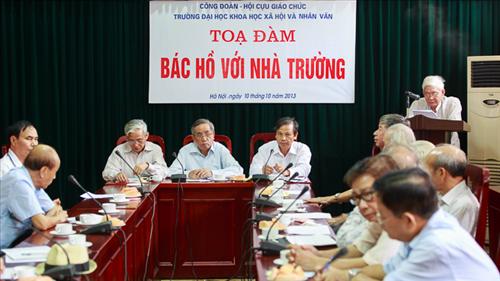
Attending the seminar were Prof. Dr. Dinh Van Duc (Chairman of the Association of Retired Faculty Members of Vietnam National University, Hanoi), Assoc. Prof. Dr. Tran Huy Ho (Secretary General of the Association of Retired Faculty Members of Vietnam National University, Hanoi), Prof. Dr. Vu Duong Ninh (Chairman of the Association of Retired Faculty Members of the University of Social Sciences and Humanities), along with other former faculty members of the University. Representing the University of Social Sciences and Humanities were Prof. Dr. Vu Duc Nghieu (Vice Rector) and Assoc. Prof. Dr. Dang Xuan Khang (Chairman of the University's Trade Union).
Immediately after the August Revolution of 1945, President Ho Chi Minh outlined three urgent tasks: combating famine, illiteracy, and foreign invasion. Thus, he considered "illiteracy" a threat no less serious than famine and foreign invasion. In September 1945, on the occasion of the first school opening day of the Democratic Republic of Vietnam, President Ho Chi Minh sent a letter to all students with the message: "Whether the Vietnamese nation will become beautiful and prosperous, and whether the Vietnamese people will reach the pinnacle of glory to stand shoulder to shoulder with the great powers of the world, depends largely on your studies."
Amidst the arduous days of the resistance war against the US, in October 1968, President Ho Chi Minh sent a letter to schools at the beginning of the new school year, reminding them: "No matter how difficult the circumstances, we must continue to strive for excellence in teaching and learning." This was the last letter he sent to the education sector before his passing. In the period between those two letters, President Ho Chi Minh repeatedly mentioned education during his visits to schools and in letters praising individuals or units that had achieved good results.
Half a century has passed, yet revisiting President Ho Chi Minh's letters still reveals a profound and scientific vision regarding the role of education in national development. His views, both theoretical and practical, address many major aspects of education, such as: what to learn, why to learn, how to learn, and the roles of teachers and students. Many issues addressed by President Ho Chi Minh remain relevant and highly topical today, including: educational reform, building a team of qualified teachers, honesty in education, combining theory with practice, and the practicality of education and training.
At the seminar, analyzing and thoroughly understanding the views, thoughts, and vision of the brilliant leader on one of the most important areas of the country's activities, the delegates shared their reflections and connections with the current state of education and training in the country, while also suggesting many positive solutions to build a modern, high-quality Vietnamese education system that is oriented towards integration with the world.
Some specific papers presented at the seminar included: President Ho Chi Minh and the educational reform through his letters; some thoughts on the practical viewpoints in President Ho Chi Minh's letters to the education sector; the role of education for students today; suggestions for educational reform through some of President Ho Chi Minh's letters on education and training; rereading President Ho Chi Minh's letters to the education sector and some thoughts on education and training today; necessary conditions for good teaching and learning at universities; according to President Ho Chi Minh's educational views and some educational issues that need attention at the University of Social Sciences and Humanities…
Author:Thanh Ha
Newer news
Older news


