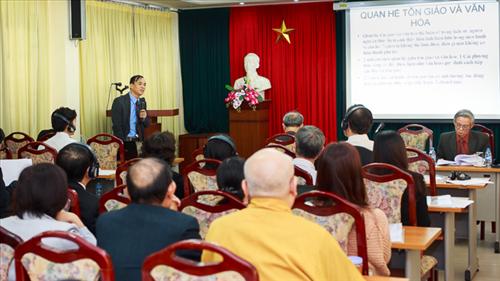
On the international scholarly side were professors: Le Xuan Hy and Marky Mark (Seattle University – USA); Professor Tran Van Doan (National Taiwan University), Professor Pascal Bordeaux (French School of Far Eastern Studies, Ho Chi Minh City), Professor Valentine Zuber (EPHE Graduate School of Applied Sciences, Paris – France); Dr. Michael Dickhardt (University of Göttingen – Germany)…
The seminar featured over 30 presentations and discussions in four subcommittees: Religion and Culture – General Theoretical Issues; Theoretical Issues of Religion and Culture in Vietnam; Some Manifestations of Religious Culture in the World and Vietnam Today; Religion and Culture: The Case of Buddhism.
In his introductory report at the opening session, Professor Do Quang Hung (Center for Contemporary Religious Studies, University of Social Sciences and Humanities) referred to Ninian Smart's 1997 proposal on studying religion from five dimensions: the doctrinal/philosophical dimension; the practical/ritual dimension; religious experience/emotional dimension; social/institutional dimension; ethical/legal dimension; and the material/religious art dimension. According to Ninian Smart, culture is a system integrating beliefs and human values. In the context of the modern world, religion and religious forms are becoming more widespread and closer together, but this does not mean that the values of religious culture erase the distinctive elements – one of the most decisive factors in determining national identity.
The report suggests that when studying the relationship between religion and culture, attention should be paid to the challenges of postmodern culture and postmodern religion; factors of cultural and religious shifts such as: human escapism (refugee status, labor migration), information escapism (the explosion of mass media, etc.), escapism from ideological values (liberalism, democracy, human rights, etc.).
Following the opening session, delegates discussed in subcommittees the main theme of the symposium: analyzing the relationship between religion and culture, and the dimensions of this relationship in history and the present. In particular, a topic that attracted much attention from scholars was: how religions in Vietnam today are present in society and culture in order to both maintain and enrich the identity of each religion; and the values of religious culture in the process of industrialization and modernization and the process of "building a culture rich in national identity."
Author:Thanh Ha
Newer news
Older news



