


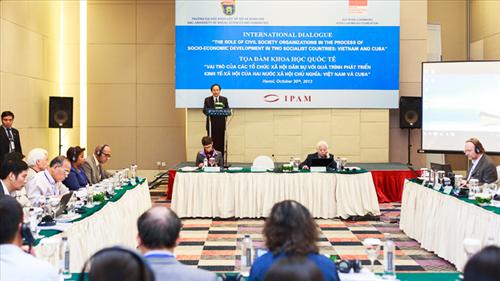

Attending the seminar were Mr. Herminio Lopez Diaz (Ambassador of the Republic of Cuba to Vietnam), and Ms. Nadja Charaby – Director of the Rosa Luxemburg Institute in Southeast Asia. Participants included experts from the Federal Republic of Germany, Cuba, Mexico, and the United States; managers and policymakers in the National Assembly; researchers from universities, institutes, and research centers; and representatives of civil society organizations in Vietnam.

In his opening remarks at the workshop, Professor Nguyen Van Khanh (Rector of the University of Social Sciences and Humanities) expressed his deep gratitude to the Rosa Luxemburg Foundation (Federal Republic of Germany) for its effective support to the University over the past 10 years. With the Foundation's support, the University successfully implemented research projects on policy planning, the project on "Left-Wing Theoretical Choices in a Changing World" (2009-2011), and the project "Left-Wing Theoretical Choices – An International Comparison from the Experiences of Socialist Countries" (2012-2013).
After nearly 5 years of operation, the project has achieved many results: organizing 8 international seminars and workshops revolving around the development of left-wing theory in Vietnam and around the world, publishing more than 5 monographs on left-wing theory which compile many valuable research results and reports on left-wing theory and the development of this theoretical system in Vietnam and several countries around the world.
This scientific seminar continues to be one of the important activities of the project. The topics discussed in this seminar will contribute to supplementing our understanding of the contributions and roles of civil society organizations in the socio-economic development process in Vietnam and Cuba, thereby providing comparisons and recommendations to help guide the future development of these organizations in both Vietnam and Cuba.

At the opening session, delegates heard a keynote presentation by Assoc. Prof. Dr. Dang Ngoc Dinh (Center for Research and Development of Community Support – VUSTA) on the topic: “How to effectively cooperate between civil society and the State: the case of Vietnam”.
This paper begins with a basic understanding of civil society and extends to reflections on the operational status, development level, and contributions of civil society organizations in Vietnam. The author argues that civil society in Vietnam currently faces many difficulties in fulfilling its roles of social oversight, critical analysis, and anti-corruption efforts. Organizations, especially at the central level, remain heavily tied to the State and lack independence, particularly when it comes to reflecting the aspirations of the people. The limitations of civil society in Vietnam are primarily related to the legal framework. The legal and policy framework has not yet been fully effective in enabling civil society to contribute to processes ranging from the implementation of social services and policy enforcement to providing feedback and critical analysis.
The discussion affirmed that mechanisms are needed to promote and facilitate civil society organizations (CSOs) to contribute more actively to the country's economic and social development. Institutions must be built to give CSOs a clearer voice in all aspects of life, not only in service provision, but also in capacity building and advocacy at all levels, in order to make a significant contribution to economic and social development in an equitable manner. Furthermore, CSOs have a crucial potential role in society in promoting transparency and controlling corruption.
Following the opening session, delegates discussed various specific topics: Political and social organizations participating in the policy-making process; Vietnam and Cuba – Economic and political transformations since the Cold War; The position, role, and responsibilities of civil society in the current national development process; The social welfare role of civil society organizations; The role of associations in protecting geographical indications – lessons from geographical indications and Cuban cigar trademarks; Civil society – an issue arising from Vietnam's reform process; Civil society in Cuba; Understanding the Cuban judicial system and some comparative references with the US and Canadian judicial systems; The role of non-governmental organizations in preventing domestic violence; The reality of policy advocacy in Vietnam and the position of civil society organizations…