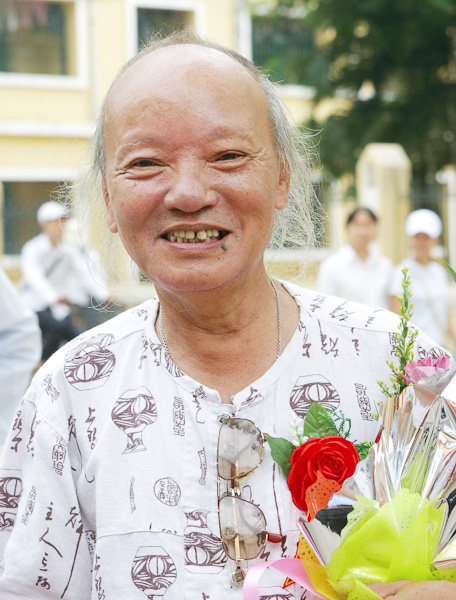
On the occasion of the posthumous awarding of the Ho Chi Minh Prize to the late Professor Tran Quoc Vuong by the State on February 18, 2012, USSH respectfully presents an article by Professor Phan Huy Le on the life and research of Professor Tran Quoc Vuong on Hanoi. This article also serves as an introduction to the book "On the Sacred Land of a Thousand Years of Culture - a collection of writings on the culture of Thang Long - Hanoi by Professor Tran Quoc Vuong," published by Hanoi Publishing House, 2010.From his youth, while enthusiastically exploring and discovering Hanoi, Professor Tran Quoc Vuong often joked with our group, "Lam, Le, Tan, Vuong," and our close friends from the History Department: "Most Hanoians are 'people from all over the country,' including you guys, but I'm considered a 'native Hanoian' because at least three generations of my family have been rooted in this city." He was originally from Ha Nam, but according to him, at least his grandfather's generation had lived in Hanoi, and according to old customs, after three years of "residence," one was considered "permanent resident." He always backed up his claims with evidence. Whether it was due to this deep connection to his roots or not, one thing is certain: Professor Tran Quoc Vuong dedicated a great deal of time, effort, and intellect to researching and contemplating Hanoi, and writing about Hanoi. Mr. Tran Quoc Vuong developed a habit very early on: he loved to travel everywhere, not just for fun, but to combine travel with research, data collection, and expanding his knowledge—in scientific terms, field research and investigation. Perhaps his footprints have been left on almost every part of the country, from Lung Cu to Ca Mau, from the Truong Son Mountains to some islands in the East Sea, with some places he visited multiple times. There's a funny story. Once, he visited my hometown in Thach Chau commune, Thach Ha district, Ha Tinh province, went to the Phan Huy family's ancestral temple, and introduced himself as a student of "Teacher Le," asking to light incense to commemorate the ancestors of the family. He was such a good "actor" that the elders in the family all believed him, although a few were a little skeptical, wondering how a student of Professor Le could be so white-haired, advanced in age, and so wise, asking all sorts of questions from the ancestors Phan Huy Can, Phan Huy Ich, Phan Huy Chu... to the branches in Nghi Xuan and Sai Son, and even the Ca Tru singing tradition of the family... When I visited my hometown, I immediately knew it was my dear friend Tran Quoc Vuong, and no one else. Later, Vuong also told me about it. Professor Tran Quoc Vuong was a well-traveled, sociable, and erudite scientist. He traveled extensively, associating with everyone from scientists of all fields—history, archaeology, ethnology, sociology, anthropology, cultural studies, and even some natural sciences like geology, geography, environment, ecology, biology, mathematics, and physics—to poets, writers, journalists, artists, and even ordinary people he met: farmers, craftsmen, fishermen, workers, rickshaw drivers, motorbike taxi drivers... By "associating," I don't mean just meeting and exchanging pleasantries, but rather exchanging and gathering information, exploring issues of interest through sociological means. His knowledge base wasn't just accumulated from researching ancient and modern texts, books, and scientific conferences and meetings, but also from many sources and individuals using diverse methods of collection, in which practical knowledge and folklore played a very important role. During those trips, he also took students on internships or invited former students working locally to participate, thereby imparting many useful lessons and valuable experiences to the younger generation. For him, even during drinking sessions, casual conversations, and truly enjoyable times, it was still an opportunity to understand people, life, and the times. This is a very distinctive research style of Tran Quoc Vuong. Tran Quoc Vuong, like our class, studied in the History-Geography Department, the first and only interdisciplinary training program of independent Vietnamese universities. During the years 1952-1956, the training program was rudimentary, but the greatest fortune for our generation was being directly taught by professors who were leading scientists of the country. Some were trained abroad and held high academic degrees, such as Professor Tran Duc Thao, Professor Nguyen Manh Tuong, Professor Pham Huy Thong, and Professor Dao Ba Cuong. Others were self-taught and conducted their own research, such as Professor Dao Duy Anh, Professor Tran Van Giau, Professor Dang Thai Mai, Professor Cao Xuan Huy, Professor Nguyen Duc Chinh, Professor Le Xuan Phuong, and Professor Hoang Thieu Son... Although the foundation of history and geography was not extensive, it provided a very basic foundation of knowledge and research methods. Indeed, studying "history" without "geography" is very deficient; history, ultimately, encompasses all human activities taking place in space and time, and historical space is precisely the geographical conditions, environmental characteristics, and ecology. Because of this training, many in our class, when pursuing historical research, often paid close attention to geography. Tran Quoc Vuong, in addition to his expertise in history and geography, also specialized in archaeology. He was one of the first archaeologists to contribute to the development of modern Vietnamese archaeology. Building upon these three foundational fields, Vuong expanded his knowledge to related disciplines such as ethnology, linguistics, folklore, sociology, cultural studies, and even feng shui and physiognomy. A second prominent research style of Tran Quoc Vuong is his consistent use of an interdisciplinary approach, reflecting on and understanding history from multiple professional perspectives, linking them together into a comprehensive and integrated view. Furthermore, Tran Quoc Vuong possesses a very unique personality, evident in every aspect: his attire, speech, behavior, teaching, writing style, and tone of voice. Anyone, domestically or internationally, will immediately recognize this personality after just one encounter with him. But behind those personalities that some consider "rude," "arrogant," or "reckless," lies a warm heart, a deep sense of loyalty to friends and students, a sharp, insightful, and perceptive intellect, and a scientist full of energy in his research, never content with what he or others already know, always striving for new discoveries in the world of knowledge. I've said quite a bit about Professor Tran Quoc Vuong's personality so that we can better understand his research on Hanoi.

Young students from the History Department of the Hanoi University of Social Sciences and Humanities, who were students of Professor Tran Quoc Vuong, wanted to create a comprehensive bibliography of his works and articles, but they kept discovering new ones and had to constantly add to it. Professor Vuong wrote extensively, published in many places, and featured in numerous journals and newspapers—daily, weekly, monthly, Hanoi newspapers, and newspapers from many provinces and cities across the North, Central, and South of Vietnam. The bibliography, which contains research results on Hanoi alone, now includes hundreds of articles and books. Besides several published books such as "Hanoi of a Thousand Years" (1975), co-authored with Tao Trang Vu Tuan San, "Hanoi, the Capital of the Socialist Republic of Vietnam" (1984), which he edited, "Hanoi as I Understand It" (2005), "Thang Long - Hanoi - Exploration and Reflection" (2006)..., he also has many other articles of varying lengths, in many genres from reports, scientific dissertations to scientific announcements, stories, memoirs... in short, "miscellaneous," "traditions," "short anthologies" of all kinds, as he himself calls them. Therefore, the Head of the History Department, Assoc. Prof. Dr. Nguyen Hai Ke, and his colleagues in the Department and the Cultural Studies Department, had great difficulty selecting 35 articles and compiling them into a book titled "Sacred Land of a Thousand Years of Culture" to be published in the Thang Long-Hanoi Millennium Book Series on the occasion of Thang Long's thousandth anniversary. The book is divided into three parts: Part I.
Sacred land of Thang Long-HanoiPart II.
Thang Long - Hanoi joins forces with the nation.Vegetable section.
The essence of Thang Long - Hanoi cultureThis is only a fraction of Professor Tran Quoc Vuong's many works and articles on Thang Long - Hanoi. However, through their selection and arrangement, I feel that Associate Professor Dr. Nguyen Hai Ke and Ms. Do Huong Thao have a deep understanding of their professor, knowing how to choose representative articles showcasing research and reflections on Thang Long - Hanoi from all perspectives and different professional viewpoints. In this book, we encounter academic scholarly works as well as descriptive, comparative, and reflective articles of all genres. We also find in this book the entire historical and cultural depth of Thang Long - Hanoi, from the ancient capital of Co Loa during the Au Lac period, the administrative center of Tong Binh, the citadel of Dai La during the pre-Thang Long period, to the milestone of establishing Thang Long as the capital by King Ly Thai To, then Thang Long - Dong Do - Dong Kinh - Ke Cho during the Ly, Tran, Ho, early Le, Mac, and later Le dynasties, to Hanoi during the Nguyen dynasty, the French colonial period, and to Hanoi in its current Doi Moi (Renovation) phase, a blend of tradition and modernity. The book also presents before us a Hanoi on the surface with its rivers and lakes, ancient fortifications, temples, shrines, streets, and even an underground Hanoi where archaeology has made many discoveries. The people of Hanoi are also shown through some famous figures and, especially, through community life in the craft streets and villages, the system of markets and wharves, through lifestyles, culinary arts, festivals, and the treasure trove of folk culture. Tran Quoc Vuong's writing style combines quoted materials from ancient texts, inscriptions, and legends with field research, and he particularly enjoys incorporating ancient poems and numerous folk songs and proverbs. What I find most interesting and highly appreciate about Tran Quoc Vuong's research on Thang Long - Hanoi is his insightful discoveries and proposals. He was the first to generalize the "river-lake landscape," to propose the "Water Quadrilateral" model of Thang Long - Hanoi, to discover the "Water Confluence" of the city gates, and to propose the characteristics of "Convergence - Interaction - Crystallization - Dissemination" and the "Triangle of Tradition - Intermingling - Innovation" in the cultural development of Thang Long - Hanoi... He was also the first to introduce the concept of "Hanoi Studies" to honor scientists who have made significant contributions to Hanoi research and to propose the establishment of a Center for Hanoi Studies. Historical understanding, like scientific understanding in general, is always a process of gradual improvement through the tireless and creative scientific work of historians, across successive generations of historians. The research results of any historian, however brilliant, will, through the test of time, have their values affirmed and endure, some aspects supplemented and adjusted, some hypotheses and proposals proven, and inevitably some things surpassed. This is the law of understanding, and no historian can escape it. Professor Tran Quoc Vuong's contributions to the study of Thang Long - Hanoi are immense and highly commendable; many of his results remain valuable to this day. Naturally, this is also within the law of historical understanding, and all of it is recognized in the process of research and understanding of Thang Long - Hanoi. For Professor Tran Quoc Vuong, encompassing all his specific research results is the image of a scientist whose entire life has been intimately connected with the thousand-year-old, heroic land of Thang Long - Hanoi. He regularly visits and surveys all the historical sites and scenic spots of Thang Long - Hanoi, which he often says he "wanders everywhere in Hanoi," participating in every archaeological excavation in Hanoi, and rarely missing festivals, cultural events, or religious activities in Hanoi. He travels, observes, listens, and learns in an effort to correctly understand the history, culture, people, and land of Hanoi, and from there, he reflects, perceives, and writes to help people better understand Thang Long - Hanoi. Professor Tran Quoc Vuong often said that Thang Long - Hanoi embodies the sacred spirit of the nation, and I can add that Thang Long - Hanoi has always been deeply ingrained in the mind of Tran Quoc Vuong, a son of Hanoi who dedicated his entire life to the research, exploration, and deciphering of Thang Long - Hanoi.