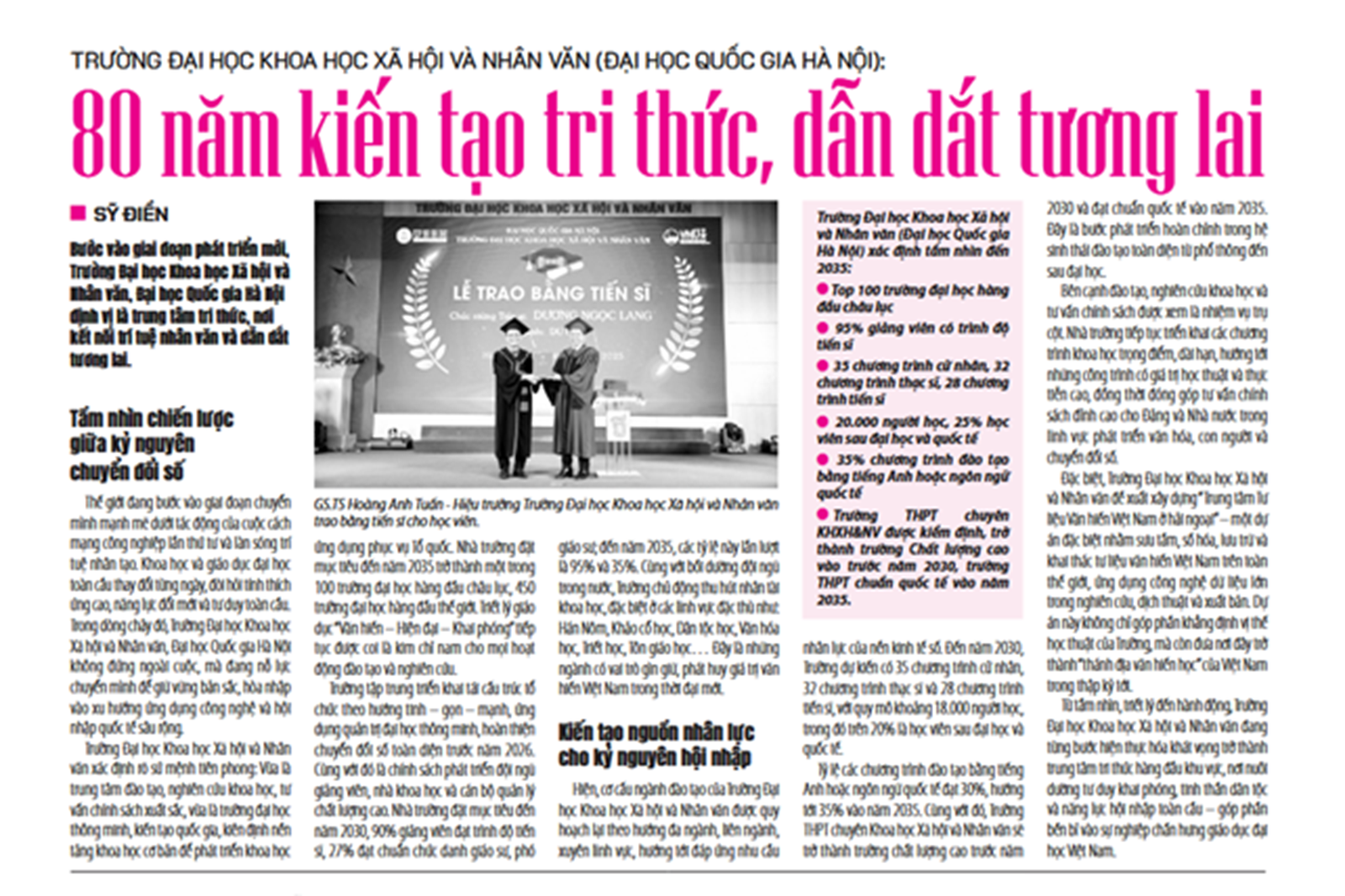
Strategic vision in the era of digital transformationThe world is entering a period of profound transformation under the impact of the Fourth Industrial Revolution and the wave of artificial intelligence. Global science and higher education are changing daily, demanding high adaptability, innovation capabilities, and global thinking. In this context, the University of Social Sciences and Humanities, Vietnam National University, Hanoi, is not standing aside, but is striving to transform itself to maintain its identity, integrate into the trend of technology application, and deeply engage with the international community.
The University of Social Sciences and Humanities clearly defines its pioneering mission: to be a center for excellent training, scientific research, and policy consulting, as well as a smart university that builds the nation, steadfastly upholding the foundation of basic science to develop applied science to serve the country. The university aims to become one of the top 100 universities in the continent and one of the top 450 universities in the world by 2035. The educational philosophy of "Cultural Heritage – Modernity – Enlightenment" continues to be considered the guiding principle for all training and research activities.
The university is focusing on restructuring its organization towards a lean, efficient, and strong structure, applying smart university governance, and completing comprehensive digital transformation before 2026. Alongside this is a policy to develop a high-quality faculty, scientists, and management staff. The university aims to have 90% of its faculty holding doctoral degrees and 27% meeting the standards for professor and associate professor titles by 2030; these percentages are targeted at 95% and 35% by 2035. In addition to training domestic staff, the university actively attracts scientific talent, especially in specialized fields such as Sino-Vietnamese studies, archaeology, ethnology, cultural studies, philosophy, and religious studies… These are fields that play a crucial role in preserving and promoting Vietnamese cultural values in the modern era.
Developing human resources for the era of integration.Currently, the training structure of the University of Social Sciences and Humanities is being restructured towards multidisciplinary, interdisciplinary, and cross-sectoral approaches, aiming to meet the human resource needs of the digital economy. By 2030, the University plans to have 35 bachelor's programs, 32 master's programs, and 28 doctoral programs, with approximately 18,000 students, of which over 20% will be postgraduate and international students.
The proportion of training programs in English or international languages will reach 30%, aiming for 35% by 2035. Simultaneously, the High School for Social Sciences and Humanities will become a high-quality school before 2030 and achieve international standards by 2035. This represents a complete development within a comprehensive education ecosystem from secondary to postgraduate levels.
Besides training, scientific research and policy consulting are considered core tasks. The university continues to implement key, long-term scientific programs, aiming for works with high academic and practical value, while contributing top-level policy advice to the Party and the State in the fields of cultural and human development and digital transformation.
In particular, the University of Social Sciences and Humanities proposes the establishment of a “Center for Documentation of Vietnamese Cultural Heritage Abroad” – a special project aimed at collecting, digitizing, archiving, and exploiting Vietnamese cultural heritage documents worldwide, applying big data technology in research, translation, and publication. This project will not only contribute to affirming the academic position of the University but also make it a “sanctuary of Vietnamese cultural studies” in the next decade.
From vision and philosophy to action, the University of Social Sciences and Humanities is gradually realizing its aspiration to become a leading knowledge center in the region, a place that fosters open-minded thinking, national spirit, and global integration capabilities – making a lasting contribution to the revitalization of higher education in Vietnam.
The University of Social Sciences and Humanities (Vietnam National University, Hanoi) has defined its vision for 2035:
- Top 100 universities in the continent
- 95% of faculty members hold a doctoral degree.
- 35 undergraduate programs, 32 master's programs, 28 doctoral programs
- 20,000 learners, 25% of whom are postgraduate and international students.
- 35% of the training program is conducted in English or an international language.
- The High School for Gifted Students in Social Sciences and Humanities will be accredited and become a high-quality school before 2030, and an international standard high school by 2035. |
Education and Times Newspaper - Special issue celebrating Vietnamese Teachers' Day, November 20th: