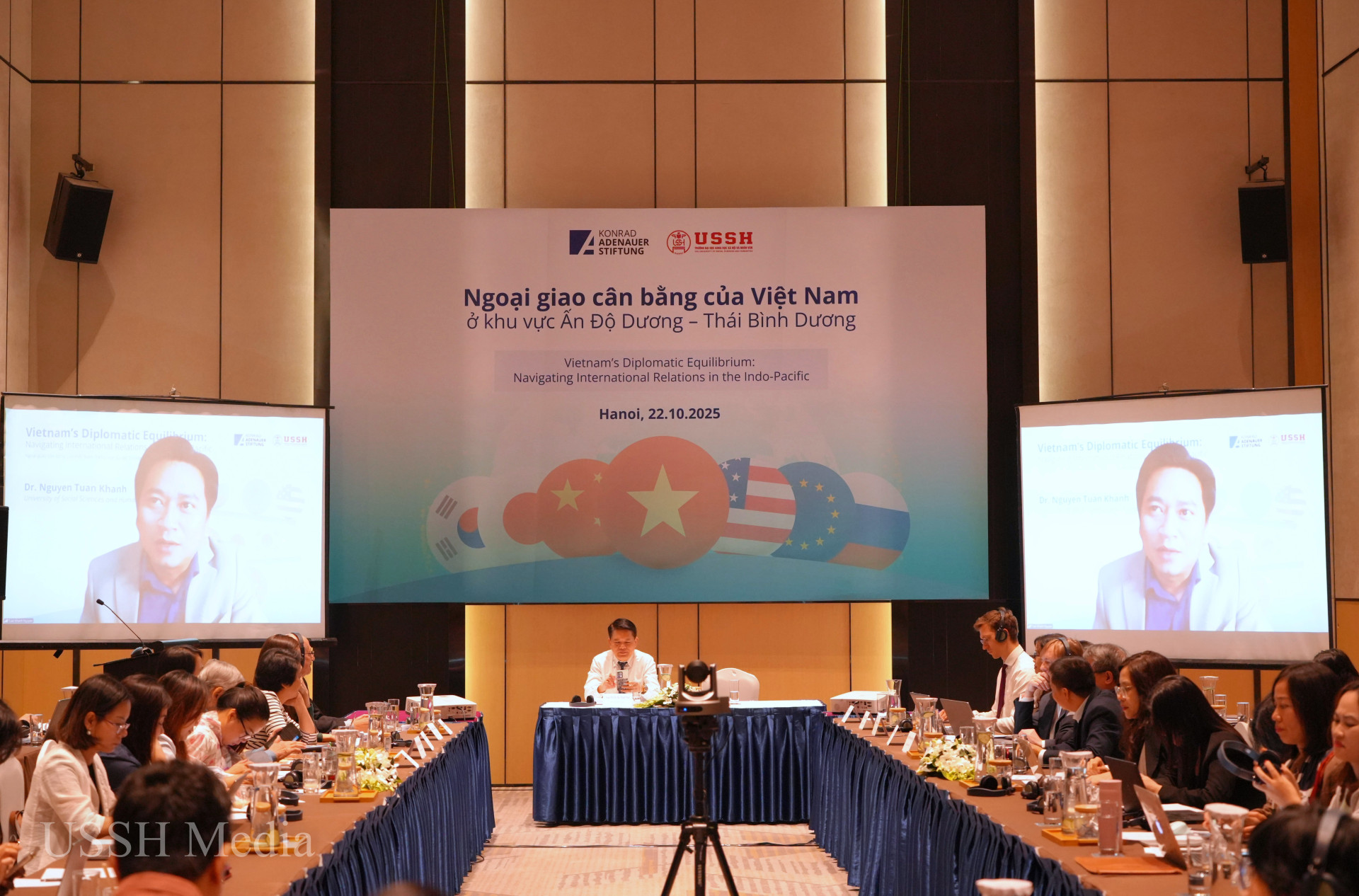
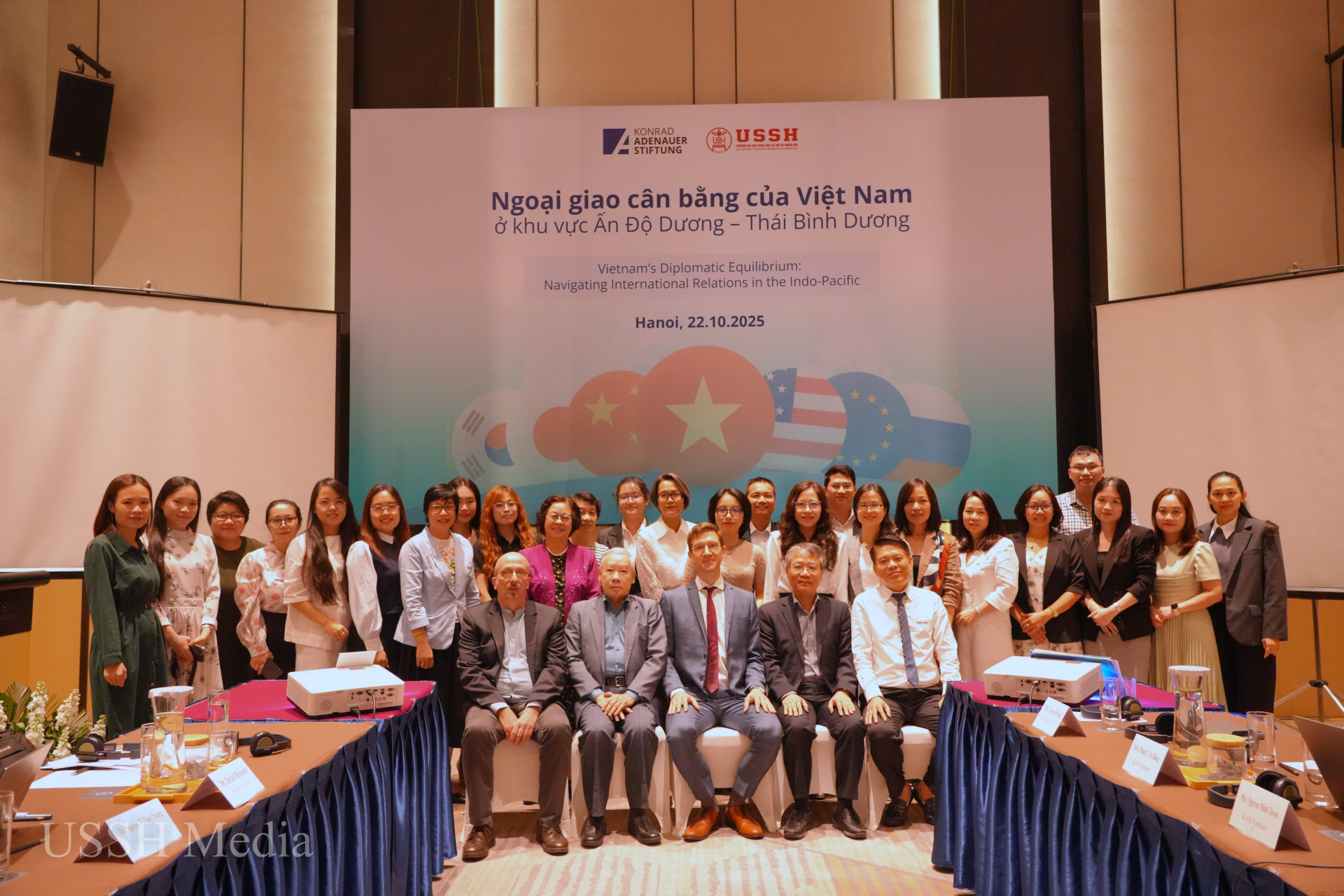
Discuss current issues of concern regarding Vietnam's balanced diplomacy.“Vietnam’s Balanced Diplomacy in the Indo-Pacific Region” is a research project conducted by the University of Social Sciences and Humanities, with support from the Konrad-Adenauer-Stifung Institute (Germany). The project will be fully implemented in 2025 – a pivotal year with many fundamental changes, aiming for breakthrough development in Vietnam in the coming years. An international conference on the theme “Vietnam’s Balanced Diplomacy in the Indo-Pacific Region” was held with the participation, both in person and online, of over 100 scientists and managers from prestigious domestic and international organizations, research institutes, and universities to share and discuss the project’s important research findings.
The workshop is also one of the activities aimed at celebrating the 80th anniversary and 30th anniversary of the development of the University of Social Sciences and Humanities within the structure of Hanoi National University.
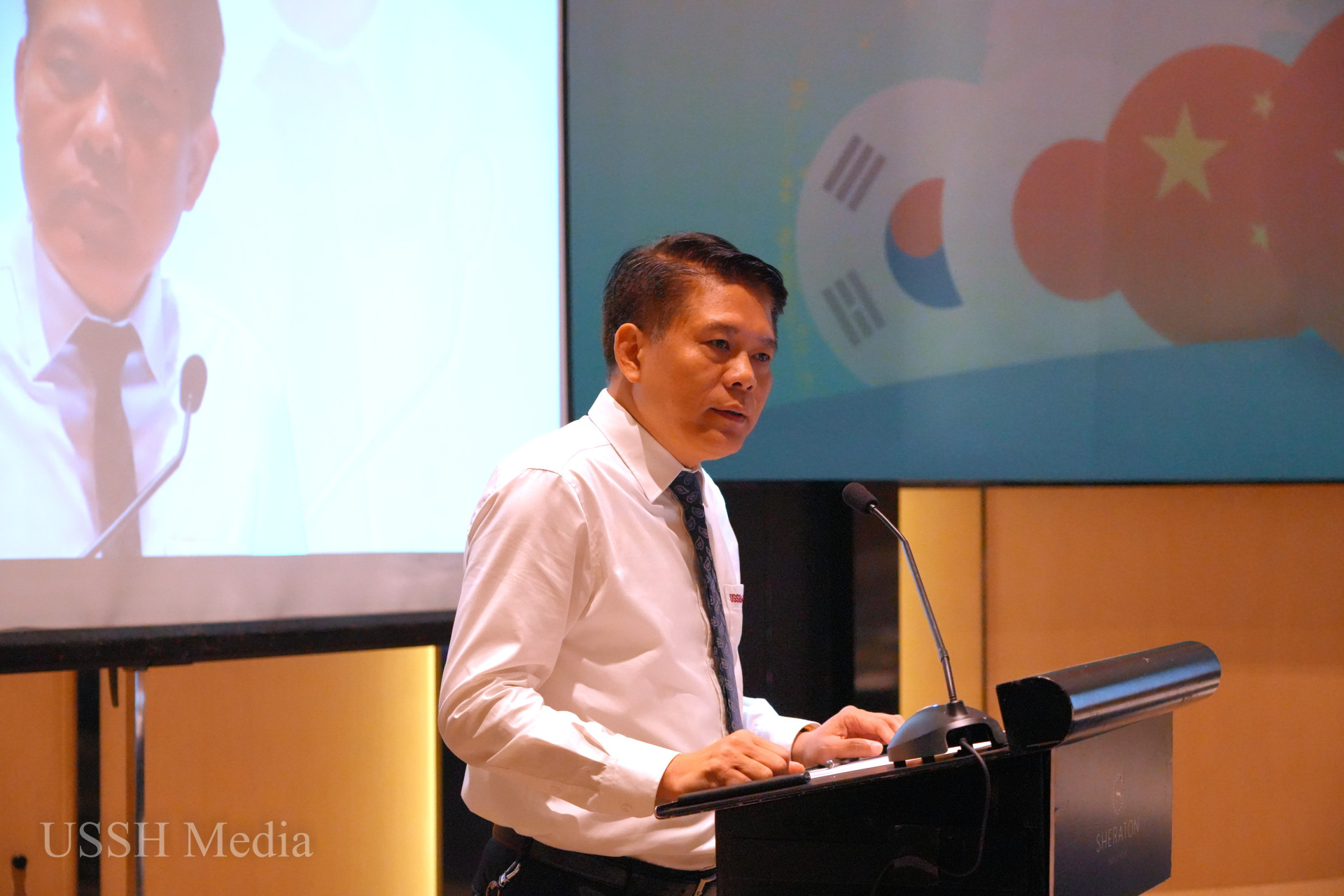
In his opening remarks at the conference, Assoc. Prof. Dr. Bui Thanh Nam - Chairman of the University Council of the University of Social Sciences and Humanities - stated that the conference's theme focuses on Vietnam's balanced diplomacy, one of the important pillars for ensuring its position and stability in a rapidly changing international environment.
Associate Professor Bui Thanh Nam - Chairman of the University Council of the University of Social Sciences and Humanities - affirmed that the results of the research project are a continuation of the successful cooperation between VNU-USSH and KAS over the years.
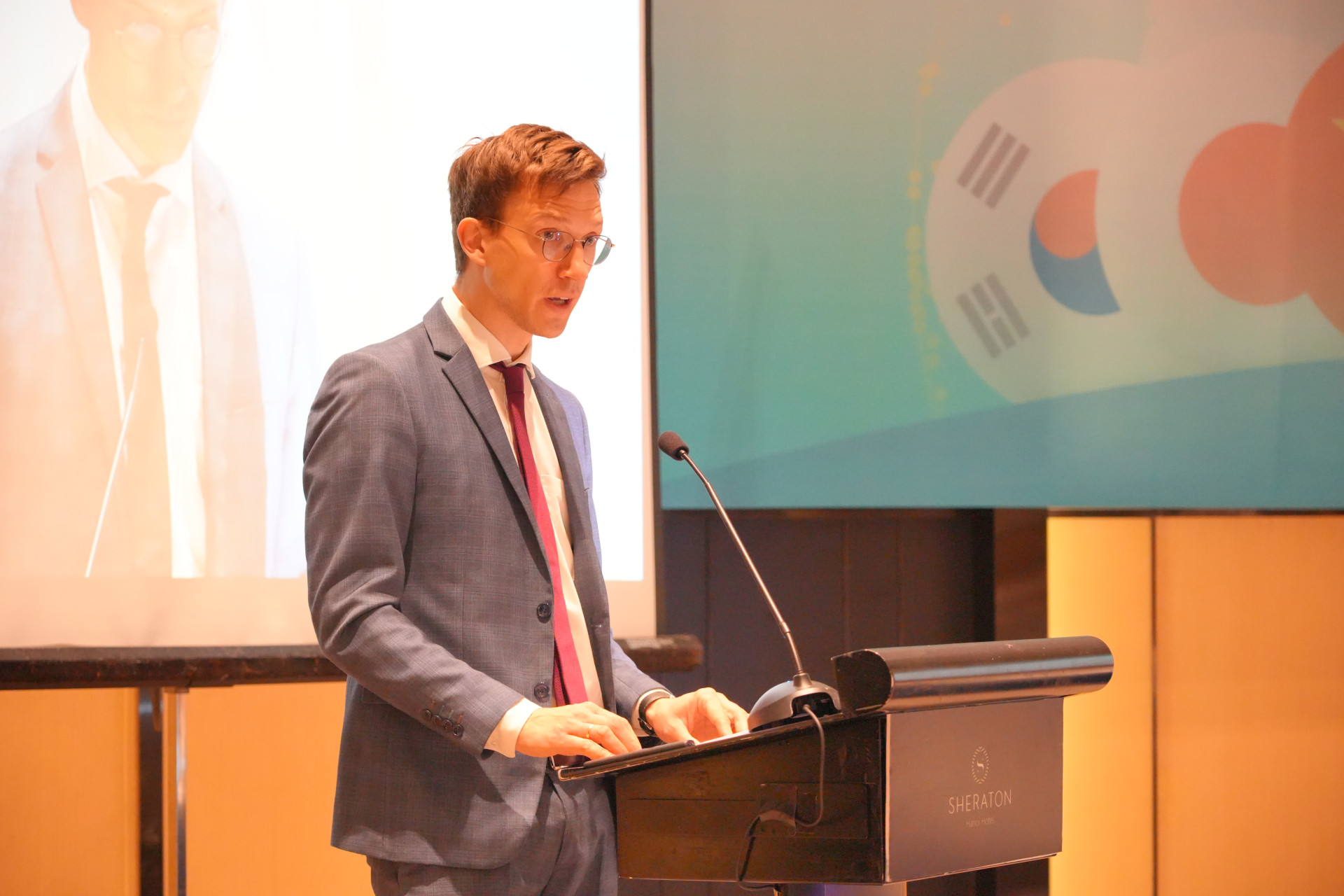
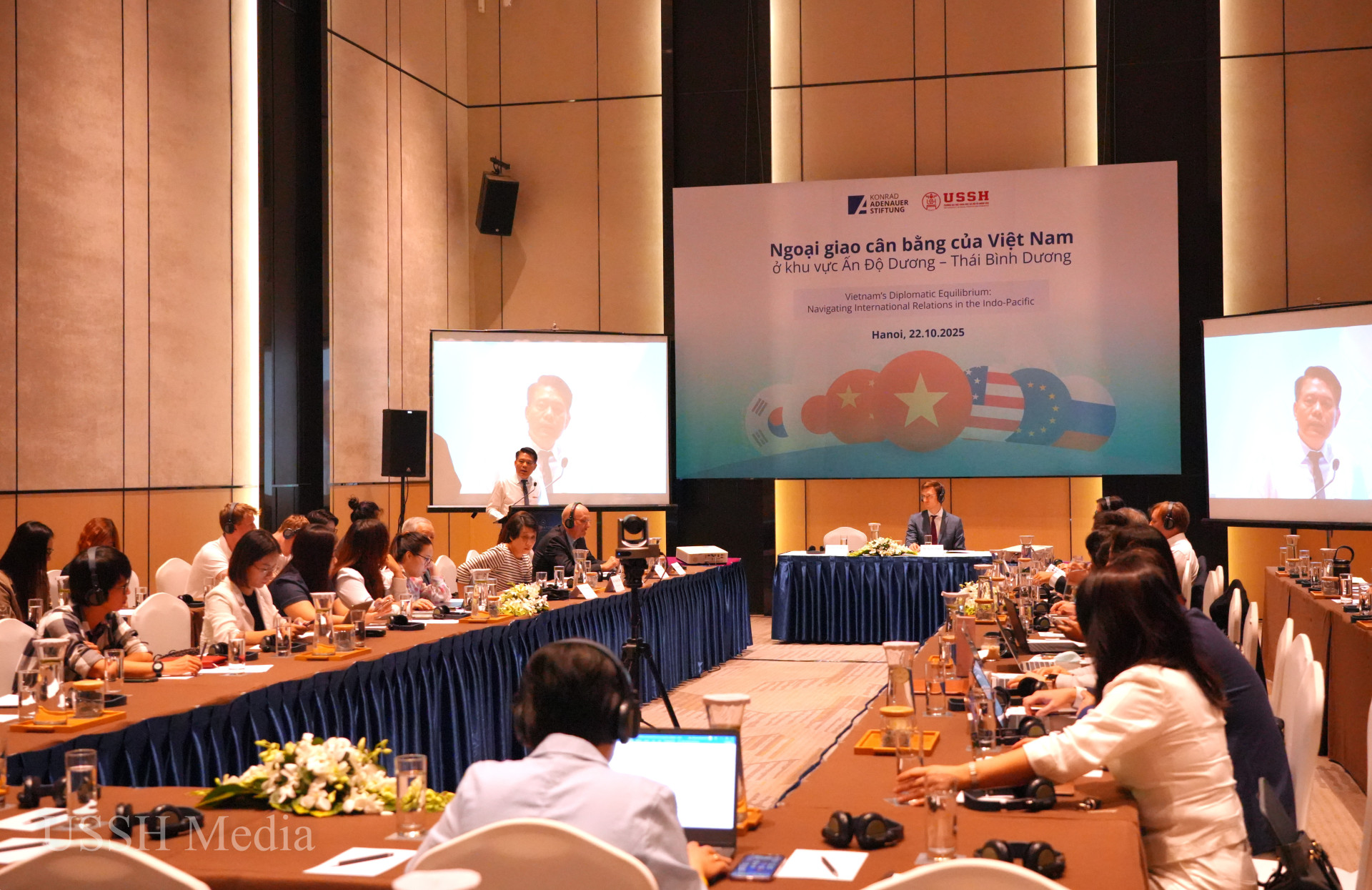
Mr. Lewe Paul, Head Representative of the Konrad-Adenauer-Stifung Institute in Vietnam, delivered a speech at the workshop.
Mr. Lewe Paul, Head Representative of the Konrad-Adenauer-Stifung Institute in Vietnam, shared that, as a German political organization, the KAS Institute supports research and organizes this workshop to promote discussions on Vietnam's balanced foreign policy in the Indo-Pacific region. Mr. Lewe Paul expressed his hope that the workshop will achieve many positive results in discussing relevant aspects, while strengthening the good relationship between the University of Social Sciences and Humanities and the Konrad-Adenauer-Stifung Institute in particular, and between Vietnam and Germany in general.
At the seminar, speakers and researchers discussed various issues concerning Vietnam's balanced diplomacy, which are receiving particular attention in the current context.
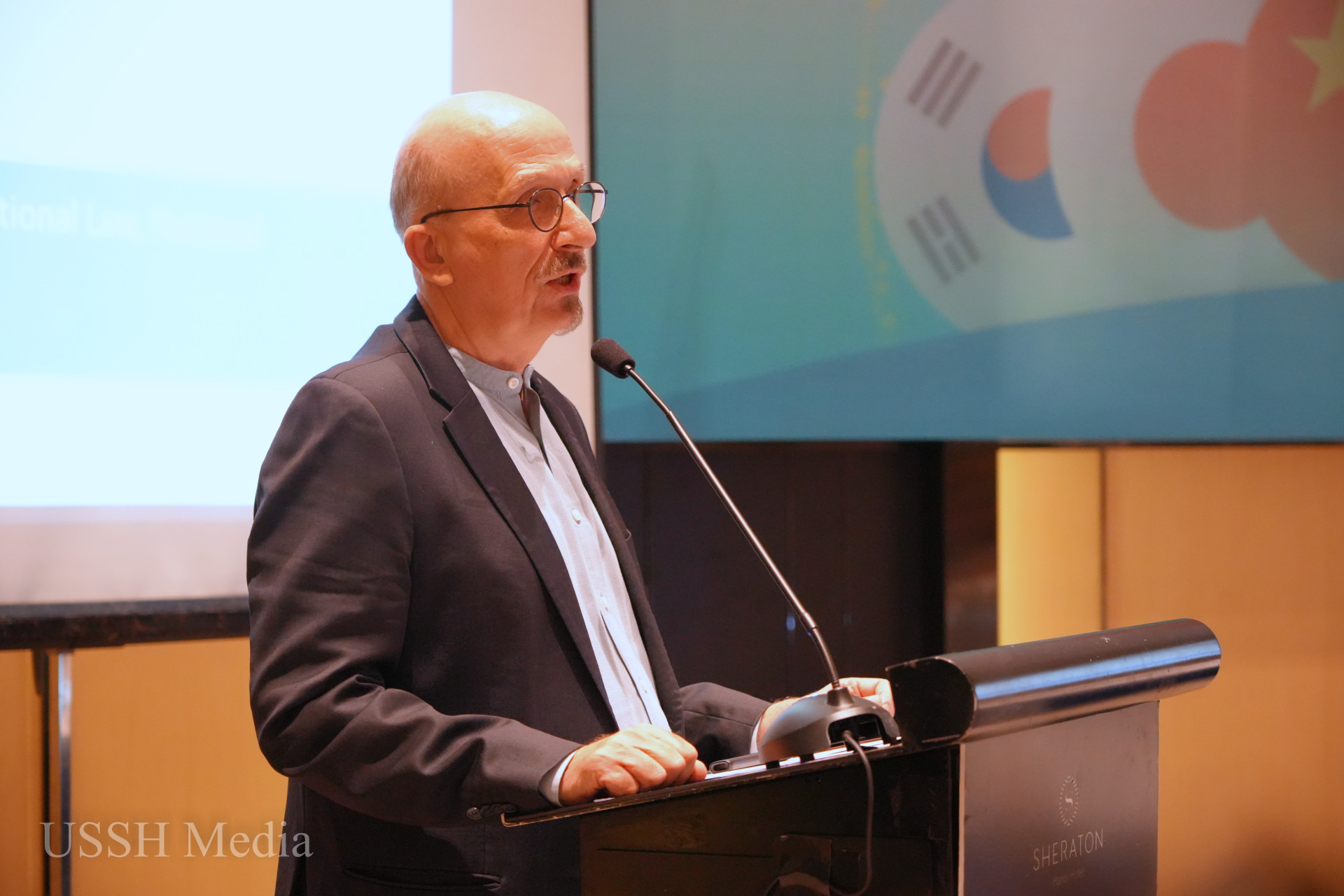
Professor Detlef Briesen of Justus Liebig Giessen University, Germany, a member of the research team, said that many different models are being discussed, from a new bipolar world system to pentapolar structures, to a multipolar world order with various forms of conflict and cooperation. International relations are in a rebuilding phase with unpredictable outcomes. This suggests at least one idea: countries like Vietnam now have more room to shape their national foreign policy.
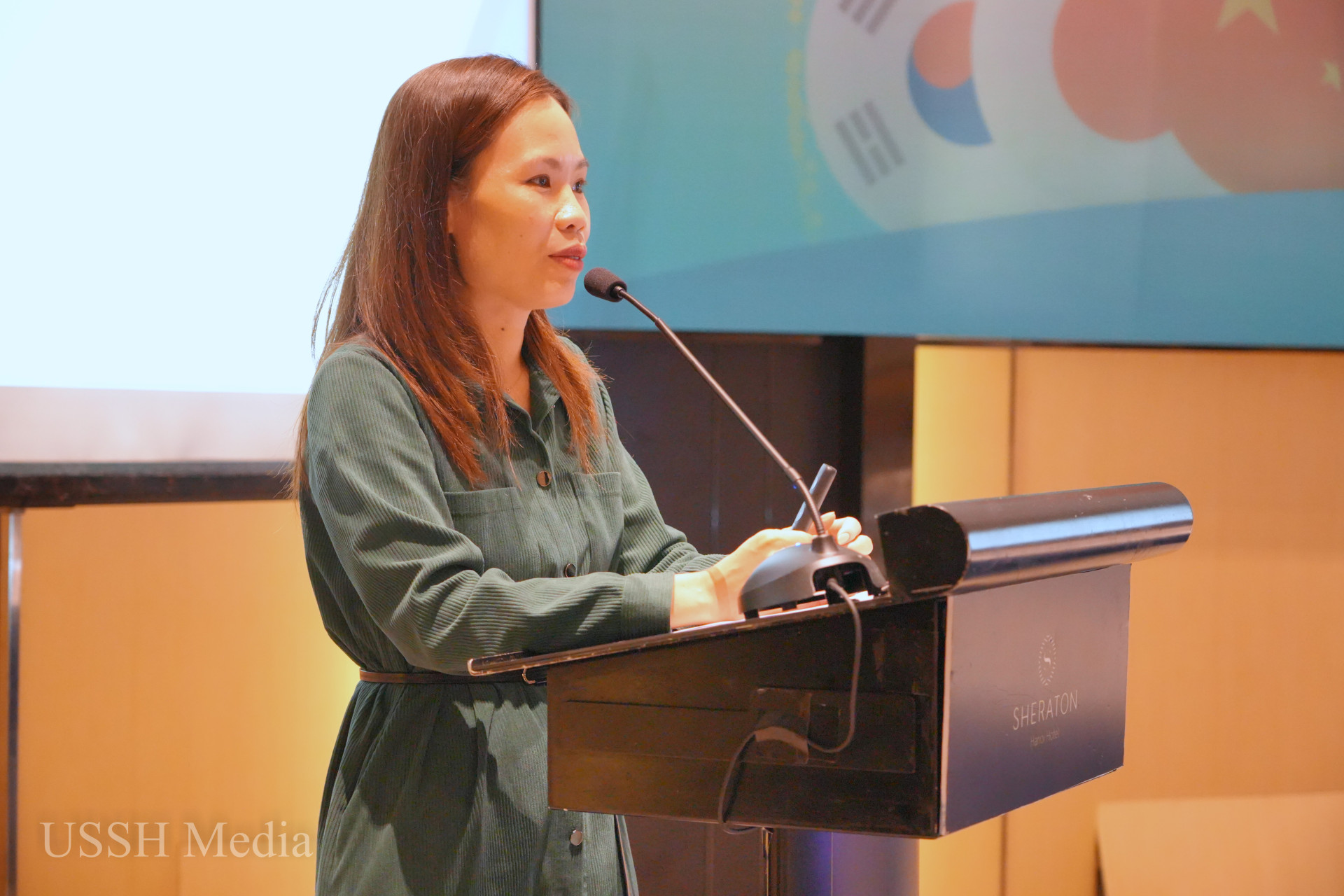
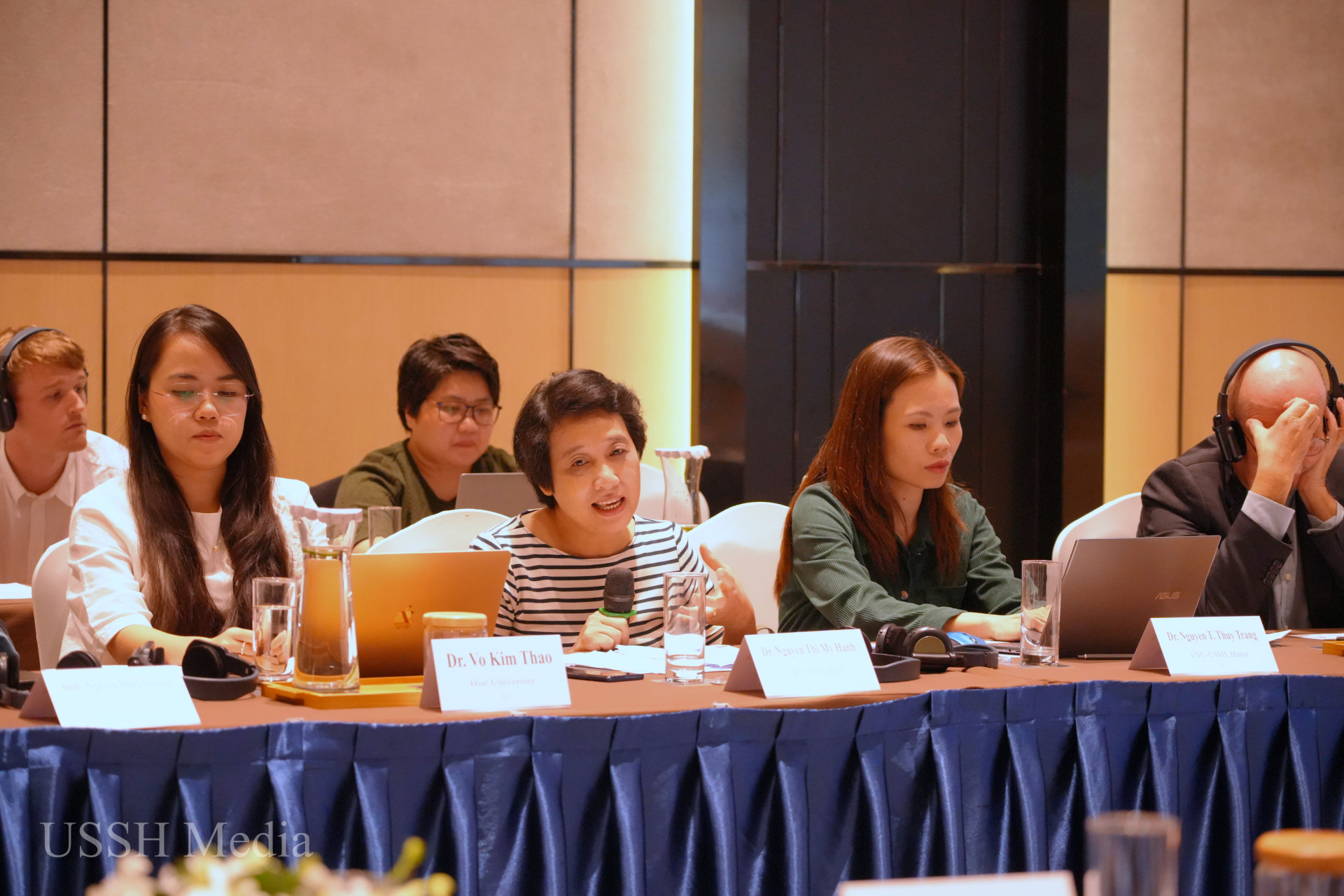
According to Dr. Nguyen Thi Thuy Trang (Faculty of International Studies, University of Social Sciences and Humanities), Vietnam has successfully addressed the challenges posed by the increasingly fierce strategic competition among major powers by adopting a rather unique model: a commitment to balance, independence, and integration. This is achieved through a comprehensive set of measures implemented by Vietnam, including: placing diplomacy as part of security; engaging in balanced economic, political, and cultural engagement with all parties; utilizing multilateral forums to mitigate asymmetry; and leveraging soft power to strengthen its strategic autonomy. It can be said that this is a distinctive foreign policy of Vietnam.
Prof. Dr. Detlef Briesen (Justus Liebig Giessen University, Federal Republic of Germany)
Dr. Nguyen Thi Thuy Trang presented a report on the topic "Agenda Convergence and Power Complementarity: The Case of Vietnam, Indonesia, and Australia in the Indo-Pacific Region".
Furthermore, researcher Nguyen Khac Giang (Yosuf Ishak Institute of Southeast Asian Studies ISEAS, Singapore) expanded on the issue of Vietnam's foreign relations within the context of the increasing trend of alliances among middle-sized countries in the region. This trend is based on the convergence of agendas and the complementarity of power among these countries.
Dr. Nguyen Khac Giang presented a research report on Vietnam's strategy for balancing relations with major powers in the Indo-Pacific region.
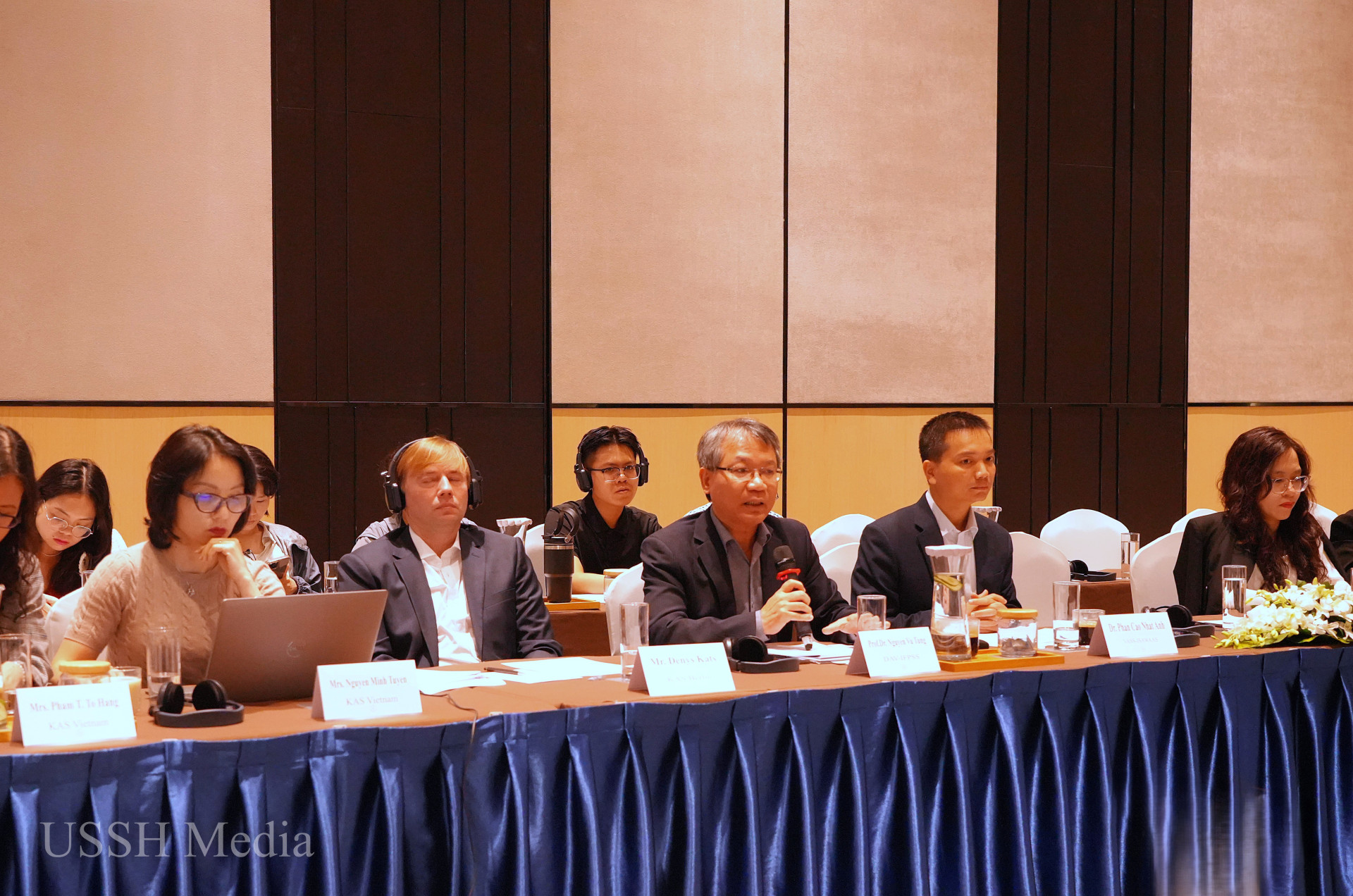
Professor Dr. Nguyen Vu Tung (Former Vietnamese Ambassador to South Korea, former Director of the Diplomatic Academy of Vietnam) shared his views at the conference.
At the conference, researchers and speakers discussed pressing issues such as the effectiveness, challenges, and future scenarios of Vietnam's balanced diplomacy strategy; comparing Vietnam's balanced diplomacy strategy with that of other Southeast Asian countries under geopolitical pressures. Simultaneously, speakers and researchers proposed several necessary and meaningful research directions for the future.
Dr. Nguyen Thi My Hanh (Department of International Studies, University of Social Sciences and Humanities) presented her views at the conference.
Policy recommendations for a balanced foreign policy in the future.The seminar "Vietnam's Balanced Diplomacy in the Indo-Pacific Region" is considered significant in enriching knowledge and understanding of Vietnamese diplomacy, contributing to a clearer understanding of the theoretical and practical aspects of foreign policy planning. It also serves as a forum to provide practical advice and recommendations to policy-making bodies, helping to concretize major directions in implementing future foreign policy strategies.
The workshop received many valuable exchanges and discussions that provided practical policy recommendations.
According to Associate Professor Bui Thanh Nam, Vietnam aims to achieve a GDP growth rate of over 8% by 2025, striving for over 10% from 2026 onwards, and striving to become a developed industrial nation with high income by 2045. To achieve high and sustainable growth, Vietnam needs to carefully prepare its foundational resources. Therefore, this workshop plays a crucial role in contributing opinions, providing policy advice, and developing models for the country during this period of significant transformation.
The organizers of the conference expect that, with the active participation of researchers, policymakers, and international partners, especially the presence of the Konrad Adenauer Stiftung, the knowledge and information shared at the conference will further enrich Vietnam's diplomatic theory, while providing specific and strategic recommendations for the country's development.
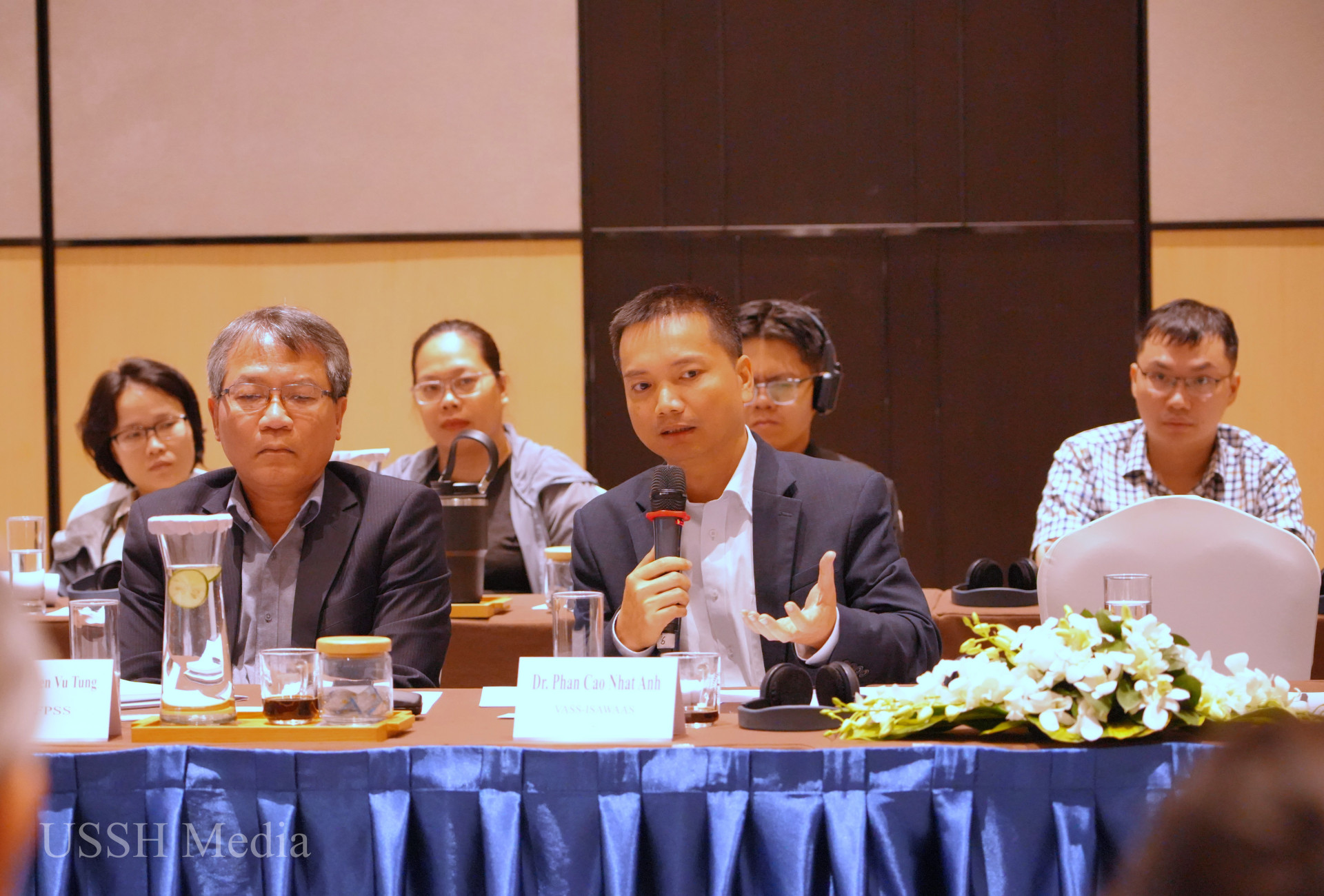
Dr. Phan Cao Nhat Anh - Vietnam Academy of Social Sciences
Representatives from the University of Social Sciences and Humanities pledged to incorporate, synthesize, and study the contributions made at the workshop into the university's policy advisory reports, serving the development of national development documents and strategies. Furthermore, the workshop's outcomes will be used as valuable academic material to impart knowledge to students in their future teaching and research.