Starting his career in the early stages of modern literary history research, Bui Duy Tan, like most of his contemporaries, was forced to temporarily set aside general theoretical issues that were not yet in line with the prevailing circumstances, choosing instead a more rational path: the study and analysis of specific authors and works. He was also fortunate to participate in the first Sino-Vietnamese studies course organized for young lecturers and researchers from university research and teaching institutions in Hanoi. Through a long process of diligent accumulation and work, driven by his personal interests and strengths, this remained his main direction and the primary contribution to social science.
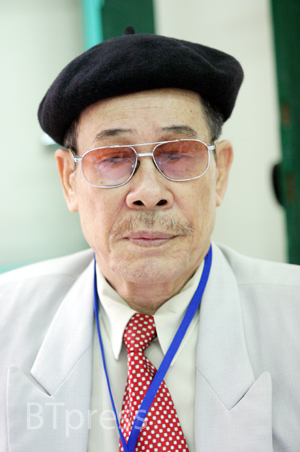
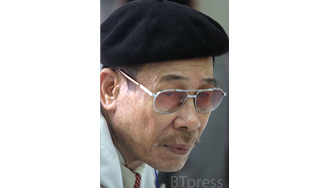
Associate Professor, People's Teacher Bui Duy Tan (1931-2009)/Photo: Bui Tuan
It can be said that his name is a guarantee of the certainty and reliability of research materials. He conducted research and identified a series of authors from the 10th century to the first half of the 18th century, from major names like Nguyen Trai and Nguyen Binh Khiem to lesser-known names such as Thai Thuan, Nguyen Bao, Phung Khac Khoan, Dao Duy Tu, Nguyen Tong Quai, and Mac Thien Tich… This quiet work not only helped to create a more comprehensive understanding of medieval literature but also provided a solid foundation for the research of later generations. Furthermore, his research on specific texts and words demonstrates a strong academic character, always cautiously questioning established beliefs that have become self-evident, not only within the research community and the wider public but also within himself. One typical example is the issue of the authorship of the famous poem that we often refer to as…Malenational mountains and riversBased onComplete History of Dai VietBased on the materials of his colleagues, he vehemently wrote a series of articles correcting the authorship of this poem, stating that it was by an anonymous author, not Ly Thuong Kiet as most of us commonly believe. Whether the poem was by an anonymous author or Ly Thuong Kiet significantly impacts our understanding of the poem as belonging to the early period of the nation's written literature. This may seem trivial, but it is actually extremely important for the study of medieval literature, a period in which the preservation and transmission of texts had unique characteristics. Along with this discovery, in this work, he restored the poem's position as the first work of Vietnamese written literature.Nam Quoc Son Hainstead ofThe plan to defeat Hoang Thao.of Ngo Quyen as inLy-Tran Dynasty poetry and literatureandNationalas inAnthology of Vietnamese Literature.He was also one of those who tried to correct a translation error that had persisted for decades, an error we greatly appreciate: "Ức Trai tâm thượng quang khuê tảo" was incorrectly translated as "Ức Trai's heart shines like the star Khuê." While this incorrect translation was widely accepted as a vindication for Nguyễn Trãi, it was an unfamiliar and meaningless metaphor in medieval times. The correct translation should be "Ức Trai's heart radiates literary brilliance." Because of the particularly important role of literature in medieval times, the feudal dynasties highly valued Nguyễn Trãi and the impact of his literature on the political and social landscape. Regarding the Tao Đàn Society, he searched through original texts from the 15th century but found no documents recording the founding of this society or its name. He concluded that this was something later generations (19th century) had invented. This discovery has significant implications for understanding literary creation as well as the reasons behind any attempts at "forgery" (if any) by later generations.
Among his scholarly works, one can mention his selections of medieval literary works. Medieval literature remains a difficult subject for the majority of readers, not only due to language barriers, writing systems, and the cultural gap between the past and present, but also because of the difficulties in finding reference materials, especially in the form of selections of original works. Bui Duy Tan not only participated in compiling large, highly academic books for professional researchers such as...Anthology of Vietnamese Literature(editor-in-chief of volumes 6 and 7) also designed valuable book series aimed at a more general readership, most notablyAnthology of Vietnamese Medieval Literature(Volumes 1, 2, and 3, Education Publishing House, 2004, 2008, and 2009). This comprehensive series encompasses outstanding works by the most representative authors while maintaining a broad overview of the literature of each period. Building upon the achievements of its predecessors, the series selects appropriate translations and provides up-to-date annotations. It can be said that this series is a significant contribution by Bui Duy Tan and the other authors to the study of medieval literature for literature enthusiasts in general.
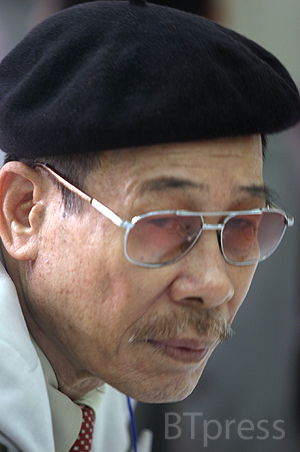
Associate Professor Bui Duy Tan was awarded the State Prize for Science and Technology in 2007 for his work.A Study and Discussion of Some Genres, Authors, and Works of Medieval Vietnamese Literature(2 episodes)/Photo: Bui Tuan
In the field of literary theory, as someone who has worked as a researcher and lecturer at a university for many years, Bui Duy Tan has achieved many accomplishments in summarizing the characteristics and trends of different periods of literature, and in summarizing and summarizing scientific topics and issues. He has written a portion of a literature textbook.Vietnam from the 10th century to the first half of the 18th centuryof the University of Hanoi (Education Publishing House, Hanoi, 1979), the entire textbook.Vietnamese literature from the 10th century to the mid-18th century(Education Publishing House, Hanoi, 1998), numerous summaries and reviews of major and minor research works on literary periods and authors. The appeal of his writings lies not in the ornate style or the novelty of his theories, but in the solidity of his documentation, the richness of his information, the carefulness of his arguments, and the profound insight into issues that comes from someone who has absorbed classical literature throughout his life.
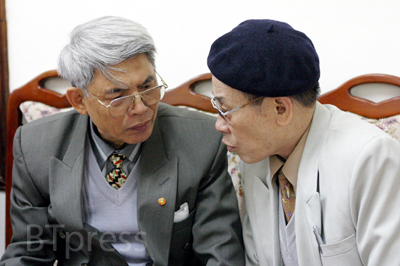
Associate Professor, Doctor of Merit Le Huy Tieu and the late Associate Professor, Doctor of Merit Bui Duy Tan / Photo: Bui Tuan
Among the thousands of pages he published throughout his research career, many works will undoubtedly stand the test of time and continue to be relevant to the study of medieval literature. Even after retirement, until his final years, he worked tirelessly to produce new works. He was a researcher always passionate about his profession, and a teacher who enthusiastically passed on to generations of students not only knowledge but also an boundless love for the study of classical literature and culture. I belong to the last group of his students, and the image I remember most of him is his sparkling eyes and resonant voice, even at an advanced age, still enthusiastically clarifying issues in the lecture hall, such as "Nam Quoc Son Ha," the Tao Dan Society, or "Uc Trai Tam Thuong Quang Khue Tao."
|
Associate Professor, People's Teacher Bui Duy Tan
+ Workplace: Faculty of Literature, Hanoi University. + Management position: Deputy Head of the Faculty of Literature (1982-1984).
Classical Vietnamese Literature(co-authored). Education Publishing House, 1964. Sai Thuan – The greatest poet of ancient Kinh Bac(Editor-in-chief). Hebei, 1978. Vietnamese literature of the 10th century and the first half of the 18th century(co-authored). Education Publishing House, 1979, 7th reprint, 2001. Six hundred years of Nguyen Trai (co-authored). Social Sciences Publishing House, Hanoi, 1982. Dictionary of LiteratureVolumes I and II (co-authored). Social Sciences Publishing House, 1983-1984. Nguyen Bao and "Chau Khe Poetry Collection"”. Thai Binh and Culture Publishing House, Hanoi, 1991. Nguyen Binh Khiem – A cultural figure (co-authored). Ministry of Culture, 1991. Dao Duy Tu – Life and Career(co-authored). Thanh Hoa, 1993. Cultural similarities between Korea and Vietnam.(co-authored). Culture and Information Publishing House. Vietnamese EncyclopediaVolume I (co-authored). Vietnam Encyclopedia Dictionary Compilation Center, 1995. Anthology of Vietnamese Literature,Volume 6 (editor-in-chief). Social Sciences Publishing House, 1997. Anthology of Vietnamese Literature,Volume 7 (editor-in-chief). Social Sciences Publishing House, 1997. Le Thanh Tong – the man and his career(co-authored). Hanoi National University Publishing House, 1998. Emperor Le Thanh Tong(co-authored). Social Sciences Publishing House, 1998. New Literature and Vietnamese Society in the Late 19th and Early 20th Centuries(co-authored). National Political Publishing House, Hanoi, 1998. Vietnamese Literature Textbook from the 10th to the Mid-18th Century. Education Publishing House, 1998. Selected Classical Chinese and Vietnamese Poetry,Volume A – 10th – 15th centuries (editor-in-chief). Hue 1999. Selected Classical Chinese and Vietnamese Poetry,Volume B – 16th century – first half of the 18th century (editor-in-chief). Hue 1999. A study and analysis of some authors and works of medieval Vietnamese literature.Volume I. Education Publishing House, 1999. Trạng Bùng Phùng Khắc Khoan: author – works(Editor-in-chief). Ha Tay Department of Culture and Information, 2000. A Study and Discussion of Some Authors and Works of Medieval Vietnamese Literature Volume II. Hanoi National University Publishing House, 2001. Anthology of Vietnamese Medieval Literature,Volume 1 (editor-in-chief). Education Publishing House, 2004. Following the line of discussion. National University of Hanoi Publishing House, 2005. Bui Duy Tan Anthology. Education Publishing House, 2007. Anthology of Vietnamese Medieval Literature,Volume 2 (editor-in-chief). Education Publishing House, 2008. Anthology of Vietnamese Medieval Literature,Volume 3 (editor-in-chief). Education Publishing House, 2009.
+ State Award for Science and Technology in 2007 for the workA Study and Discussion of Some Genres, Authors, and Works of Medieval Vietnamese Literature(2 volumes). |
Author:Dr. Do Thu Hien

