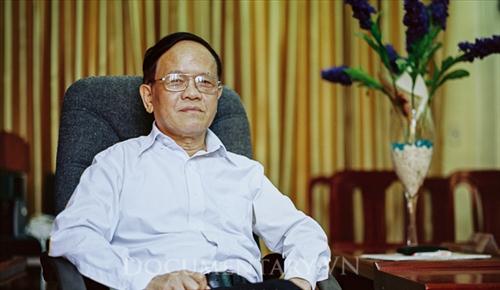
Memories that will last forever
Writing an introduction to a scientist is difficult, but introducing my own mentor is even harder, especially considering the significant age and professional experience I share with him.
According to official records, he was born in 1949. According to fortune-telling books, people born in this year tend to have a hot temper but cool down quickly. After more than 20 years as his student, I've come to realize that this assessment isn't entirely accurate, at least not in his case.
I don't necessarily think he was hot-tempered. Perhaps serious and straightforward would more accurately describe his personality. Like his predecessors, he believed that "A father's failure to properly raise his child is his fault. A teacher's laxity in teaching is his negligence." [If a child is not properly raised, the fault lies with the father; if a teacher is not strict in their teaching, the fault lies with the teacher.Perhaps that's why, in the eyes of his students (at least those of my generation and earlier), he was a serious and strict teacher.
However, no matter how hard he tried to hide it, I could still sense the "affection" in his strict attitude towards his students. At the end of 1997, when I was working on my undergraduate thesis, I was fortunate to have him as my supervisor. My inexperience led me to naively go on a field trip before the research proposal was approved. Honestly, at that time, I don't know why I forgot this very basic step. Perhaps it was the eagerness of a student who thought he was about to become an "adult" to travel far and "do science," or perhaps it was the mesmerizing allure of the beauty of the Thai girls from Northwest Vietnam (which I imagined through his lectures and those of other professors) that made me feel like I was under a spell. I immediately packed my bags and left Hanoi during the Lunar New Year holiday, heading north to Muong So, Phong Tho in the White Thai region of Lai Chau.
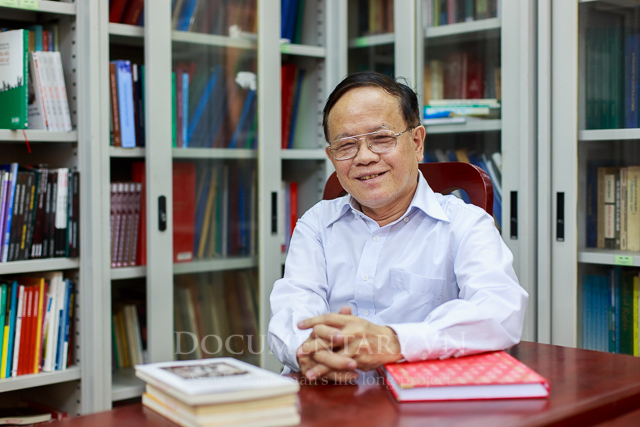
Associate Professor, Doctor, Distinguished Teacher Le Si Giao
After a month of fieldwork, upon returning to Hanoi, I remained carefree, paying no attention to my professor. Then, late one evening, I met a classmate, also under the same professor, who looked dazed, as if he'd just lost his scholarship. He dragged me to Mrs. Chi's pho restaurant, ordered a bottle of wine, and asked for some leftover bones from the bottom of the broth (which we called "grave bones"). He said, "I'm dead," the professor had really hit me hard. Before leaving, I had already approved the outline and report to the professor, written my best, but still received a "bright red" critique. Honestly, I'll never forget that chilling feeling. I felt less sorry for my friend and more worried about myself.
Then, when I submitted my thesis, the professor was visibly angry, making me feel like I was sitting on hot sand for the whole week. I thought this might be even more humiliating than my friend's. Luckily, after reading my thesis, he only gently reprimanded me, saying, "You wrote well, but it would have been even better if you had worked with me before going on the field trip..." With just that one sentence, I understood his true feelings for me and for his students.
Later, I learned that he had also secretly helped many people in one way or another. Although, in quite a few cases, for some reason, people had "gently forgotten" those acts of kindness. He rarely bothered to do so, and I never heard him reproach anyone.
The initial impression might lead someone meeting him for the first time to think he's a difficult, dry person. Only the most observant, attentive, and close to him would understand that he's actually an introverted and emotional person. Perhaps that's why he went through a rather "quiet" period in his life after the death of his closest friend. Once, when we visited, we sat silently beside a few bottles of beer for an hour, constantly picking them up and putting them down. At those times, his eyes were so sad, as if drawn to some invisible point. Some people say he's too sentimental and weak. I don't think so. He's more of a sentimental person. One can control reason, but who can command the heart in this world?
There's one thing I think is true about the book on astrology, at least in his case. That is, he's considered intelligent and eloquent. If you read his writings, you can easily see a clear, systematic way of thinking, a precise yet witty writing style, and a use of words that are both scientific and very "down-to-earth." I really like his playful writing style, a style that keeps the reader engaged, prompting reflection before fully understanding, a style that, without sufficient "writing skill," could easily become clichéd…
He also possessed a witty and humorous style of expression, always playfully teasing others with his words and unique intonation. During my university years, we students found it most exhausting to listen to his endlessly long speeches at school events. However, his speeches always brought refreshing, lighthearted laughter to the audience. He skillfully transformed dry slogans into something soft, relatable, and humorous.
Contributions to the field of Ethnology
Among the current full-time lecturers of the Department of Anthropology, Faculty of Social Sciences and Humanities, Vietnam National University, Hanoi, Associate Professor Dr. Le Sy Giao has the longest tenure. After graduating from Hanoi University in 1973 (4.5-year program), he was retained as a lecturer in the Faculty of History. From 1983 to 1987, he was sent to study for a postgraduate degree at Leningrad State University in the Soviet Union.
During his more than 40 years of research and teaching, he focused deeply on several fields such as: agricultural ethnology, the Tay-Thai language group ethnic groups in Vietnam, ethnic relations, and ethnic groups in Asia. The fruits of his tireless work and contributions to the field of ethnology are:extremely impressive: around 100 works, including textbooksGeneral EthnologyHis work includes monographs, journal articles, and scientific reports for conferences both domestically and internationally. He has also supervised over 20 doctoral students, 20 master's students, over 70 undergraduate students on their graduation theses, and over 30 undergraduate students on their scientific reports (including two individuals and a group of students who won third prize from the Ministry of Education and Training).
In addition to teaching, he spent many years in administrative work: over 10 years as Party Secretary of the History Department, 8 years as Vice Dean of the History Department, 8 years as Head of the Ethnology Department, 4 terms as a member of the Central Executive Committee of the Vietnam Ethnology Association, and one term as General Secretary of the Vietnam Ethnology Association. He was also one of the four founders of the Thai Studies Program (along with scholars Cam Cuong, Cam Trong, and Hoang Luong).
With such comprehensive contributions, he received a Certificate of Merit from the Prime Minister in 2001 for his many achievements in his work, contributing to the cause of building socialism and defending the Fatherland; two Certificates of Merit from the Director of Hanoi National University (1999: for outstanding achievements in training, education, building and developing Hanoi National University; 2001: for achieving the title of Excellent Lecturer at the grassroots level in the 1999-2000 academic year)... Particularly in 2012, he was awarded the title of Outstanding Teacher, a fitting recognition of his contributions to the cause of "nurturing people" for over 40 years.
For over 40 years as a teacher and scientist, the life of Associate Professor Dr. Le Sy Giao can be divided into two phases. The first phase is from the beginning of his career to the mid-2000s. This period clearly showed the image of an exemplary, strict teacher and a careful, sharp scientist. The second phase, from the mid-2000s to the present, shows a "new vitality" emerging in him. His work and life have become more "real." It seems that after all the ups and downs of life, he has finally "realized" his "meaning of life."
|
Associate Professor, Doctor, Distinguished Teacher Le Sy Giao
+ Workplace: Department of History (1974-2010). Department of Anthropology (2010-2015). + Management position: Deputy Head of the Department of History (1996-2004). Head of the Department of Cultural Anthropology (2010-present).
+ TextbookGeneral Ethnology(Editor) (18 reprints). |
Author:MSc. Nguyen Cong Thao

