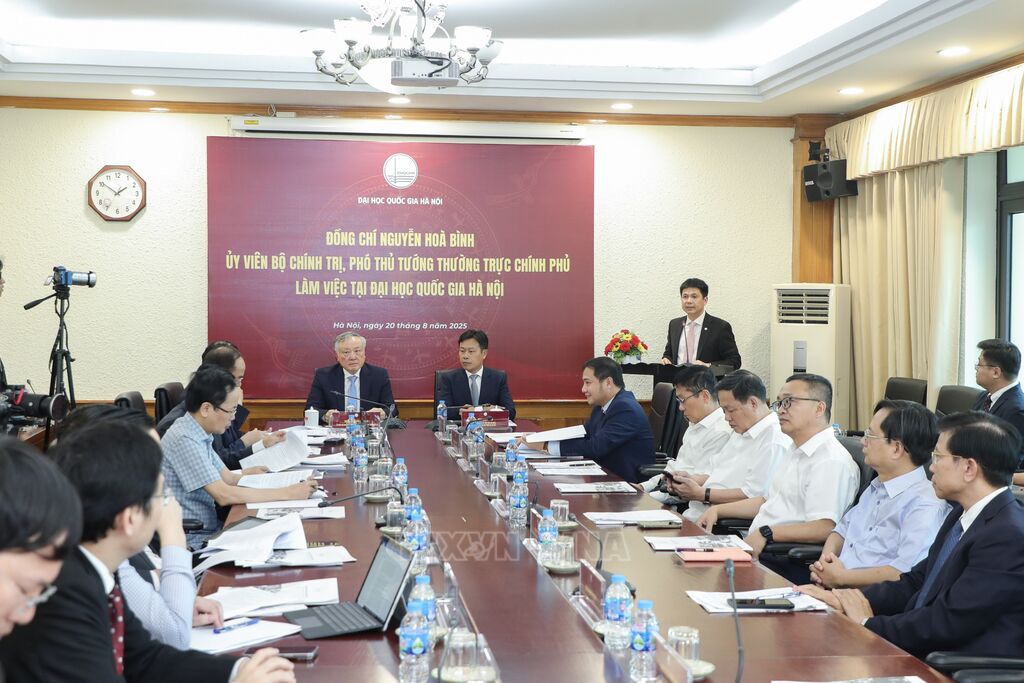
On the afternoon of August 20th, in Hanoi, Politburo member and Standing Deputy Prime Minister Nguyen Hoa Binh held a working session with the Vietnam National University, Hanoi, regarding the implementation of Politburo Resolution No. 18-NQ/TW on continuing to innovate and reorganize the political system's organizational structure to be streamlined, effective, and efficient; and Politburo Resolution No. 57-NQ/TW on breakthroughs in the development of science, technology, innovation, and national digital transformation.
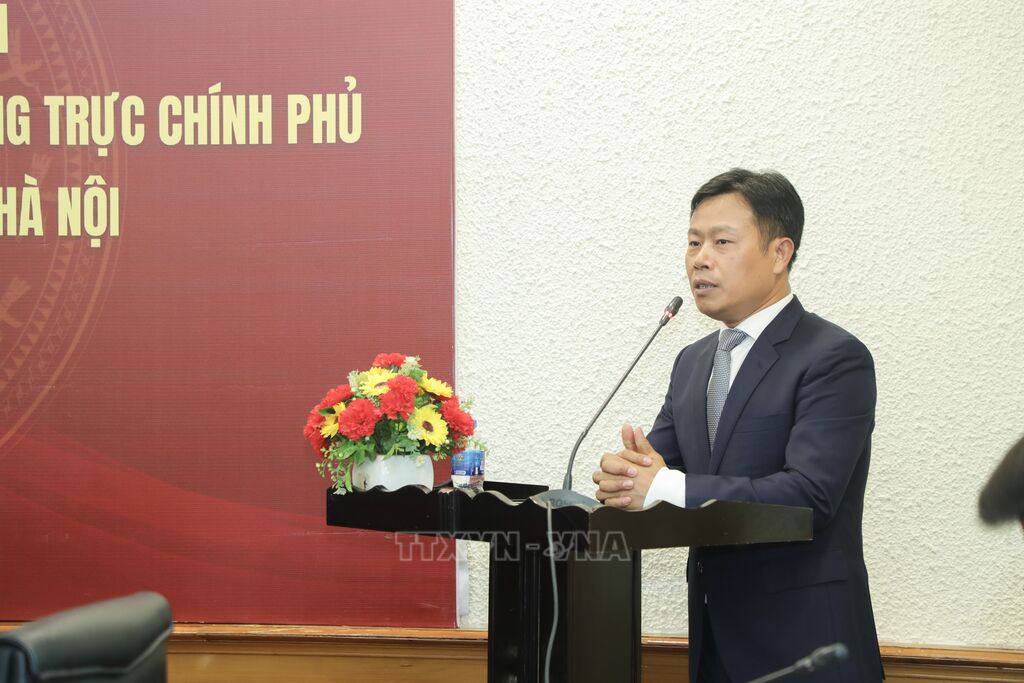
Minimize overlapping functions and responsibilities.Sharing with Deputy Prime Minister Nguyen Hoa Binh and the delegation, the Director of Hanoi National University, Le Quan, stated that Hanoi National University has always been a pioneer in implementing Resolution 18-NQ/TW, restructuring its organization and streamlining its apparatus, while focusing on developing a research-oriented university model and promoting decentralization and delegation of power. The university has also issued standards for Hanoi National University scientists, developed a set of development indicators linked to the implementation of Resolution 57-NQ/TW, and established the Center for Technology Training and Innovation.
Director of Hanoi National University, Le Quan, delivers a speech. Photo: VNA
In particular, Hanoi National University has significantly boosted training in science and technology fields. Previously, these fields accounted for only 16% of the university's enrollment, but this has now increased to over 40%. Furthermore, there has been no "brain drain," and the university has attracted approximately 500 PhDs, professors, and associate professors to teach and conduct research. Revenue from self-funded recurrent expenditures has grown strongly. The average income of lecturers reached 35.5 million VND/person/month; some units even had an average income of up to 60 million VND/person/month. Alongside this, Hanoi National University has put its Hoa Lac campus into operation, developed approximately 46 strong research groups, and established a Development Fund to focus investment on key areas.
Reporting on the implementation of Resolution 18-NQ/TW, Vice Director of Hanoi National University Nguyen Hieu stated that Hanoi National University has basically completed the restructuring and streamlining of its member units and affiliated units, reducing the number from 36 to 25, achieving a rate of 30.5%; reviewing and adjusting job positions and the number of employees; and setting a target of reducing administrative and intermediate personnel by at least 15% and reducing the number of personnel receiving salaries from the state budget by at least 20% for units that are not yet financially autonomous.
The restructuring and streamlining of the organizational apparatus at Vietnam National University, Hanoi, is carried out in accordance with Resolution 18-NQ/TW, minimizing overlapping functions and tasks, enhancing operational efficiency, and reducing costs. However, Vietnam National University, Hanoi, recognizes that there are still limitations regarding autonomy that have not been fully institutionalized, as well as challenges in attracting high-quality human resources due to policy barriers that need to be addressed in the future to maximize its potential.
In implementing Resolution 57-NQ/TW, Vietnam National University, Hanoi has proactively promoted research, technology transfer, and commercialization of research results. The university has established three key research institutes under the High-Tech and Innovation Park: the Semiconductor and Advanced Materials Institute, the Quantum Technology Institute, and the Artificial Intelligence in Sustainable Development Institute, initially achieving significant breakthroughs in semiconductor microchips and quantum technology. Vietnam National University, Hanoi has also approved eight priority technology areas for the 2025-2035 period, while attracting many leading global experts to advise and lead these strategic research institutes.
Hanoi National University focuses on the "Three-Party" cooperation model (State - University - Enterprise), receiving orders from businesses worth nearly 50 billion VND, transferring 8 products, and currently owning 61 intellectual property assets ready for transfer and commercialization.
According to Vice Rector Nguyen Hieu, in the coming period, Hanoi National University will continue to refine its autonomy model, improve governance efficiency, and pilot excellent research institutes and centers in key areas, striving to have at least 5 such units by 2030. The university will also issue specific policies to attract talent, develop an excellent scientific team, and promote the mechanism of "ordering" research and policy advice.
The unit will also strengthen the application of digital technology and artificial intelligence in human resource management and performance evaluation, aiming to streamline the organizational structure and improve productivity; pilot a mechanism for paying salaries based on work performance, scientific products, inventions, and technology transfer; and establish a high-tech venture capital fund to support applied research activities.
Develop key research areas.
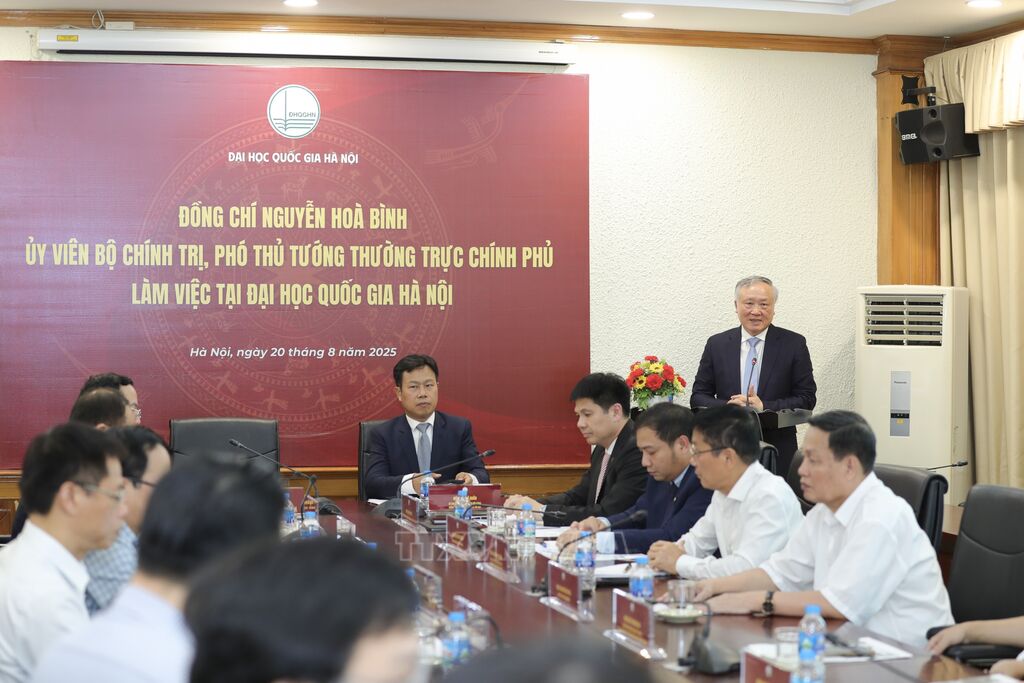
Member of the Politburo and Standing Deputy Prime Minister Nguyen Hoa Binh speaks at the working session. Photo: VNA.
Speaking at the working session, after hearing the report from Hanoi National University on the implementation of two important resolutions of the Politburo (Resolution 18-NQ/TW and Resolution 57-NQ/TW), Deputy Prime Minister Nguyen Hoa Binh welcomed and highly appreciated the results achieved by Hanoi National University in the past period, noting that despite some very difficult tasks, the unit has done very effectively and in the right direction.
The Deputy Prime Minister highly appreciated the "concise but sophisticated" approach, especially the establishment of research institutes for semiconductor chips, AI, and quantum technology – fields that are still in their infancy globally, but which Vietnam has proactively taken to leapfrog ahead.
Furthermore, Hanoi National University has made significant progress in linking training with practice, as evidenced by the number of businesses commissioning research and recruiting students directly from the university. The Deputy Prime Minister considered this a bright spot, especially in the context of Vietnamese higher education still facing the limitation of a "mismatch" between training and market needs. The Deputy Prime Minister highly appreciated the university's ability to generate good income for lecturers and employees – a figure many other universities would envy; and the rapid attraction of newly established training programs, demonstrating the appeal of a reputable training institution. However, to truly assess the quality of education, the Deputy Prime Minister noted that Hanoi National University needs to continue paying attention to the percentage of graduates working in their field of study.
Deputy Prime Minister Nguyen Hoa Binh also stated: The Politburo will soon issue a Resolution on breakthroughs in education and training development, expected to be issued before the new school year, with the determination to revitalize the country's education system. In particular, higher education will implement many groundbreaking policies, granting greater autonomy to training institutions.
Therefore, the Deputy Prime Minister requested that Hanoi National University not neglect basic science, emphasizing that for Vietnam to develop and move forward, it needs a solid foundation, and basic science is the springboard for the country to reach the heights of science and technology. The fact that Hanoi National University is establishing research departments and institutes in new fields is consistent with the Politburo's orientation on key areas. The Deputy Prime Minister also noted that Hanoi National University should continue to focus on ensuring the quality of its graduates to meet the demands of the labor market. Besides training in knowledge and expertise, the university should not forget to cultivate Vietnamese character, culture, civic responsibility, and a desire to contribute in each student; the example of teachers should also become a standard for students to follow.
The Deputy Prime Minister expressed his wish that Hanoi National University, along with the rest of the country, would enter a new era with favorable conditions, meeting the expectations of the Politburo, becoming one of the leading universities in the country and the region, and ranking among the top 200 universities in the world in the near future.
Vietnam News Agency: Deputy Prime Minister Nguyen Hoa Binh: Hanoi National University is taking a shortcut to innovation.