Before being hospitalized a few weeks ago, Professor Phan Huy Le He also participated in a business trip to Truong Sa in early June. Afterwards, he was hospitalized for emergency treatment due to heart disease and some lung problems.
Professor Phan Huy Lê was born on February 23, 1934, in Thạch Châu commune, Thạch Hà district, Hà Tĩnh province, a culturally rich region of Nghệ An province, steeped in patriotic, revolutionary, diligent, and studious traditions. Both his paternal and maternal families were renowned scholarly lineages, boasting prominent cultural figures such as Phan Huy Cẩn, Phan Huy Ích, Phan Huy Thực, Phan Huy Vịnh, Phan Huy Chú, Cao Xuân Dục, Cao Xuân Tiếu, and Cao Xuân Huy. His father, Phan Huy Tùng, was a Confucian scholar and doctor who served in the Huế imperial court. He was known for his integrity, virtue, kindness, and deep love for his children and grandchildren.
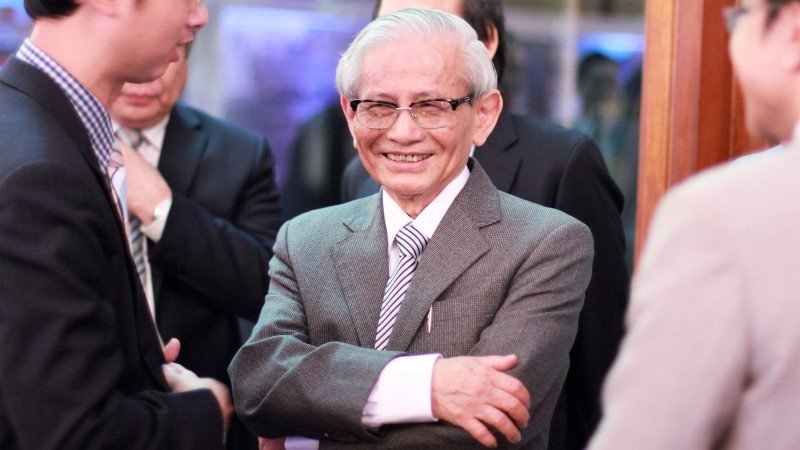
Professor Phan Huy Lê (1934-2018). Photo: Vietnamnet
In 1952, at the age of 18, he left his family to attend a preparatory university in Thanh Hoa, where he had the opportunity to interact with leading revolutionary intellectuals of the country. Being a gifted student with a passion for natural sciences, he initially planned to choose mathematics and physics for his future career, but fate seemed to have predetermined his path to becoming a historian. He sensed his own path within the depths of Vietnamese history.
According to Professor Nguyen Quang Ngoc, Vice President of the Vietnam Historical Science Association, it was Professor Tran Van Giau and Professor Dao Duy Anh who first recognized this valuable quality in Phan Huy Le and guided him to study history and geography at Hanoi Pedagogical University.
In 1956, Hanoi University was established, comprising four faculties: mathematics-physics, chemistry-biology, literature, and history. Phan Huy Le, having just graduated with a bachelor's degree in history and geography, was immediately admitted to the Department of Ancient and Medieval Vietnamese History, Faculty of History, under the direct supervision of Professor Dao Duy Anh.
Even while working as a teaching assistant, he was entrusted by Professors Tran Van Giau and Dao Duy Anh with writing lecture notes and undertaking the tasks of true experts. Perhaps that is why, just two years later, when Professor Dao Duy Anh transferred to the Institute of History, at the young age of 24, he was firmly established in the important role of Head of Department, leading the organization and development of a key discipline within the Vietnamese social science system.
During the war against the US, Professor Phan Huy Le shifted his research to the resistance wars against foreign invaders and major battles in history. He organized a series of field surveys in the battle zones, not only significantly expanding the source of historical materials to understand in a concrete and multifaceted way the historical events that were recorded very concisely in old historical texts, but also opening up a new direction of research and training, closely linked to the needs of practical life. His works..."Lam Son Uprising"; "The tradition of nation-building and national defense of the Vietnamese people", "Some strategic decisive battles in the history of the nation", "The Battle of Bach Dang in 938 and 1288"...have become exemplary works of military history.
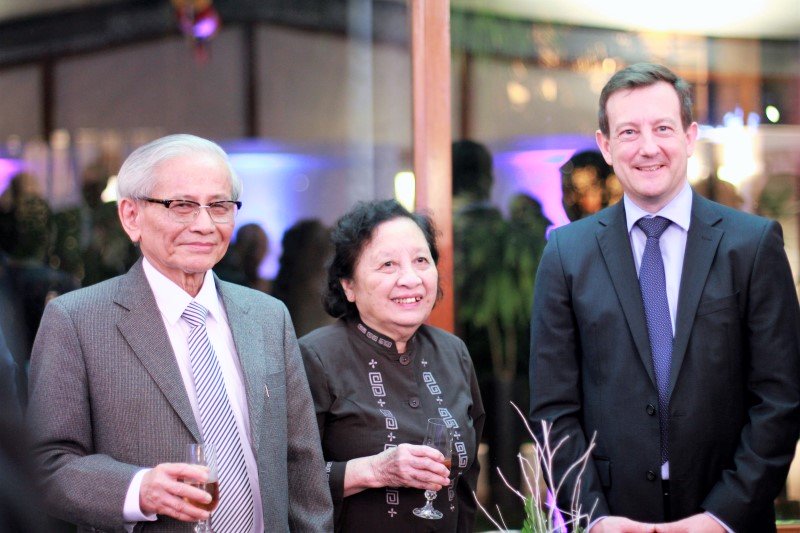
Professor Phan Huy Le and his wife pose for a photo with the French Ambassador, Bertrand Lortholary, at the medal awarding ceremony of the French Academy of Inscriptions and Fine Arts on March 20, 2017. Photo: Vietnamnet
After the reunification of the country, Professor Phan Huy Le continued to devote much of his efforts to the topic of resistance against foreign invasion. In the approximately 15 years from 1975, he wrote over 80 works of this type, bringing the total number of works on the history of resistance against foreign invasion to 120 (accounting for 26.97% of the 445 works he completed).
Along with military history, Professor Phan Huy Le also devoted much time to the topic of land ownership, farmers, and villages. From the 1980s, Professor Le began to expand his research into the field of culture and traditions. His notable works include:Tradition and Revolution, "Traditional values and the Vietnamese people today(3 episodes)Vietnamese patriotism, tradition and modernityand a system of articles about the cultural heritage of Thang Long - Hanoi...
Professor Nguyen Quang Ngoc believes that the greatest responsibility placed upon Professor Phan Huy Le was to summarize the history of the country. As early as 1959, he had already compiled a collection of lectures.History of Vietnam from 1406 to 1858For two consecutive years afterward, he released "History of the Vietnamese Feudal SystemVolume II (1960) and "History of the Vietnamese Feudal SystemVolume III (1961) contributed to the stature of the Department of History. In 1971, he and the late Professor Tran Quoc Vuong wrote "History of VietnamVolume I is considered the first comprehensive history of the new regime. During this period, a series of lectures and other textbooks on "History of VietnamThese were created (in 1966, 1970, 1978...) as the basis for the emergence of "History of VietnamVolume I (1983) - a book summarizing the history of Vietnam from the prehistoric period to the 10th century in a relatively complete and up-to-date manner.
Particularly recently, in the state-level independent scientific project to develop a set of books...History of VietnamIn four volumes, Professor Phan Huy Le served as both editor-in-chief and the main author of volumes I and II, which are considered the highest-level summary of the historical period from its origins to the mid-19th century.
From 1988 to the present, Professor Phan Huy Le has continuously served as the Chairman of the Vietnam Historical Science Association. He has also held key leadership positions or served as a member of many National Councils such as the National Council for the Compilation of the Encyclopedia, the National Council for Science and Technology Policy, the Central Theoretical Council, the Council for Science and Training of Hanoi National University, the State Council for Professor Titles, the National Council for the Ho Chi Minh Prize and State Prizes, the National Council for Cultural Heritage... In every position he has held, he has made outstanding contributions.
He was awarded the title of Professor (1980), Distinguished Teacher (1988), and People's Teacher (1994); he was awarded the Second Class Resistance Medal (1985), the First Class Labor Medal (1998), the Second Class Labor Medal (1994), and the Third Class Labor Medal (1974); he was awarded the State Prize (2000), the Fukuoka Asian Culture International Prize, Japan (1996), and the Order of Academic Palms from the French government (2002).
According to nld.com.vn
Author:Yen Anh

