
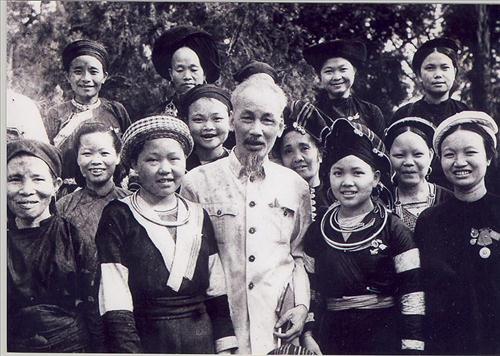
Whenever natural disasters or enemy attacks occur, the indomitable spirit that ensures the nation's survival is the strength of national unity. It's unclear when exactly, but the mindset of solidarity and mutual support among our people has been transformed into folk songs, proverbs, and idioms passed down through generations, such as:
-The gourd should have pity on the pumpkin.
Although they are different species, they share the same trellis.
-Troubles and disturbances obscure the mirror's surface.
People of the same country should love one another.
Or:
Our people remember one word: unity.
Agreement, unity of purpose, solidarity, alliance.
Or:
-Standing shoulder to shoulder; unity brings life, division brings death.
Over two thousand years ago, our legend of Saint Gióng, unlike the Greeks, was born among the people, with his mother and relatives in the village. He neither stood above nor outside the people, living among them, thus being nurtured and helped by them. He rose up with the strength of the people, defeated the Yin invaders, saved the country, triumphed, and returned to Heaven, disregarding fame, fortune, and power. How bright and pure the spirit of our people over two thousand years ago! The legend of Saint Gióng is both a poetic dream about the model of a national hero and an affirmation of the truth that only the strength of the people can give wings to a hero to reach the pinnacle of human liberation. It is truly moving that, over two thousand years ago, the consciousness of national unity, placed in close interaction with the character of a person who lives for the people and the country, has already been affirmed.
These are the lessons our people have learned over thousands of years of fighting natural disasters and foreign invaders, sharing joys and sorrows with a sense of brotherhood to nurture and preserve national culture, a strength that ensures the nation's longevity. From the depths of our nation's history of fighting foreign invaders, the strength of national unity is highly manifested when the country is in danger. That is when national pride and self-respect are recognized and expressed at the highest level by each citizen. It was so then, and it remains so today. That is the traditional strength of our nation, forged over thousands of years. That traditional strength is always preserved and always promoted on the path of nation-building and national defense.
The August Revolution was successful, marking a tremendous political transformation in the history of our country. The people's position changed qualitatively; from being oppressed and exploited, they stepped onto the political stage, mastering their own destiny and their own lives. A new value of human rights and civil rights emerged in Vietnam for the first time. National rights and human rights are increasingly affirmed and protected by the Constitution and laws. The Communist Party of Vietnam, from its role as a political organization propagating, mobilizing, and leading the revolutionary movement, transformed into a ruling party and has led the state and society for the past 70 years.
That great victory was the result of national unity under the leadership of the Party. Deeply aware of the people's role in shaping history, the Communist Party of Vietnam proactively mobilized the strength of the masses within its organization.National United Front.This was the broadest mass organization of the people, with communists as its core. They were truly exemplary, pioneering fighters, unafraid of imprisonment or shackles, and ready to sacrifice themselves for the cause of national liberation. These examples truly inspired many people to emulate them, ready to sacrifice for the greater good. They fought and sacrificed like true communists!
The exemplary struggle and sacrifice for national independence, for the freedom and happiness of the people, vividly demonstrates the Party's embodiment of the Front, simultaneously leading the masses and fighting alongside them during times of intense conflict. Through concrete actions, our Party is both the leading force of the Front and a truly exemplary and pioneering member organization within the great national unity bloc. Therefore, the Party deserves to be the leading force of Vietnamese society, and it is our Party that creates the deep, unwavering bond in the Party-People relationship.
The Party's prestige gradually permeated and deeply ingrained itself in the subconscious of the working class. The Party gained the people's trust, support, protection, and patronage, forming a tremendous force with the power of a raging flood, leading to one victory after another, culminating in reunifying the country and carrying out the reform process, achieving many historically significant and epochal accomplishments.
The revolutionary practice in Vietnam shows that the Party has integrated itself with the working masses, fighting for the people's rights and achieving national independence, thus making the Party truly the center of the great national unity. It can be said that the mission of being the center of national unity is both in the interest of the people and the country, and is also the duty and condition for the existence of the ruling Party in the process of building and developing the nation's internal strength.
It can be said that, in the midst of the struggle for national independence, our Party demonstrated an exemplary image of unwavering, blood-and-flesh ties with the people through the Fatherland Front. Therefore, the Viet Minh Front and the National Liberation Front of South Vietnam left their mark on the history of national independence. At the same time, the emergence and operation of these fronts practically met the demands of the revolution. This was the art of mass organization practiced by the Party and leader Ho Chi Minh.
National unity has always been a crucial factor for our nation. It can only be formed when the people are united in purpose, strength, and cooperation; in other words, it is the people's hearts that unite to form the nation. Our country is facing many opportunities for development as well as unpredictable challenges. When the people's hearts are united, it becomes a source of many other resources, enabling us to effectively utilize opportunities and overcome challenges to achieve development.
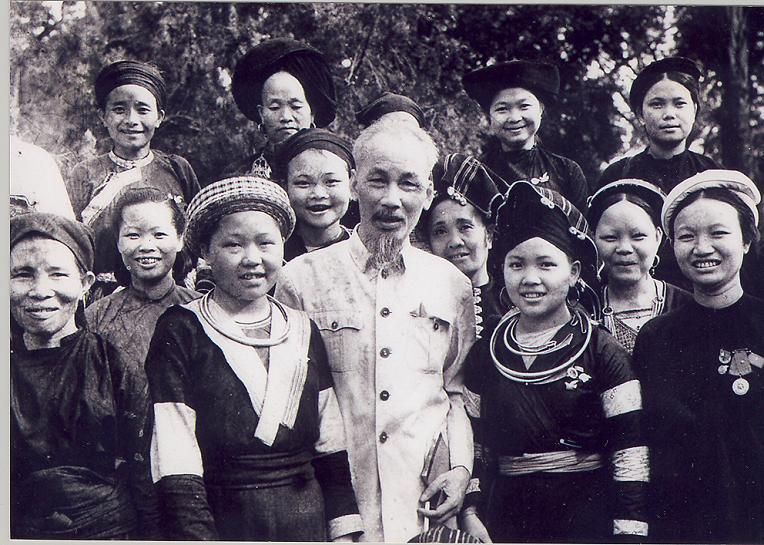
In the past, our Party was exemplary and pioneering in its close ties with the people; today, it needs to demonstrate even greater closeness to continue being the soul of national unity. During the thirty years of reform, alongside the great achievements that the Party has led the people to attain, the Party itself is also grappling with the challenge of pushing back against "a not insignificant segment" to make the Party cleaner and stronger.
The draft political report submitted to the 12th National Congress clearly states: "Socialist democracy and the strength of national unity have not been fully utilized." The draft highlights the limitations of 30 years of reform: “The four dangers raised by the 7th National Congress of the Communist Party of Vietnam (1994) still exist, some with complex developments, such as the dangers of “peaceful evolution,” “self-evolution,” and “self-transformation” within the Party. The trust of cadres, Party members, and the people in the Party and the regime has, in some aspects, decreased. In addition, the Party's policies and viewpoints on national unity and the legitimate rights and interests of all classes and strata of the people have not been promptly institutionalized, or have been institutionalized but not seriously implemented… The legal system, mechanisms, and policies to institutionalize the Party's guidelines and policies on the Fatherland Front (MTTQ) and people's organizations are still lacking and not synchronized. Furthermore, a segment of cadres, Party members, and civil servants have not truly respected, listened to, and addressed the legitimate aspirations of the people. The activities of the Fatherland Front and other organizations are inadequate.” People's organizations sometimes take a formal, bureaucratic approach, failing to stay close to the grassroots.Draft.
When meeting with constituents after the recent National Assembly session, the President exclaimed: "It's sad, shameful, and humiliating. Why is it that our country, heroic in its resistance against foreign invaders for thousands of years, has such a blatant and unacceptable problem of corruption?"according to Tuoi TreIn the writer's humble opinion, this "scandalous corruption" is not something far-fetched, but lives right within the regime, within the party system, involving leaders and managers in various positions. Every day they greet each other as comrades, but friend and foe are mixed together, with enemies in a state of "Form and emptiness, nothingness"The fight to clean up the system is difficult, that's for sure! But it's not impossible to overcome, if the entire Party is determined."
These observations show that the aforementioned limitations have/are potentially having many negative consequences for building national unity, especially limitations in..."The trust of cadres, Party members, and the people in the Party and the regime has, in some aspects, declined."The causes of the limitations mentioned in the draft need to be identified more urgently in order to promptly address them, creating favorable conditions to strengthen trust and provide impetus for the practice of national unity. The issue of unity within the Party is being raised today as the core of national unity.
Before his departure, President Ho Chi Minh instructed:It must be preserved.Our Party is truly They must be clean and upright, worthy of being leaders and truly loyal servants of the people." and …From the Central Committee to the grassroots branches, we must safeguard the Party's unity as carefully as we protect the pupil of our eye. Within the Party, practicing broad, frequent, and serious self-criticism and criticism is the best way to strengthen and develop the Party's unity and solidarity. There must be mutual affection and camaraderie among comrades."(Testament).
From the practical experience of revolutionary struggle, the Party organization must always be the nucleus that unites the Party, both within and outside the Party, and the entire nation. To achieve unity, solidarity, and great unity, there must first be genuine unity within the Party. To achieve genuine unity, democracy must be practiced regularly—democracy for self-criticism and criticism in the spirit of building and protecting the Party. Self-criticism and criticism by each Party member and each Party committee is always a weapon for building a clean and strong Party, and a means of consolidating unity within the Party. Only in a truly democratic environment for self-criticism and criticism, based on camaraderie and with the aim of purifying the Party, can there be genuine unity. Unity within the Party is an example that spreads throughout society, and has the power to unite the people to achieve success, success, and great success. It can be said that if the Party is not clean and strong, the people will lose faith, will not support or follow it, and then the ruling Party will find it difficult to unite the people and harness the strength of national unity. That is the theory; action is what truly transforms reality. Here, the role and responsibility of the leaders will be decisive and guiding.
Today, amidst unpredictable changes in the political landscape, when the need to protect national sovereignty and territorial integrity is intertwined with maintaining a peaceful and stable environment for development, and when there is a demand to strengthen national internal capabilities to build and defend the Fatherland in all circumstances, the factors of enhancing democracy, unity, and consensus within the Party – the core of national unity – become more important and urgent than ever before.
Furthermore, the reform process has also created numerous obstacles to national development and has resulted in a weakening of the Party-People relationship, reducing trust among Party members and the people. The Party has identified and is gradually addressing and combating corruption and waste, especially the degeneration and corruption of "a significant portion." This portion both diminishes the Party's leadership capacity and fighting strength, and undermines the Party's prestige among the people. If this "significant portion" is not urgently eradicated, how can our Party maintain its qualities as a leader and a truly loyal servant of the people? Where will the "morality and civilization" that President Ho Chi Minh once proudly boasted about be? In that case, the Party will not be able to set an example and lead society.
Building a clean and strong Party is, therefore, first and foremost, the Party's own duty, and also the responsibility of all working people towards the ruling Party. A thought-provoking reality is that 70 years ago, with only 5,000 Party members supported by the people, the August Revolution was achieved, yet today, with over 3 million members, the fight against corruption and degeneration is so difficult. Regardless, the Party needs to resolutely rectify its ranks more than ever, because only a clean Party can lead to a strong and stable government, and a clean and strong state. A clean and strong Party and State are achieved when the Party reaches the level of intellect, heart, and vision of a core force promoting and developing the strength of national unity. We hope and believe that the 12th National Congress of the Party will have guidelines, policies, and a team commensurate with the task of creating a core force for national unity, aiming for a prosperous people, a strong nation, democracy, fairness, and civilization. The delegates to the congress demonstrated a high sense of responsibility to the people and the Party, possessing wisdom, courage, and cultural discernment in selecting individuals with integrity, vision, and talent. They resolutely refused to allow individuals lacking credibility at the grassroots level to infiltrate the new Executive Committee, regardless of their background. The purity, strength, and genuine unity of the Party are the source that unites the people, and the strength of national unity is formed by the combined will of the people.
Article published in the Spring Newspaper: FILES AND EVENTS OF TCCS
Author:Assoc. Prof. Dr. Pham Xuan Hang
Newer news
Older news

