In addition to young researchers from the University of Social Sciences and Humanities, the seminar included the participation of experts such as Assoc. Prof. Dr. Nguyen Kim Son (Vietnam National University, Hanoi), Prof. Dr. Do Quang Hung (University of Social Sciences and Humanities).Prof. Dr. Hoa Huu Lan (Hanoi Institute for Socio-Economic Development Research), …
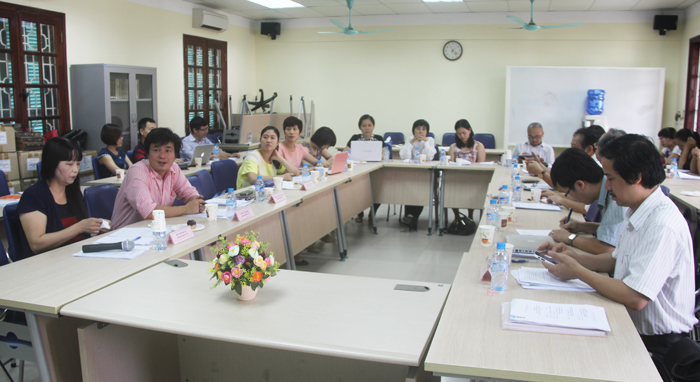
Overview of the seminar
The seminar heard and discussed three main presentations.
PresentationThe tolerant worldview in the thought of the monk Shinran (1173-1262)"By Dr. Pham Thi Thu Giang (Department of Japanese Studies). Shinran was a monk who lived during the Kamakura period, known as the founder of Jodo Shinshu, one of the largest Buddhist sects in Japan and unique to Japan. The overarching philosophy throughout Shinran's 90 years of religious activity, and the strongest appeal of Jodo Shinshu, was his broad and open worldview. Shinran always aspired to build a form of Buddhism for "ordinary people" and "evil people," seeking a path to liberation suitable for them. Through concepts such as Karma, Buddha-nature, Desire, and the theory of the Right Cause of Evil, Shinran expressed his skepticism towards traditional Buddhism and his boundless compassion for the suffering of ordinary people, who were not considered by contemporary Buddhists as objects of liberation."
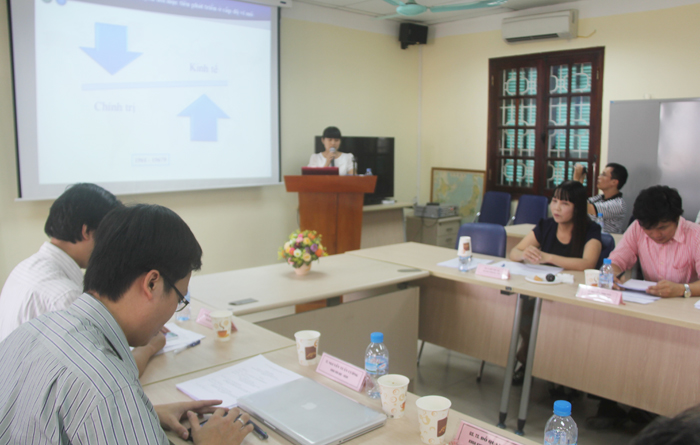
Ms. Nguyen Thi Thu Huong (Department of Korean Studies) presented a paper on the harmony in South Korea's economic development strategy during the period 1961-1970.
PresentationConfucianism and Democratic Thought (Treatise on Tran Trong Kim's Confucian "democratic" thought within Confucianism)This paper, presented by Dr. Nguyen Tho Duc (Head of the Department of Chinese Studies), outlines the basic content and viewpoints of Tran Trong Kim on Confucian "democracy" within Confucianism. Based on this, it assesses the strengths and weaknesses of Tran Trong Kim's perspective on Confucian "democracy." Furthermore, the paper initially places Confucianism within the context of the overall development of Confucianism in the region at the beginning of the 20th century, preliminarily exploring the similarities and differences in the content and methods of modernizing Confucian thought regarding "democracy" between Tran Trong Kim and modern Chinese Neo-Confucianism.
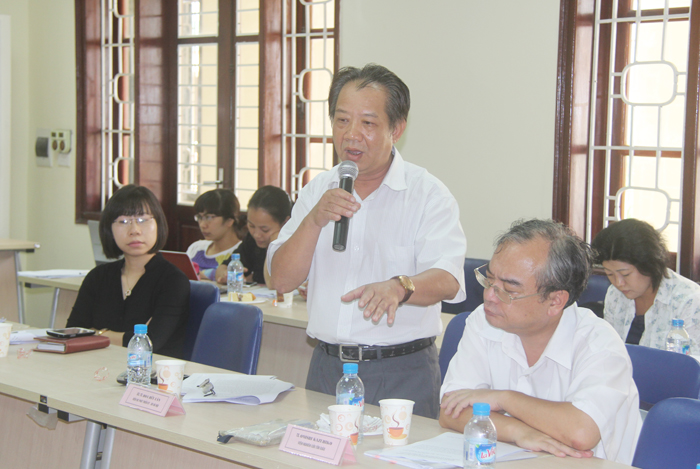
Prof. Dr. Hoa Huu Lan (Hanoi Institute for Socio-Economic Development Research)Comments on the report by Ms. Nguyen Thi Thu Huong, M.Sc.
The final presentation of the seminar was:The harmonious nature of South Korea's economic development strategy during the period 1961-1970 emphasized both capital and human resources.This research paper, by Ms. Nguyen Thi Thu Huong (Department of Korean Studies), surveys the direction of capital and human resource utilization proposed in the economic development policy planning process of South Korea from 1961-1979 (during the period when the late President Park Chung-hee came to power). Based on this, the paper points out the harmonious combination of domestic and foreign capital, and the integration of Western educational methods with traditional Korean moral foundations such as Confucianism and discipline. Commenting on this scientific report, Assoc. Prof. Dr. Nguyen Duy Dung (Vietnam Academy of Social Sciences) stated that the research correctly identified the key issue that contributed to the miraculous "Legend of the Han River" of South Korea in the 1960s and 70s, when South Korea transformed from a poor and backward country into an Asian dragon. This is the rational utilization of capital and human resources. The success of the paper not only helps to identify... This study examines each aspect of South Korea's economic development strategy, providing a well-founded explanation both theoretically and practically, thereby highlighting valuable lessons for Vietnam's development.
The series of seminars "New Research on Japan and Asia," sponsored by the Toshiba Foundation, aims to promote research and academic exchange among young researchers, while also fostering the sharing of new scientific research findings on Japan in particular and Asia in general. The third seminar in this series is scheduled to be held in November 2014.
Author:Thanh Ha
Newer news
Older news

