
On December 9, 2013, the 20th anniversary celebration of Vietnam National University, Hanoi was solemnly held at the Nguyen Van Dao Hall. Comrade Nguyen Phu Trong – General Secretary of the Central Committee of the Communist Party of Vietnam – attended and gave important directives regarding Vietnam National University, Hanoi.
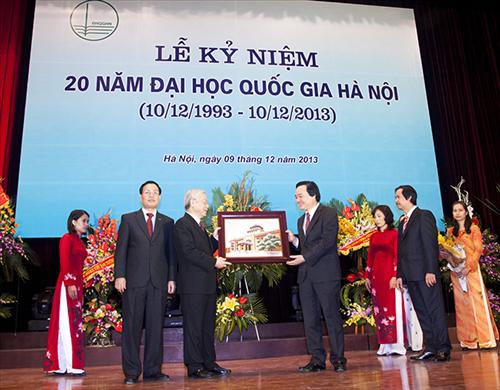

On the part of Vietnam National University, Hanoi, there was Comrade Phung Xuan Nha – Alternate Member of the Central Committee of the Party, Secretary of the Party Committee, Director of Vietnam National University, Hanoi, along with generations of leaders, scientists, teachers, administrators, and students, postgraduate students, and doctoral candidates of Vietnam National University, Hanoi.
In his welcoming speech, Director Phung Xuan Nha expressed his deep gratitude to the leaders of the Party, State, Government, National Assembly, Central Ministries, Departments, and Agencies, Hanoi, localities, domestic and foreign partners; to the late Professor Nguyen Van Dao – the first Director of Vietnam National University, Hanoi; former Directors: Professor Dao Trong Thi, Professor Mai Trong Nhuan, and generations of leaders, staff, and students of Vietnam National University, Hanoi for their immense contributions that laid the foundation for the construction and development of Vietnam National University, Hanoi over the past 20 years. The speech also reviewed important historical milestones, looked back at the difficulties and challenges overcome, and acknowledged the proud achievements… to reflect and draw profound lessons, thereby proposing a new direction for the future development of Vietnam National University, Hanoi.
Established at a historic moment – the early 1990s – Vietnam National University, Hanoi (VNU) was founded with the aspiration of becoming an advanced, multidisciplinary, high-quality university model, creating breakthroughs and innovations for the Vietnamese education system. Thanks to inheriting the outstanding academic traditions of the University of Indochina and the University of Hanoi, along with extraordinary efforts, perseverance, continuous innovation, and a desire to conquer new heights and strive towards international standards, VNU has overcome the difficulties of its circumstances and internal challenges to gradually realize its goals, establishing itself as a leading high-quality university in the country and gaining increasing prestige in the region and internationally.
From a macro-management perspective, the most striking achievement is the successful implementation of a modern, two-tiered university model, unprecedented in Vietnam. Accordingly, VNU simultaneously performs three functions: macro-management; coordination and linkage of units; and direct leadership in the implementation of major, interdisciplinary, and far-reaching tasks. VNU's units are organized and operate under an open and interconnected mechanism, utilizing the common resources of the entire VNU and leveraging the specialized strengths of each unit. Currently, VNU has 28 affiliated units, with training and research fields spanning from natural sciences and technology to social sciences and humanities, economics, law, education, foreign languages, and medicine.
To fulfill its mission of becoming a high-quality and advanced training and research center, Vietnam National University, Hanoi (VNU) has focused on investing in development towards a research university orientation. VNU's faculty and scientists are among the strongest in the country, with 45% of staff holding PhDs and Doctor of Science degrees, and 18.5% holding professorships and associate professorships. The ratio of postgraduate to undergraduate training is currently approximately 1/2. The proportion of high-quality, talented, and internationally standardized training has reached nearly 20%. Quality accreditation, especially accreditation according to the standards of ASEAN and international university associations, has been implemented.
Scientific research activities have also continuously developed in both quantity and quality, especially in technology development research, which has made remarkable progress. To date, Vietnam National University, Hanoi (VNU) has hundreds of scientific and technological products that have been implemented in practice. The number of international publications in the ISI system from VNU has increased by approximately 20 times, accounting for about 12% of the total number of ISI publications nationwide. VNU has won 19 Ho Chi Minh Prizes, 18 State Prizes, and dozens of prestigious international scientific awards. In 2012, VNU was ranked in the top 250 (i.e., within the top 5%) of leading universities in Asia by international university rankings.
Also in 2012, the Vietnamese Law on Higher Education was passed, recognizing the multidisciplinary, multi-field university model with the criteria and characteristics that Vietnam National University, Hanoi (VNU) has persistently strived to build. This is an affirmation and high appreciation from the Party, State, Government, and society for the model and quality of training and scientific research of VNU, thereby contributing to affirming the essence of modern Vietnamese higher education – which is to promote the autonomy and self-responsibility of higher education institutions.
Director Phung Xuan Nha affirmed that over the past 20 years, Vietnam National University, Hanoi (VNU) has learned and inherited many valuable lessons, the most important of which are the spirit of solidarity; the determination and steadfastness in pursuing development goals towards international integration; and the pioneering spirit of readily accepting difficulties and challenges. In addition, VNU has always affirmed its high sense of responsibility to society, always prioritizing human resources, and being flexible with bold and groundbreaking innovative policies that are appropriate to the practical circumstances.
The Director of VNU also emphasized that in the coming period, VNU's strategic goal is to be among the top 200 universities in Asia by 2015, and to rise to the top 100 advanced universities in Asia by 2020.
Speaking at the commemorative ceremony, General Secretary Nguyen Phu Trong extended warm congratulations to the staff, students, and trainees of Vietnam National University, Hanoi, and expressed the joy of a former student of Vietnam National University, Hanoi, returning to visit his alma mater.
The General Secretary assessed: “Vietnam National University, Hanoi (VNU) is a major interdisciplinary and multidisciplinary research and training center in our country, holding a particularly important position in the national education system.” Over the past 20 years, VNU has continuously strived to gradually establish its leading and core role in the Vietnamese education system and has achieved an increasingly high position in the region and internationally, deserving of the Gold Star Medal and many other prestigious awards bestowed by the Party and State. To date, its organizational structure and staff, with numerous faculties, research institutes, and affiliated units, have been adjusted, reorganized, consolidated, and developed into an organic entity of reasonable scale and effective operation.
The General Secretary also noted the limitations and difficulties that Vietnam National University, Hanoi is facing: the number of leading scientists is not large enough, the quality of staff needs to be improved to meet the requirements of an advanced university, scientific and technological activities among different groups of disciplines and units are not uniform; infrastructure and information and communication systems have not been invested in adequately…
The General Secretary assigned the task: Vietnam National University, Hanoi (VNU) must strive to be the core of the higher education system and research and development in science and technology, leading the way in effectively implementing Resolution No. 8 of the 11th Central Committee on fundamental and comprehensive reform of education and training and Resolution No. 6 of the 11th Central Committee on the development of science and technology. VNU must successfully fulfill its pioneering role in reaching advanced standards and levels of knowledge and technology in the region and the world.
In its upcoming development phase, Vietnam National University, Hanoi (VNU) needs to focus on the following tasks: continuing to refine its organizational model towards modernization, aligning with international standards and Vietnam's conditions; prioritizing the development of students' qualities, vision, capabilities, skills, and employability; developing high-quality training programs and specializations, aiming to develop member faculties, universities, and VNU to meet international standards; regarding research, it is necessary to fully recognize and leverage VNU's role as a cradle of basic scientific research, a place that produces the "mother engine," trains, and provides a source of basic science personnel for the entire national education, training, and science and technology system, which has its own unique characteristics and requires specific, appropriate mechanisms and policies.
Regarding social sciences and humanities, General Secretary Nguyen Phu Trong suggested that Vietnam National University, Hanoi (VNU) should soon research and propose to the Central Party Committee and the Government specific solutions, mechanisms, and policies to improve the quality of training and research in social sciences and humanities within the national university system. Building on the foundation of basic science and social sciences and humanities, VNU should focus on developing interdisciplinary sciences and cutting-edge technologies that directly contribute to effectively addressing the practical issues facing the country's development.
To accomplish these tasks, according to the General Secretary, Vietnam National University, Hanoi needs to pay special attention to building a democratic working environment, promoting innovation, creativity, and academic freedom; and to investing in and developing a team of cadres, civil servants, and staff with sufficient moral qualities and professional competence to meet the requirements of developing into a research university, with a focus on developing leading and pioneering cadres.
General Secretary Nguyen Phu Trong also expressed his belief in the future development of Vietnam National University, Hanoi: "I hope and believe that Vietnam National University, Hanoi will truly become a beautiful symbol of the spirit, intellect, and cultural essence of Vietnam."
Also at the ceremony, Director Phung Xuan Nha presented the Commemorative Medal for the Development of Vietnam National University, Hanoi to General Secretary Nguyen Phu Trong.
Author:Thanh Ha
Newer news
Older news

