
Tourism has been identified as a key economic sector in Vietnam, experiencing rapid growth year after year and making a significant contribution to the country's GDP.In 2013, Vietnam welcomed 7.57 million international tourists – reaching its target two years ahead of schedule.The number of domestic tourists also reached a record high of 35 million. Total revenue for the entire industry reached 200 trillion VND. This is considered an impressive growth in the history of Vietnam's tourism industry.
According to data from the Vietnam National Tourism Administration, Vietnam currently has approximately 1.5 million workers in the tourism industry. Forecasts indicate that the industry will need an additional 40,000 workers annually, with 12% requiring a college or university degree or higher. Currently, over 30 universities in Vietnam offer bachelor's degrees in tourism and related fields. The number of graduates each year is around 4,000-5,000, only meeting 60% of the current demand for tourism human resources. After graduating, the need for further education and skill development among these graduates is significant.
Furthermore, many universities are seeking lecturers with master's degrees in Tourism. Many state management agencies, such as the Vietnam National Administration of Tourism and provincial Departments of Culture, Sports and Tourism, need to upgrade the qualifications of their staff to better fulfill their responsibilities in state management of tourism. Many government agencies and organizations require highly qualified personnel in tourism; many businesses, hotels, and travel agencies need to improve the skills of their management staff. However, to date, no institution offers a master's degree program in Tourism. Only a few large universities, such as the National Economics University and the University of Commerce, offer majors related to tourism, such as Tourism Economics and Tourism Business Administration, with a limited number of students, approximately 5-10 per year.
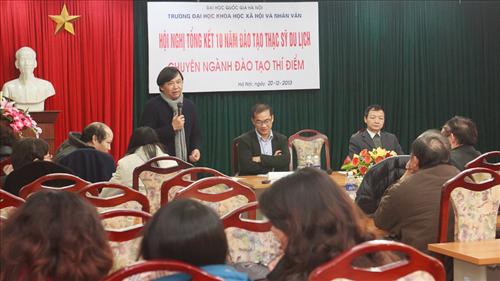
In 2003, the Faculty of Tourism Studies, University of Social Sciences and Humanities, was assigned by Vietnam National University, Hanoi to develop a pilot master's program in Tourism, with the goal of providing high-level human resources in tourism for the entire country's tourism industry. To date, the Faculty of Tourism Studies has been training master's students in tourism for 10 years, having completed 14 cohorts (10 in Hanoi, 3 in Ho Chi Minh City, and 1 in Hue).
The Faculty of Tourism Studies is a long-standing and reputable training unit in Vietnam specializing in tourism. The Faculty's tourism education focuses on both a broad and solid foundation in economics, culture, society, history, etc., while also delving into specialized areas of tourism science. This is a significant advantage in the Faculty's training, as currently, postgraduate training in tourism-related fields at universities mostly leans towards Business Administration, Economic Management, Tourism Geography, Economic Geography, Vietnamese Studies, etc. The number of courses in tourism-related specialization in these programs is relatively small.
The Faculty also boasts a strong team of highly qualified and experienced teachers with extensive research and teaching experience in Tourism Studies both domestically and internationally. The Faculty has trained nearly 2000 undergraduate and postgraduate students for the Vietnamese tourism industry, published over 20 monographs and university textbooks, and over 100 scientific articles in specialized journals. The Faculty maintains close collaborative relationships with numerous universities and tourism research institutes in various countries, including the University of Toulouse (France), Dusit Thanis (Thailand), Rikkyo University (Japan), Munich University of Applied Sciences (Germany), and the University of Missouri (USA). Each year, the Faculty regularly welcomes lecturers and volunteers from the USA, France, and Canada to teach and work.
According to statistics, the Faculty of Tourism Studies has trained 466 students, including 185 who have been awarded Master's degrees in Tourism and 37 students awaiting their degrees. Graduates from the Faculty have a wide range of employment opportunities: teaching at universities and colleges, working in research institutions, government agencies, businesses, and many other economic and social sectors. This demonstrates that the Faculty's postgraduate human resources are effectively meeting the job and societal needs of Vietnam's tourism industry in all aspects.
Dr. Pham Hong Long (Deputy Head of the Faculty of Tourism Studies) stated:Our biggest current problem is the training program code. Although the Faculty of Tourism Studies has demonstrated the quality of its Bachelor's and Master's degrees in Tourism, meeting the practical needs of society, this field of study is still not included in the official training program code list of the Ministry of Education and Training. While tourism is considered a special profession in modern society and tourism training (tourism studies, tourism and hotel business management, tourism culture, etc.) is being implemented at many colleges and universities nationwide, to date, from a state management perspective, there is still no unified view on this program code..
Dr. Long also shared the view that many universities have been forced to make tourism a specialization within Vietnamese Studies, or Economics, Business Administration, Geography, Environment, and Culture. On January 27, 2005, the Prime Minister signed Decision No. 25/2005/QD-TTg.Regarding the regulations on the list of education and training programs within the national education system.According to this decision, in the fields of education and training, tourism, hospitality, sports, and personal services (with a separate code, 81) are included across all 10 levels of education and training, from short-term vocational training (Code 2281) to doctoral degrees (Code 6281). Within this code, the third-level industry code is 81.02, which is Hospitality. This could be interpreted as code 81.01 being the Tourism industry code. However, according to the latest document...Category of Education and Training Level IV: Master's and Doctoral DegreesThe regulations issued with Circular No. 04/2012/TT-BGDĐT dated February 15, 2012, by the Minister of Education and Training do not yet include codes for master's and doctoral programs in Tourism.
Agreeing with the above viewpoint, Associate Professor Dr. Tran Thi Minh Hoa (Vice Rector of the University of Social Sciences and Humanities, former Head of the Faculty of Tourism Studies) stated: InCategory of Education and Training Level IV: Master's and Doctoral DegreesIssued together with Circular No. 04/2012/TT-BGDĐT dated February 15, 2012, by the Minister of Education and Training, the code 6090 is assigned to other Master's degree training programs. For Social Work, since it cannot be categorized under any existing code, the Ministry assigns the code 60900101. Similarly, Occupational Safety and Health is assigned the code 60900103. Tourism Studies is inappropriately categorized under Business Management or Vietnamese Studies; therefore, it could be suggested that it be placed under a different group, such as 60900104 or 60900102.
Furthermore, despite having a 10-year history of training, the Master's degrees in Tourism currently awarded to students still bear the label "pilot program," causing considerable concern among learners. The delay in establishing an official industry code for Tourism significantly impacts the training process and the rights of students, especially in the context of the Faculty of Tourism Studies, University of Social Sciences and Humanities, which is currently promoting a doctoral program in Tourism Studies to better meet the societal demand for highly qualified human resources in the tourism industry.
Author:Thanh Ha
Newer news
Older news

