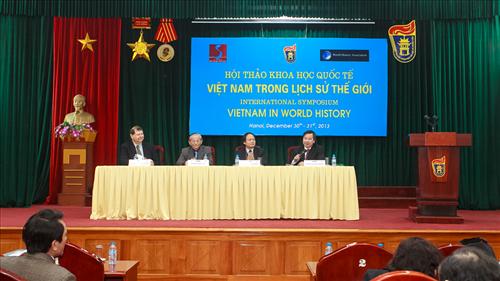
In his opening remarks at the conference, Professor Nguyen Van Khanh (Rector of the University of Social Sciences and Humanities) spoke about the important role of historical science in promoting awareness and development in Vietnam in the past and present. A significant achievement of historical science over the past 50 years has been the positioning and role of Vietnam in the region and the world, contributing to Vietnam's dynamic integration into the international exchange network. Thanks to this integration, Vietnam has strong exchanges and transfers with the outside world in terms of economics, culture, religion, ideology, technology, etc. In fact, Vietnam has had early connections with other countries due to its important location on regional and international trade routes. Since 1986, thanks to strong reforms and innovations, Vietnam has continued to be a center of attention for the global community.

Professor Nguyen Van Khanh delivered a speech at the opening session.
The Rector highly appreciated the significance of the conference, emphasizing the interdisciplinary and multidisciplinary nature of the research on Vietnam presented at this conference. This is an opportunity for many generations of Vietnamese and international historians to discuss and share their understanding of Vietnam from various perspectives and approaches, in comparison and relation to world history.
Representing the World Historical Society, Professor Marc Jason Gilbert spoke about the appeal and challenges of studying the current process of innovation and reform in Vietnam from a global perspective. He also suggested that closer collaboration and exchange are needed between Vietnamese and international scientists to share knowledge and foster deeper understanding in science and practice.

Professor Marc Jason Gilbert
The seminar also heard insightful remarks from Professor Phan Huy Le (Chairman of the Vietnam Historical Science Association) on the main theme of this year's seminar. His speech focused on the argument that Vietnamese history, as a nation, is always an integral part of world history. Studying and understanding Vietnam without considering its regional and global context will lead to subjective and biased assessments. Therefore, to contribute to a deeper and more comprehensive understanding of Vietnam in relation to the world, the sharing of research findings between domestic and international historians is essential.
Following the opening session, delegates participated in eight discussion sessions.
Session 1: The Chinese in Vietnam; The rise and fall of the Cham world; Mobilizing resources to support the war effort for the Second Indochina War (1954-1975).
Session 2: Trade, maritime and political issues in the “Mediterranean Asia” region; The Cham world – changing over time; Education policy as a foundation and bridge between cultures.
Session 3: The post-war world shaped the First and Second Indochina Wars; Development issues – from villages to nations; Land reform as an aspect of Vietnamese history.
Session 4: Intercultural exchange and national integration in a globalized world; Fundamental issues in Vietnam's wartime history (1954-1975); Near and far – positive impacts on Vietnam's neighborly relations.
Session 5: Maritime trade and politics in the “Mediterranean-Asian” region; From war to peace – dimensions of international conflict; Colonialism – gender and identity.
Session 6: Formal and Informal Diplomacy and World Wars; Cultural Transformation in Vietnamese History; Global Legacy of the Indochina War – Political and Cultural Issues.
Session 7: Modern Issues; Colonialism and Liberation Movements in Southeast Asia from a Comparative Approach; The Formation of the Vietnamese State from a World History Perspective.
Session 8: Vietnam in the dimensions of space and time; Vietnam in recent world history; Teaching history at the university level.