
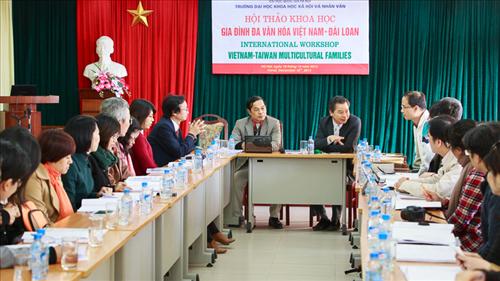
The workshop "Vietnamese-Taiwanese Multicultural Families," organized by the University of Social Sciences and Humanities, was held on December 18, 2013, with the participation of many Vietnamese and Taiwanese scientists.

According to statistics, the number of marriages between Taiwanese men and Vietnamese women is increasing in both Taiwan and Vietnam. In Soc Trang province, from 2005-2010, 825 out of 2115 cases involved marriages with Taiwanese men, accounting for 39%. Statistics from the Departments of Justice in several provinces of the Mekong Delta show that among women marrying foreign men, those marrying Taiwanese men account for 79%.
When leaving their home country for another, these couples face cultural and lifestyle differences, environmental, economic, educational, linguistic, and cognitive and emotional shifts, making it difficult for them to adapt to their new circumstances. Many challenges arise in intercultural marriages, such as: prejudice and discrimination against immigrants; cultural assimilation across generations within families and communities; the relationship between in-laws and extended families; communication and relationship quality within marriage; and raising children. The mental health needs and coping mechanisms of intercultural couples are identified from a multicultural perspective. Based on this, proposals for social care and psychological services for these families are discussed.
Specifically, many concrete issues were raised in the discussions: What difficulties do Vietnamese women in Taiwan face in raising their children due to language and educational limitations? How do economic difficulties, language barriers, cultural differences, and lifestyles lead to psychological and emotional differences that affect Vietnamese-Taiwanese families? Are there conflicts and competition for jobs between Vietnamese wives and Taiwanese workers? How have Vietnamese women married to Taiwanese men overcome the pressures and difficulties in their lives? What is the effectiveness of the policies that the Taiwanese government provides to assist foreign brides? Are there differences in the difficulties and challenges faced by Vietnamese women married to Taiwanese men living in rural areas compared to urban areas? What difficulties do children of Vietnamese-Taiwanese couples face in their lives?…
The workshop "Vietnamese-Taiwanese Multicultural Families," organized by the University of Social Sciences and Humanities on December 18, 2013, was attended by many Vietnamese and Taiwanese scientists.
The reports presented at the workshop reflected the reality of marriages between Vietnamese women and Taiwanese men over the past years and delved into analyzing the challenges and difficulties faced by intercultural families, especially Vietnamese wives living in Taiwan, thereby highlighting the cultural and social consequences for the local community.
According to statistics, the number of marriages between Taiwanese men and Vietnamese women is increasing in both Taiwan and Vietnam. In Soc Trang province, from 2005-2010, 825 out of 2115 cases involved marriages with Taiwanese men, accounting for 39%. Statistics from the Departments of Justice in several provinces of the Mekong Delta show that among women marrying foreign men, those marrying Taiwanese men account for 79%.
When leaving their home country for another, these couples face cultural and lifestyle differences, environmental, economic, educational, linguistic, and cognitive and emotional shifts, making it difficult for them to adapt to their new circumstances. Many challenges arise in intercultural marriages, such as: prejudice and discrimination against immigrants; cultural assimilation across generations within families and communities; the relationship between in-laws and extended families; communication and relationship quality within marriage; and raising children. The mental health needs and coping mechanisms of intercultural couples are identified from a multicultural perspective. Based on this, proposals for social care and psychological services for these families are discussed.
Specifically, many concrete issues were raised in the discussions: What difficulties do Vietnamese women in Taiwan face in raising their children due to language and educational limitations? How do economic difficulties, language barriers, cultural differences, and lifestyles lead to psychological and emotional differences that affect Vietnamese-Taiwanese families? Are there conflicts and competition for jobs between Vietnamese wives and Taiwanese workers? How have Vietnamese women married to Taiwanese men overcome the pressures and difficulties in their lives? What is the effectiveness of the policies that the Taiwanese government provides to assist foreign brides? Are there differences in the difficulties and challenges faced by Vietnamese women married to Taiwanese men living in rural areas compared to urban areas? What difficulties do children of Vietnamese-Taiwanese couples face in their lives?…
Author:Thanh Ha
Newer news
Older news

