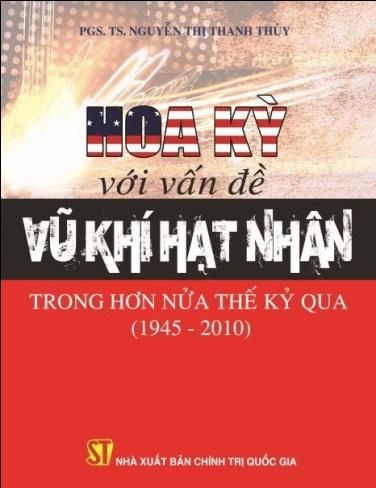
USSH introduces the book "The United States and the Nuclear Weapons Issue Over the Past Half-Century (1945-2010)" by Assoc. Prof. Dr. Nguyen Thi Thanh Thuy (Department of International Studies, University of Social Sciences and Humanities), National Political Publishing House - Truth, October 2012, 344 pages.
Nuclear weapons, along with nuclear disarmament, have been a major political and military issue since World War II. As the first country to successfully develop and use nuclear weapons in warfare, the United States has used them as an effective tool in its foreign policy.

Alongside the nuclear arms race, the United States was acutely aware of the importance of controlling the proliferation of nuclear weapons in order to maintain its monopoly and advantage in international affairs. However, in 1949, the Soviet Union broke the US monopoly, becoming the second country to possess this dangerous weapon. Subsequently, a number of countries such as Britain, France, China, etc., also produced nuclear weapons. In the context of the Cold War, the issue of nuclear weapons, especially the nuclear arms race between superpowers, primarily between the United States and the Soviet Union, pushed the world to the brink of destruction. The issue of disarmament became urgent, and the United States became a pioneer in the process of controlling and reducing nuclear weapons. The question arises: why did the US administration propose controlling and limiting nuclear weapons so early on? What were the main motivations of the United States in this matter? To assist scientists, military experts, and a wide readership interested in learning about nuclear weapons, the National Political Publishing House - Truth has published the book "The United States and the Issue of Nuclear Weapons Over the Past Half-Century (1945-2010)" by Associate Professor Dr. Nguyen Thi Thanh Thuy (Faculty of International Studies). The book provides basic information on the issue of nuclear weapons in particular and weapons of mass destruction in general. Based on this, the author focuses on the following issues: 1. The motives and role of the United States in the process of controlling and reducing nuclear weapons; 2. The significance of the treaties on nuclear arms control and reduction signed by the United States for world peace and security. In addition, the book also addresses the global movement against the arms race and nuclear weapons; and Vietnam's views and policies on nuclear armaments and nuclear technology.
National Political Publishing House - Truth
The book consists of four chapters with the following main contents: Chapter 1: The Foundations of Nuclear Arms Control and Reduction (1945-1962). This chapter presents the context of the emergence of nuclear weapons, the motives of the United States in dropping atomic bombs on Japan in 1945 and its consequences. Several other issues related to nuclear weapons are presented in this chapter, including the views of the American people and the American government on nuclear weapons, the initial stages of the nuclear arms race between the United States and the Soviet Union, the Cuban Missile Crisis of October 1962 and its consequences, and the initial negotiations between the United States and the Soviet Union on nuclear arms control and reduction. Chapter 2: The United States and the Issue of Nuclear Arms Control and Limitation (1963-1976). This chapter analyzes the international context, the reality of nuclear proliferation worldwide, and the balance of nuclear weapons between the United States and the Soviet Union. These are crucial foundations for the planning and implementation of foreign and nuclear policies by US administrations. During this period, the United States signed five bilateral and multilateral treaties on nuclear arms control and limitation. The author analyzes the US motivations for participating in these documents, as well as their impact on international relations and US-Soviet relations. Chapter 3: The United States and the Issue of Strategic Nuclear Arms Reduction (1977-1991). Chapter 3 presents the foreign and nuclear policies of US administrations during this period in relation to international relations, US-Soviet relations, and the global nuclear arms race. This chapter also presents the signing of three important treaties on strategic nuclear arms reduction between the United States and the Soviet Union, analyzing the significance and impact of these documents on international political life, especially in Europe. Chapter 4: The United States and the Nuclear Weapons Issue After the Cold War (1992-2010). This chapter focuses on the nuclear policies of the US administrations under Presidents Bill Clinton, George Bush, and Barack Obama in the context of the international security and political situation in the post-Cold War era. The role of the United States in the North Korean and Iranian nuclear crises, and the movement against the nuclear arms race worldwide during this period are also the main contents of Chapter 4.