
The workshop was attended by Ms. Caitlin Wiesen (United Nations Development Programme – UNDP), Mr. Peng Shiduan (Chinese Embassy in Vietnam), Assoc. Prof. Dr. Pham Van Linh (Vice Chairman of the Central Theoretical Council), Prof. Dr. Nguyen Van Kim (Party Secretary, Vice Rector of the University of Social Sciences and Humanities), and Prof. Dr. Pham Quang Minh (Rector of the University of Social Sciences and Humanities).
Along with economic growth, social development management plays a crucial role in promoting rapid and sustainable national development. Social development management is the process of implementing social policies and programs to address social issues, thereby promoting sustainable and equitable development. These issues relate to social security, welfare, basic social services, social equality, social security and harmony, income, and poverty reduction. If social issues are not effectively addressed, the country's development process will face many risks and be slowed down.

The political report of the Central Committee of the 11th Party Congress at the 12th National Congress of the Party acknowledged the achievements in Vietnam's social development management over the past 30 years, such as: implementing effective poverty reduction policies; improving the quality of human resources; paying attention to policies for people with meritorious services; and continuously improving the living standards and income of the people. However, the report also pointed out limitations and shortcomings such as: unsustainable poverty reduction; increasing wealth inequality and disparity; and the lack of timely policies and solutions to address wealth inequality and social stratification.
The workshop "Managing Social Development in the Context of a Market Economy, International Integration, and the Current Fourth Industrial Revolution" was organized to analyze and evaluate the current state, strengths, and weaknesses of Vietnam's social development management activities. Through this, lessons and experiences were drawn, and solutions and recommendations were proposed to improve and enhance this work in the new context and situation.
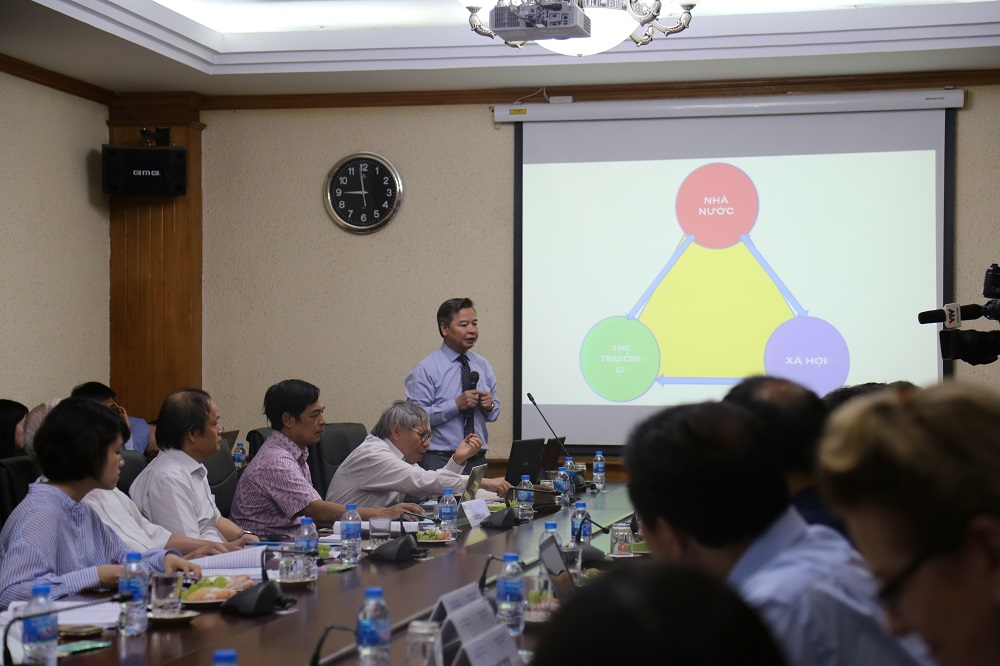
Professor Pham Quang Minh presented the introductory report.
At the workshop, Professor Pham Quang Minh presented the keynote report "Towards a Sustainable Social Development Management Model in Vietnam." The report highlighted key social issues in Vietnam today, such as the widening gap between rich and poor due to insufficient and untimely resources; shortcomings in vocational training and job creation; and a lack of coordination mechanisms in insurance. According to the report, the main cause of these social problems is the lack of equal participation and contribution from non-state actors in regulating and managing these issues. Therefore, the report proposed a shift from a social development management model to a social development governance model, where equal participation, cooperation, and shared responsibility are ensured among the three main parties: the government, the market, and society. The report concluded with a recommendation to reform Vietnam's political institutions, aiming to enhance accountability, transparency, and consistency in the application of laws.
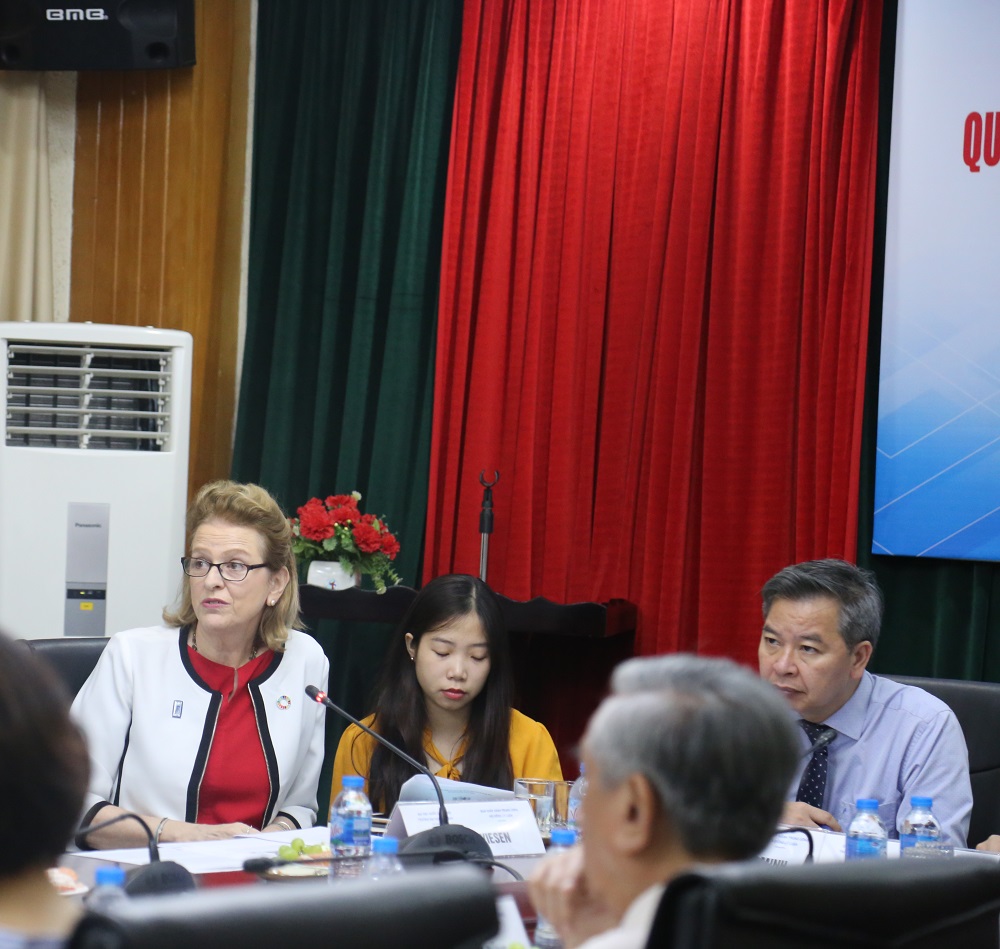
Ms. Caitlin Wiesen presented the report "PAPI: Trends in Meeting Consumer Expectations Over the Past 10 Years and Implications for the Future".
Following the introductory report, the workshop continued with seven presentations: “Innovation in development management for social welfare and human security” (Prof. Dr. Pham Tat Dong – Vietnam Association for the Promotion of Learning); “PAPI: Trends in meeting people's expectations over the past 10 years and implications for the future” (Ms. Caitlin Wiesen – United Nations Development Programme – UNDP); “Managing social development and human security in the context of market economy development, building a rule of law state and international integration” (Assoc. Prof. Dr. Nguyen Tuan Anh – University of Social Sciences and Humanities); “Understanding development and governance in Chinese society” (Mr. Peng Shiduan – Chinese Embassy in Vietnam); “The role of the social community in managing social development – lessons from tradition” (Prof. Dr. Dang Canh Khanh – Institute for Traditional and Development Studies); “Social Development and Management: Experiences of Some Southeast Asian Countries and Lessons for Vietnam” (Assoc. Prof. Dr. Nguyen Duy Dung – Institute of Southeast Asian Studies); “The Impact of Climate Change and Current Social Development Management Strategies in Vietnam” (Prof. Dr. Nguyen Huu Khien – National Academy of Public Administration).
Author:Tran Minh
Newer news
Older news

