
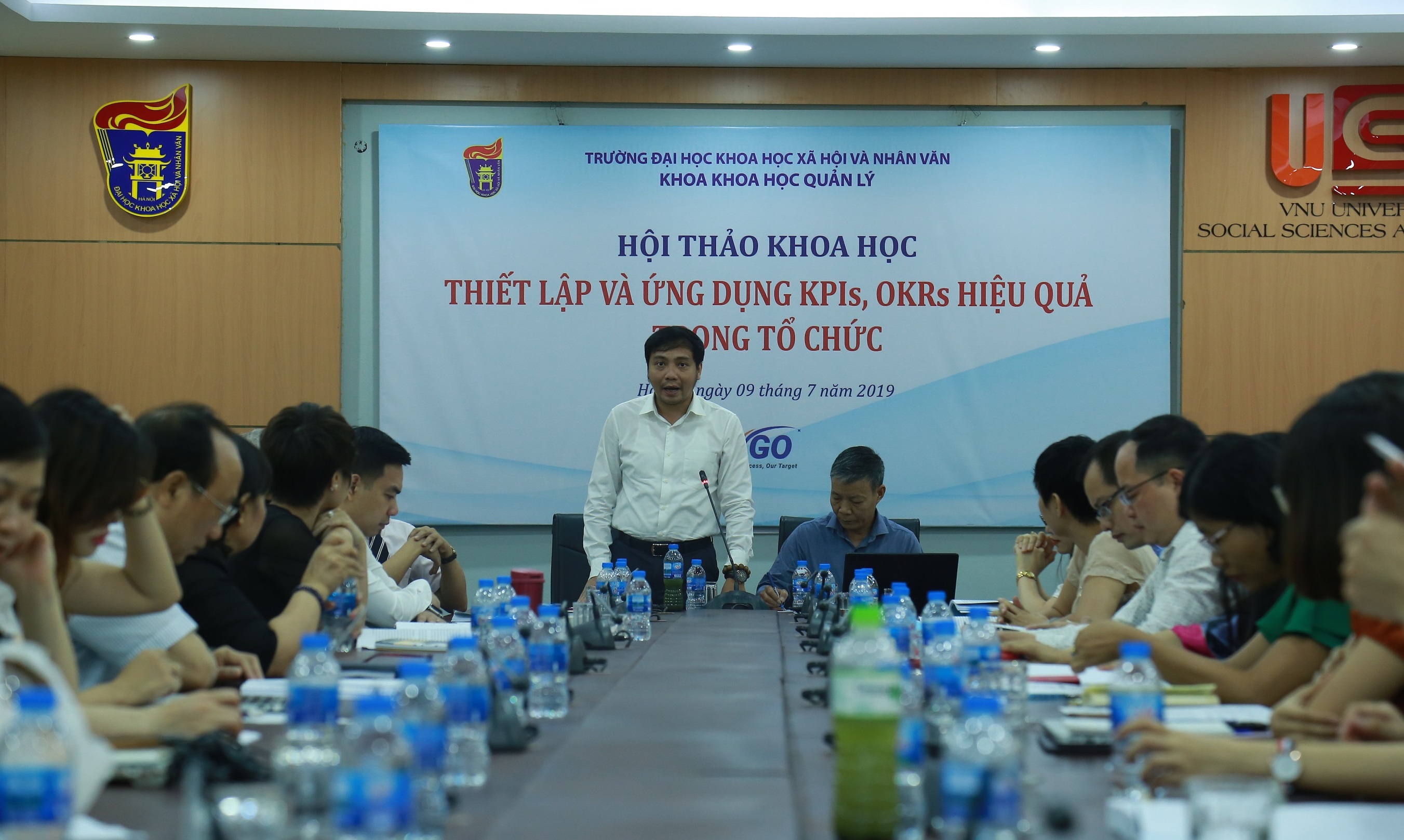
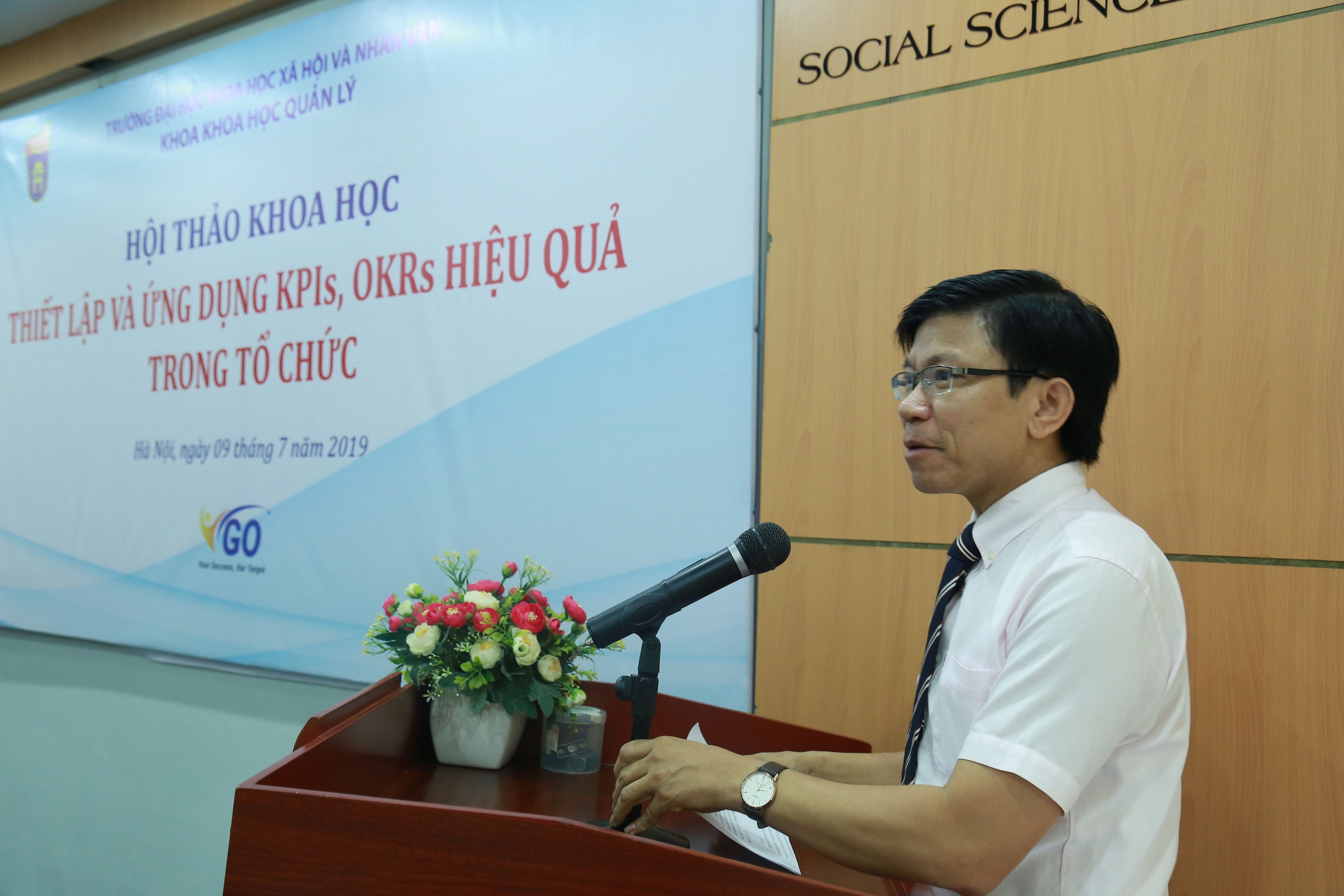
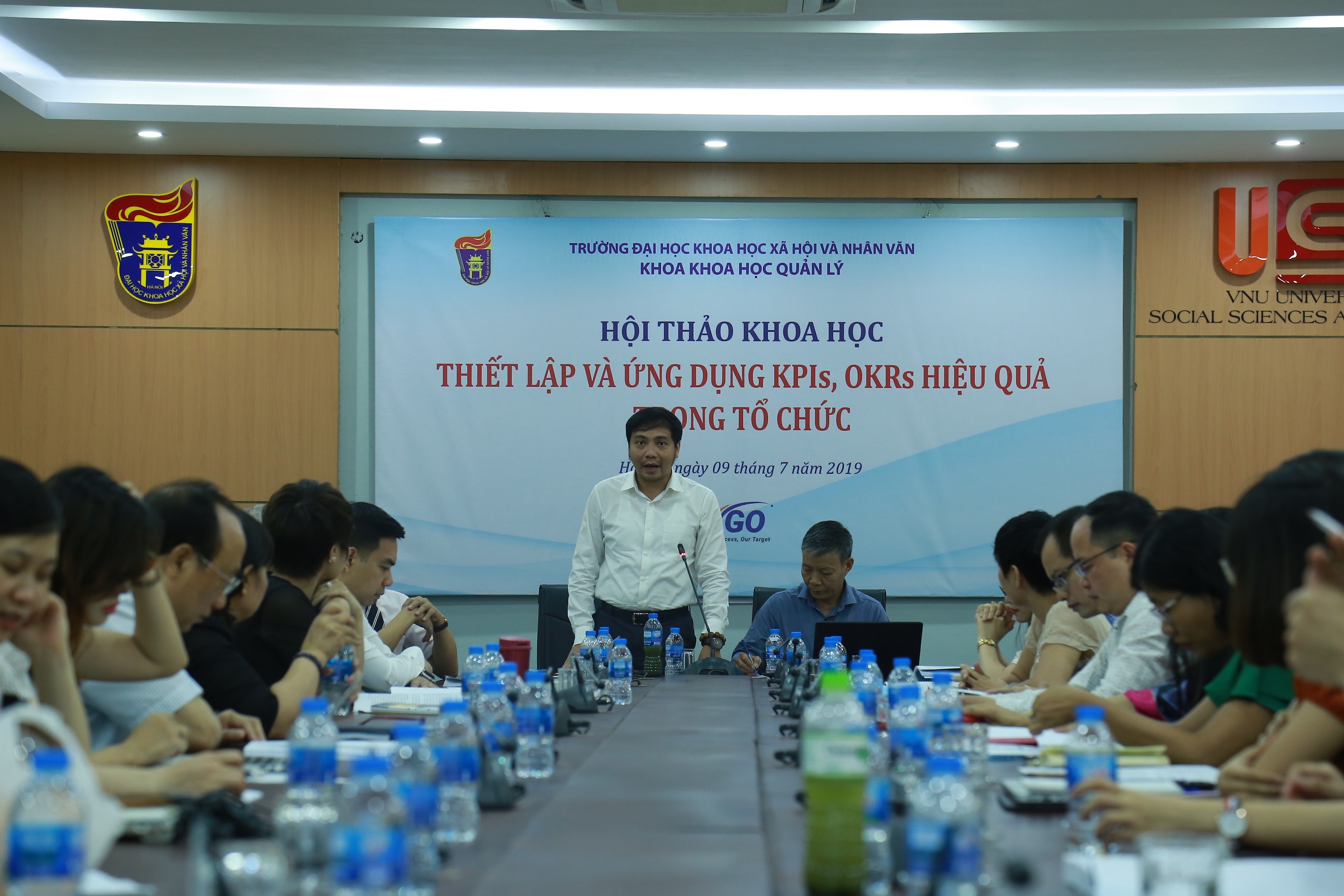
Vice Rector Hoang Anh Tuan delivered the opening remarks at the workshop.
In his opening remarks at the workshop, Assoc. Prof. Dr. Hoang Anh Tuan (Vice Rector of the University of Social Sciences and Humanities) emphasized: “KPIs and OKRs are tools that help organizations maximize resources, maintain and build a transparent and professional working environment. However, many businesses and organizations have not been truly successful in using this method. In particular, OKRs are not yet widely adopted. So what difficulties and challenges are businesses/organizations facing? What needs to be done to overcome these difficulties and effectively use KPIs and OKRs? That is a central theme of this workshop.”
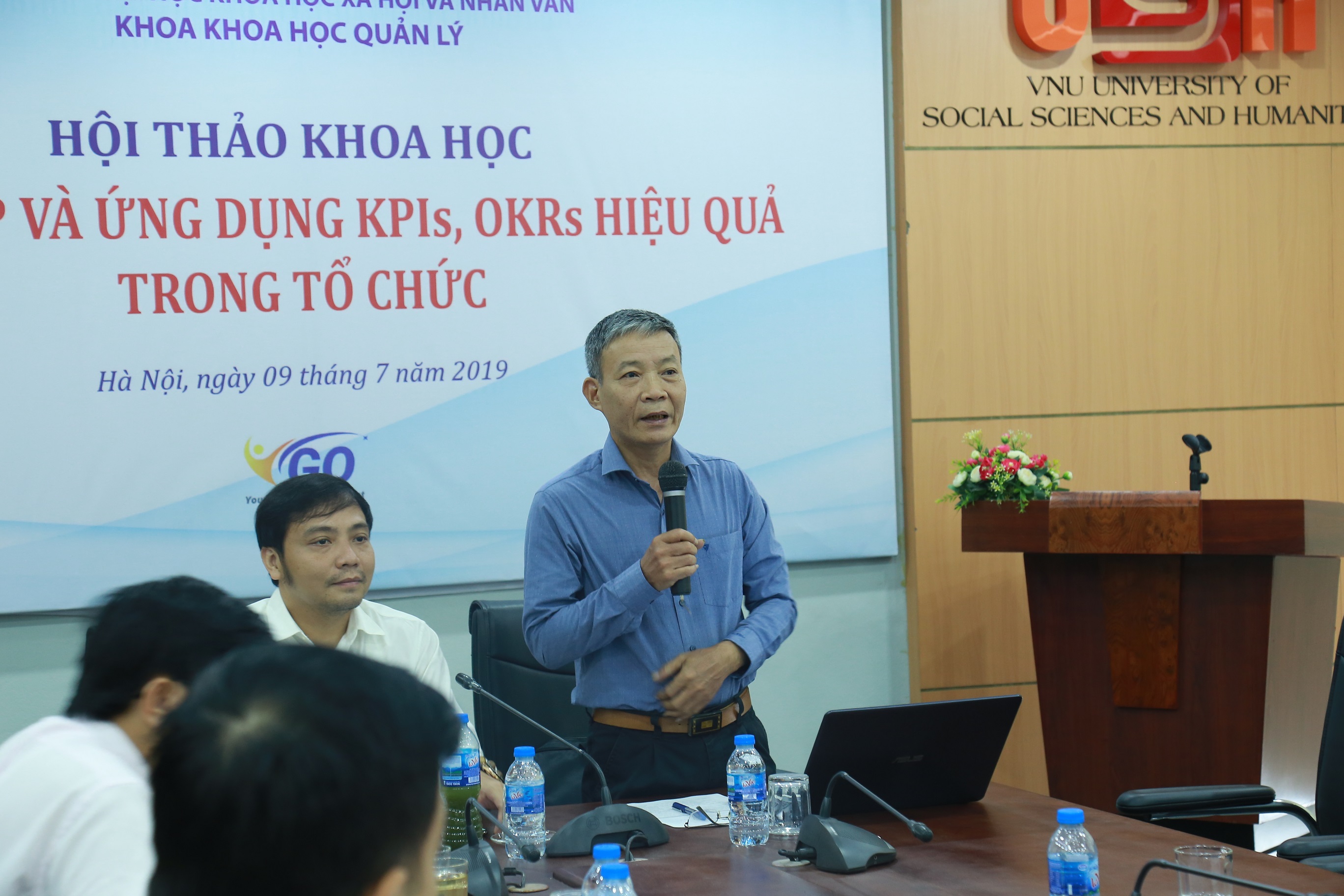
Assoc. Prof. Dr. Hoang Van Luan - Head of the Scientific Research Management Department, delivered a speech at the conference.
Dr. Nguyen Thi Kim Chi (Deputy Head of the Faculty of Management Science, University of Social Sciences and Humanities) presented a paper at the conference titled "OKR and the Benefits of OKR for Vietnamese Businesses." The paper addressed the concepts of KPIs and OKRs and analyzed the positive effects of applying these management methods in business administration. According to the paper, KPIs, short for Key Performance Indicators, are performance evaluation metrics, including basic performance indicators. They are tools for measuring and evaluating work efficiency, expressed through data, ratios, and quantitative targets. The paper also presented the structure of OKRs (Objectives and Key Results), which includes a grand objective and key results, where achieving key results leads to the completion of the grand objective. However, in reality, many Vietnamese businesses have not yet been truly successful in applying these two management tools.
Assoc. Prof. Dr. Dao Thanh Truong - Head of the Faculty of Management Science, delivered a speech at the conference.
Dr. Nguyen Thi Nam Phuong (Deputy General Director of OCD Management Consulting Joint Stock Company) addressed the mistakes to avoid and proposed solutions to overcome them in the design and implementation of KPIs and OKRs. In Vietnamese businesses, KPIs and OKRs are not yet viewed as a strategic system but are mainly used in human resource management to evaluate individual work performance, lacking connection with the business strategy and connection between functional departments. The five main mistakes pointed out by the manager are: Inappropriate design methods, Inappropriate implementation methods, Lack of application for monitoring, analysis and reporting, Using KPIs inappropriately for the function of the system, and Not considering KPIs as a continuous change process.
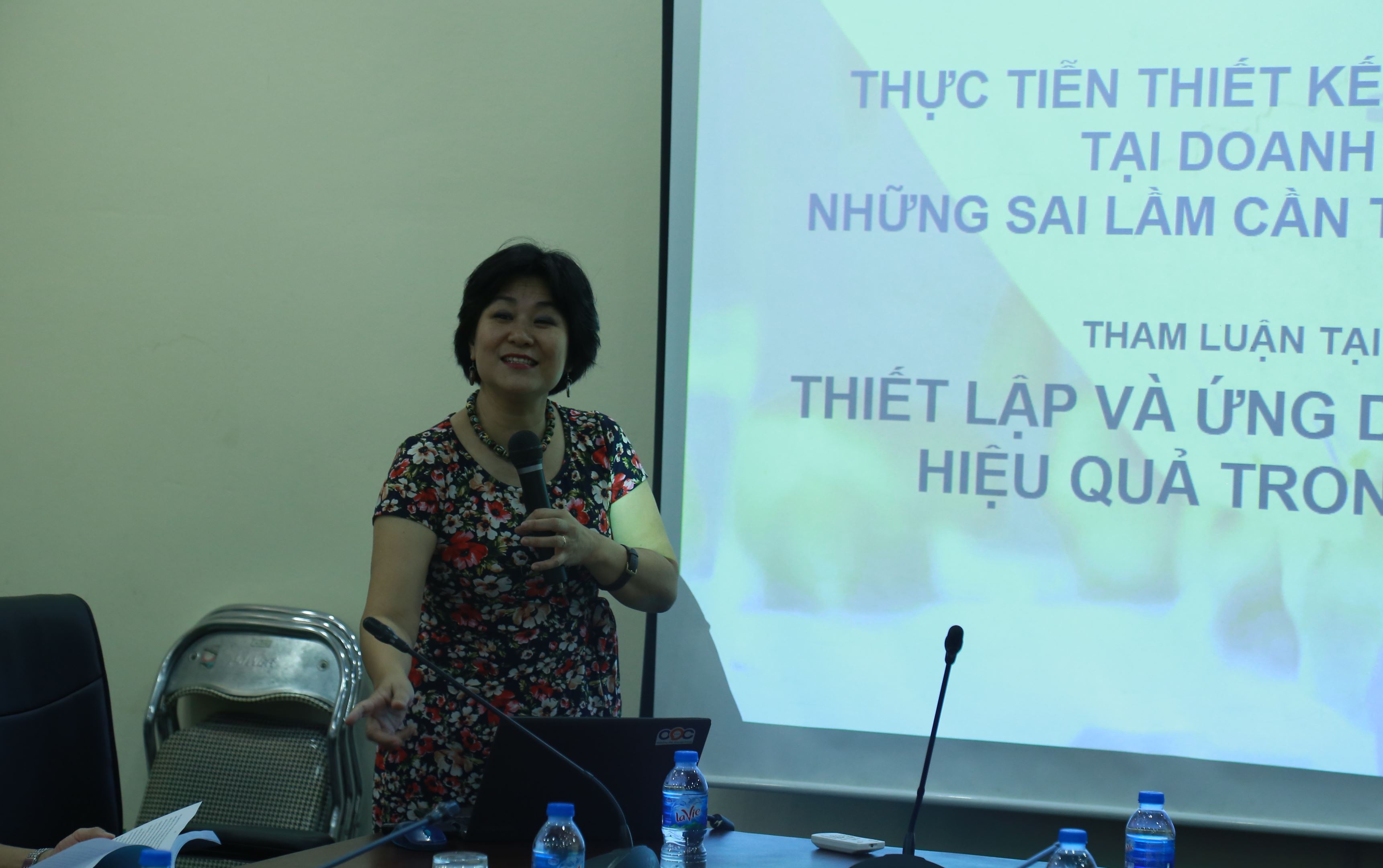
Dr. Nguyen Thi Nam Phuong - Deputy General Director of OCD Management Consulting Joint Stock Company
According to Dr. Nguyen Thi Nam Phuong, to overcome the above limitations, it is necessary to choose an appropriate method and roadmap: if OKRs are suitable for businesses in the startup phase with strong growth, while KPIs are a suitable choice for businesses with relative stability. Furthermore, it requires competent personnel to implement and appropriate technology to monitor, statistically analyze, and evaluate results.
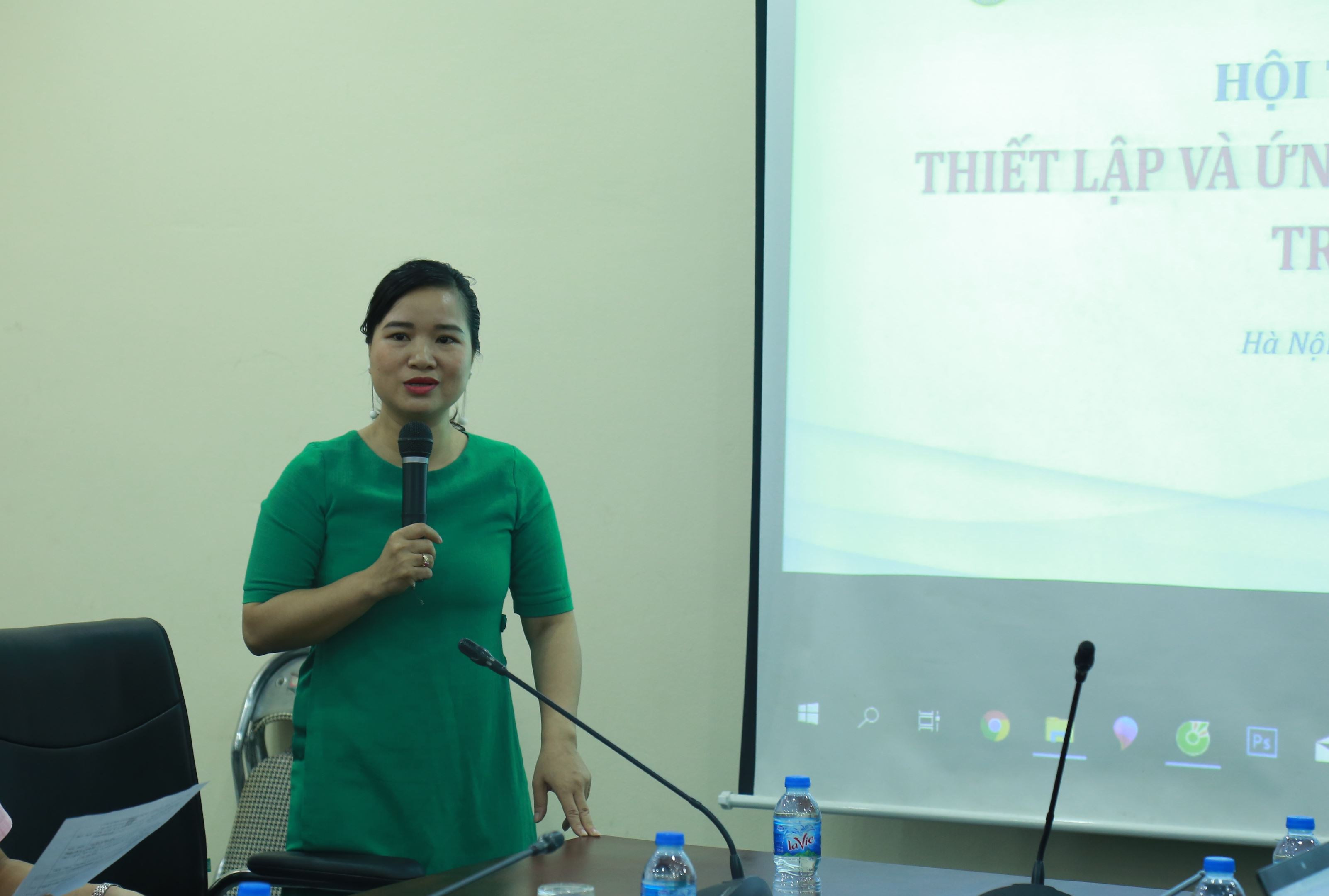
Dr. Nguyen Thi Kim Chi - Deputy Head of the Faculty of Management Science, presented the report "OKR and the Benefits of OKR for Vietnamese Businesses".
MSc. Phan Van Son (Director of Consulting Services – H&D Academy) approaches KPIs and OKRs from the perspective of "Researching the changing trends in performance management through two case studies: Microsoft and Google." Based on the development and growth processes of these two giant corporations, the author offers the following observations on the shifting trends in performance management:
Firstly, a structural shift: Breaking down the rigid, top-down administrative evaluation system (department head evaluating deputy head, deputy head evaluating staff, etc.). Each position will be evaluated by stakeholders whose performance quality is influenced by the department's personnel (employees within the department evaluating their own head, department heads with collaborative relationships evaluating each other, etc.).

MSc. Phan Van Son - Director of Consulting Services - H&D Academy
Secondly, there's a shift towards a data-driven approach to evaluation: Assessments should be based on data and records, rather than subjective judgments.
Thirdly, a shift in the rating scale: The rating scale may not need to be tied to specific scores, but should clearly indicate the level of improvement needed so that the person being evaluated can focus on change, and the level of excellence so that the person being evaluated can discuss and identify the behaviors that create excellence in order to develop and replicate them.
Looking at the benefits that KPIs and OKRs bring, learning from common mistakes businesses make, and drawing on performance management trends from Microsoft and Google's operations – this is crucial foundational data for effectively establishing and applying KPIs and OKRs within an organization.
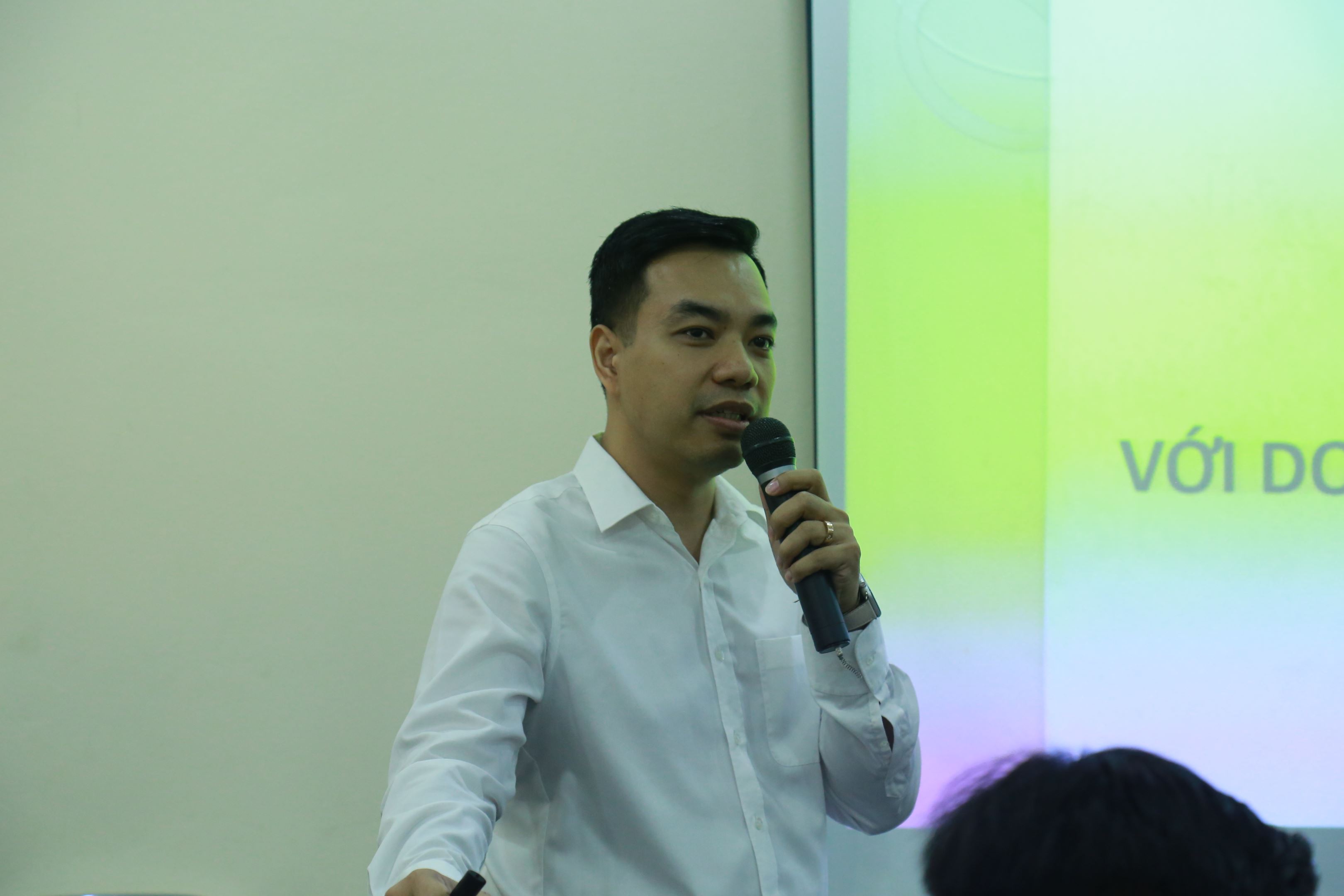
Dr. Mac Quoc Anh - General Secretary of the Hanoi Association of Small and Medium Enterprises
As Vice President and Secretary General of the Hanoi Small and Medium-sized Enterprise Association, Dr. Mac Quoc Anh presented a paper on the relationship between "KPI and OKR with Vietnamese small and medium-sized enterprises." Currently, small and medium-sized enterprises (SMEs) account for 97% of the total number of businesses in the national economy. The number of SMEs dissolved in 2018 accounted for 36% of the total. Dr. Mac Quoc Anh analyzed that, in terms of awareness, businesses need to recognize that KPIs and OKRs are extremely important management tools for micro, small, and medium-sized enterprises (SMEs) and their development, especially in the current era of integration. They help eliminate the familiar, traditional, and hereditary relationships within micro, small, and medium-sized enterprises; at the same time, they help enhance the reputation of businesses and ensure sustainable development in line with strategic goals. Business leaders and department heads must have a correct and thorough understanding of these management tools and grasp the mindset of their superiors. Employees must understand that these management tools not only benefit the business but also benefit the employees themselves.

Ms. Tran Thu Hong - CEO and Chief Consultant of HSM Technology Investment and Development Company
From the perspective of someone implementing KPIs in a business, Ms. Tran Thu Hong (CEO – Chief Consultant of HSM Technology Investment and Development Company) presented a paper titled "Applying KPIs in the Practical Operations of Businesses" for large enterprises that still lack a full level of business maturity.
Once again, Ms. Tran Thu Hong affirmed that "KPIs must be linked to the strategic goals of the organization," and each business needs to build its own KPI system. Secondly, KPIs should be defined based on the key or core business objectives of the enterprise, not confused with performance indicators in production and business operations. Thirdly, it is necessary to establish "SMART" and "SMARTER" KPIs: Write a clear objective for the KPI; Share KPI information fully, clearly, and promptly with relevant parties in the organization, ensuring KPI implementation; Incorporate concrete actions; Ensure the KPI system is appropriate to changing needs in production and business operations.
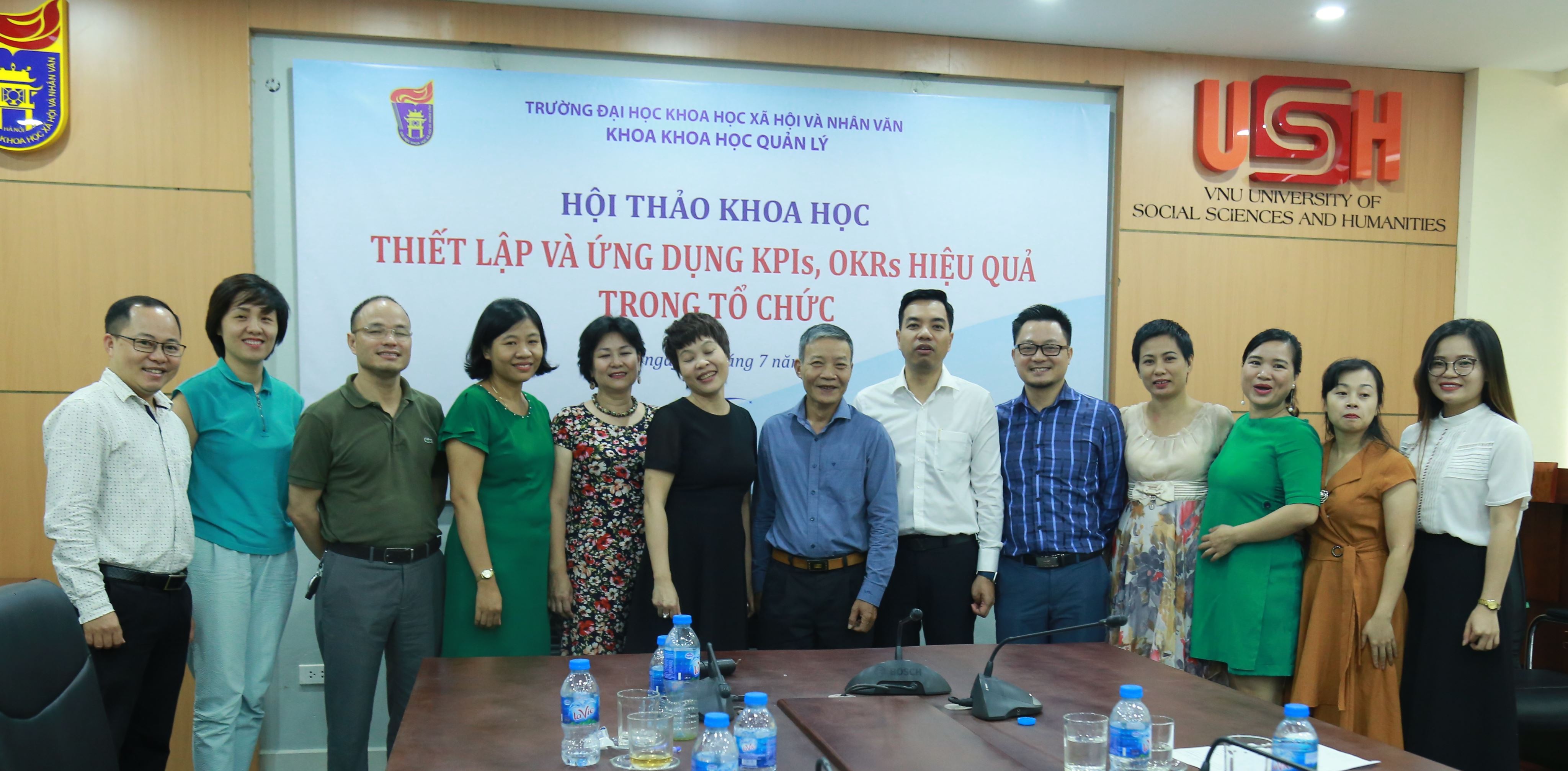
Concluding the presentations at the workshop, Ms. Bui Trang Huong (lecturer at the Faculty of Management Science, University of Social Sciences and Humanities) introduced to everyone the "Key Performance Indicators (KPIs) and their application for university lecturers," with detailed criteria for evaluating the teaching and research activities of lecturers.
Author:Nguyen Nga, Le Huy
Newer news
Older news

