
|
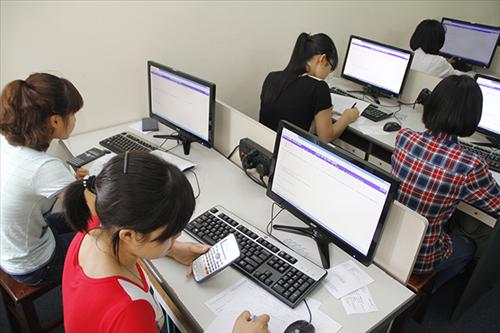
Over 1200 first-year students from Vietnam National University, Hanoi, who had passed the "3 common subjects" entrance exam, are now applying to the talented, advanced, high-quality, and internationally standardized bachelor's degree programs. Of these, 730 candidates participated on the first day of the exam, representing approximately 90% of the registered candidates. This is an examination for training units of Vietnam National University, Hanoi to select students with the necessary abilities and qualities to study in the talented, advanced, high-quality, internationally standardized bachelor's degree programs. A total of 110 staff members participated in supervising and serving the first aptitude test. Vietnam National University, Hanoi mobilized 459 computers in 14 examination rooms to support the exam. The general aptitude test is structured as a multiple-choice exam, including compulsory and optional sections, with a time limit of 195 minutes, and is conducted on a computer. The maximum total score is 140 points. The compulsory section consists of two components: Part 1 comprises 50 questions testing mathematical knowledge (quantitative reasoning) and Part 2 comprises 50 questions testing literary knowledge (qualitative reasoning). For the optional section, candidates can choose one of two components: Natural Sciences (Physics, Chemistry, Biology) or Social Sciences (History, Geography, Civic Education), each consisting of 40 questions.
The VNU's competency assessment test integrates assessment content based on scientific principles of competency evaluation. It's not a mechanical synthesis of knowledge from various subjects, and while the basic knowledge tested is within the high school curriculum, it focuses on assessing core competencies such as cognitive ability, synthesis, analysis, creativity, aesthetic appreciation, and critical thinking. The test will consist of 20% easy questions, 60% medium-level questions, and 20% difficult questions. Each correct answer is worth 1 point; incorrect or skipped questions do not result in point deductions. After the first day of the exam, all candidates expressed enthusiasm for the competency assessment method at Vietnam National University, Hanoi. Most candidates felt that the exam content was based on textbooks and covered a wide range of knowledge. Tomorrow, September 11, 2014, the exam will continue at two testing centers: Xuan Thuy testing center (in the computer labs of the University of Foreign Languages, University of Technology, University of Economics, and the Faculty of Law); and Thanh Xuan testing center (in the computer lab of the University of Social Sciences and Humanities).
I believe that competency-based assessment is a very good form of examination, suitable for evaluating students from multiple perspectives and providing a comprehensive assessment. The exam content reflects all the knowledge we have learned in high school. I found the exam structure to be reasonable. Most of the content wasn't difficult; only a few questions were a bit challenging for me. * Nguyen Le Hai, student of the Faculty of Information Technology, University of Technology
The examination method researched by Vietnam National University, Hanoi, approaches the assessment of candidates' abilities in an international manner. In my opinion, this method, used for admissions to various majors elsewhere, helps to synthesize all social knowledge, not just the subjects tested in the university entrance exam. * Nguyen Thi Thuy Quynh, a student majoring in English Pedagogy, University of Foreign Languages - VNU Hanoi. The exam method is different, novel, and highly innovative. It not only requires knowledge we've already tested in the D-block subjects but also integrates knowledge from many other subjects, including a rich area of social science knowledge. Up until now, we've focused primarily on the subjects we'll be tested on in university entrance exams. We haven't paid much attention to other subjects, so we've encountered some difficulties as a result.
* Duong Thao Ngoc Anh (pictured), a student majoring in Chinese Language and Culture, Faculty of Foreign Languages, Vietnam National University, Hanoi. The exam covered most of the knowledge I had learned in high school. Personally, I was unsure about the answers to some of the questions. |
Newer news
Older news


.jpg)
.jpg)
 * Du Anh Quan, a student majoring in Computer Science, University of Technology, Vietnam National University, Hanoi
 This new exam format, applied for the first time, comprehensively assesses all the knowledge we've learned since high school and can be applied to future fields. Typically, students tend to overlook social studies if they specialize in natural sciences; this exam format forces students to study all subjects, areas of knowledge, and fields equally.
 If this exam format is widely implemented, it will take some time for students to adapt. Most students are still studying according to their chosen exam group, so they pay less attention to other subjects. This type of exam requires us to have a comprehensive and fairly balanced knowledge base across all subjects.