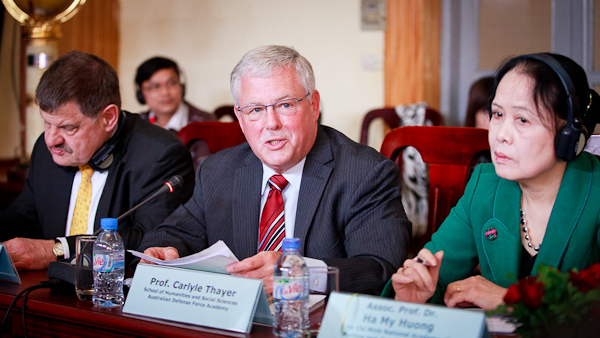
On December 10, 2010, the University of Social Sciences and Humanities, in collaboration with the Rosa Luxemburg Foundation (Federal Republic of Germany), successfully organized the international conference "The Role of Vietnam in the Asia-Pacific Region".The conference was attended by leading Vietnamese and international scholars from the Central Committee of the Communist Party of Vietnam's Foreign Affairs Department, the Diplomatic Academy (Ministry of Foreign Affairs), the Institute for Strategic Studies (Ministry of Public Security), the Institute of International Relations, the Department of Foreign Affairs (Ministry of National Defence), the Communist Magazine, the Institute of World Economics and Politics, the Institute of Southeast Asian Studies, the Institute of African and Middle Eastern Studies, the Institute of Chinese Studies, the Faculty of History (Hanoi University of Education 1), and representatives from faculties of the University of Social Sciences and Humanities. Notably, the conference also featured Professor Carlyle Thayer from the Australian Defence Academy and Dr. Gerhrard Will from the Institute of Scientific and Political Studies (Federal Republic of Germany). A total of 15 papers were presented at the conference. On behalf of the university leadership, Vice Rector Assoc. Prof. Dr. Nguyen Van Kim thanked the Rosa Luxemburg Foundation for its close cooperation with the university in implementing many research and training projects that have achieved high efficiency and quality. Vice Rector Nguyen Van Kim also highly appreciated the initiative of the Faculty of International Studies and the Rosa Luxemburg Foundation in organizing this conference in the final days of 2010, when Vietnam held the ASEAN chairmanship and the region was experiencing complex developments with a new security architecture gradually taking shape. On behalf of the Rosa Luxemburg Foundation, Ms. Dorit Lehrack also expressed satisfaction with the good cooperation between the two sides and affirmed that they would continue to support future projects.

During the presentations and discussions, delegates engaged in lively exchanges on several key points. Firstly, the Asia-Pacific region holds a particularly important geopolitical and geoeconomic position, characterized by a complex interplay of traditional and non-traditional security challenges, and is also a battleground for the strategic interests of the world's largest powers such as the United States, China, Japan, and Russia. Secondly, scholars argue that currently and in the coming years, regional security in the Asia-Pacific will be primarily influenced and shaped by the struggle between major powers, mainly between the superpower United States and rising China. Thirdly, the Asia-Pacific region is gradually forming a new security architecture with the increasingly active participation of small and medium-sized countries, exemplified by ASEAN, playing a central and leading role. Fourth, in this complex context, the question arises as to accurately, objectively, and scientifically assess Vietnam's position and strength. In that spirit, the conference engaged in frank and lively discussions about Vietnam's role from historical, political, economic, security, cultural, and diplomatic perspectives.

Although no final conclusion has been reached, scholars unanimously agree that this is a topic of immense importance, and as a leading research and training center in social sciences and humanities in the country, the University should continue to maintain and strive to organize such conferences annually to share information, enhance understanding, and provide scientific arguments to contribute to solving issues of concern to the country and society.