University of Social Sciences and Humanities - VNU Hanoihttps://ussh.vnu.edu.vn/uploads/ussh/logo-ussh-2_100_100.png
Thursday - December 12, 2024 11:20 AM
Today, October 7, 2024, Prime Minister Pham Minh Chinh and Professor Klaus Schwab, Founder and Chairman of the World Economic Forum (WEF), visited Vietnam National University, Hanoi (VNU) and interacted with students on the topic of "Positioning Vietnam in the Smart Age - A Vision for the Young Generation" at the Nguyen Van Dao Auditorium.
On October 7, 2024, at the Nguyen Van Dao Auditorium, Prime Minister Pham Minh Chinh and Professor Klaus Schwab, Founder and Chairman of the World Economic Forum (WEF), visited Vietnam National University, Hanoi (VNU) and interacted with students on the topic of "Positioning Vietnam in the Smart Age - A Vision for the Young Generation."
Attending the program were Professor Hilde Schwab - wife of Professor Klaus Schwab and co-founder of the Schwab Social Entrepreneurship Foundation. International delegates included Mr. Thomas Gass - Swiss Ambassador to Vietnam; Mr. Joo-Ok Lee - Head of the Asia-Pacific Agenda Program; Ms. Clara Chung - Head of the Asia-Pacific Business Cooperation Program; and Mr. Piyamit Bing Chomprasob - Deputy Head of the Asia-Pacific Agenda Program. Representing the Vietnamese Central Ministries and Agencies were Mr. Nguyen Kim Son - Minister of Education and Training; Mr. Huynh Thanh Dat - Minister of Science and Technology; Mr. Do Duc Duy - Minister of Natural Resources and Environment; Mr. Do Ngoc Huynh - Deputy Head of the Government Office; Ms. Nguyen Minh Hang - Deputy Minister of Foreign Affairs; and Mr. Le Van Thanh - Deputy Minister of Labour, Invalids and Social Affairs. The Chairman of the Council and Director of Vietnam National University, Hanoi, Professor Le Quan, presided over the reception for Prime Minister Pham Minh Chinh and the Founder and Chairman of the World Economic Forum, Professor Klaus Schwab.
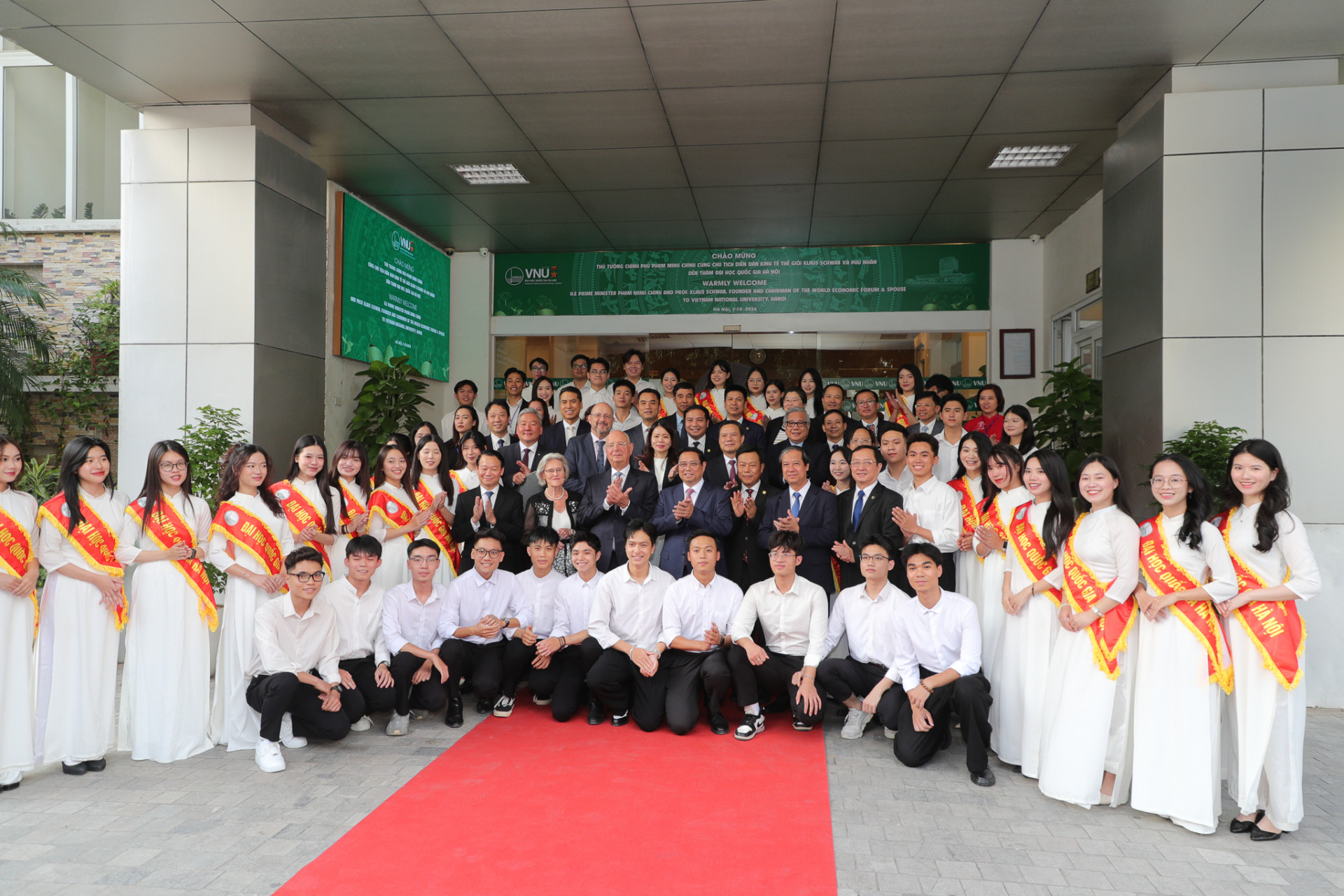
Prime Minister Pham Minh Chinh and the Founder and Chairman of the World Economic Forum (WEF), Professor Klaus Schwab, along with leaders and students of Vietnam National University, Hanoi.
This is an exciting event, marking the return of Professor Klaus Schwab, founder and chairman of the WEF, to Vietnam after 15 years, aiming to encourage and inspire the creativity and determination of Vietnamese students and youth to overcome difficulties. Accordingly, the exchange focused on trends shaping the smart era; opportunities, challenges, and Vietnam's positioning in this new development era; and the requirements for the younger generation to grasp contemporary trends and play a pioneering role in contributing to national development. Speaking at the event, Director Le Quan expressed his honor and pride that Vietnam National University, Hanoi (VNU) was once again honored to welcome Prime Minister Pham Minh Chinh and other leaders from central ministries, departments, and agencies to visit and work with him. In particular, VNU was very pleased to welcome Professor Klaus Schwab, Chairman of the World Economic Forum, who has made significant contributions to shaping global economic trends, and his wife. Vietnam National University, Hanoi (VNU) is proud to be one of the country's leading educational and research institutions, at the forefront of implementing the Party and Government's strategic policies and directions in the fields of education and science. In line with the spirit of the Resolution of the 13th National Party Congress, VNU has been actively participating in the national digital transformation process, making strong contributions to training high-quality human resources to meet the country's development requirements in the context of the Fourth Industrial Revolution.
"We are constantly innovating our training programs, improving the quality of teaching and research, pioneering the development of educational programs that meet the needs of the digital economy, and implementing interdisciplinary research projects aimed at solving national and global issues related to sustainable development, technology application, and environmental protection.", according to Professor Le Quan. Addressing the students – the generation holding the future of the country, the pioneers in the digital transformation process and shaping Vietnam's position in the Smart Era – the Director of Vietnam National University, Hanoi, Le Quan, hoped that they would equip themselves not only with knowledge but also with a spirit of continuous learning, creativity, and a desire to overcome all difficulties. He believed that Professor Klaus Schwab's sharing on economic and technological development trends would open up a new perspective for the students on their role in the development of the country and the world. At the same time, Director Le Quan also hoped that the students would turn this valuable opportunity into motivation to become future leaders, pioneers who will take Vietnam to a new level in the smart era.
Opportunities for the young generation of Vietnam to contribute to and shape the future of the country.
During the program, Professor Klaus Schwab shared an overview of the forces shaping the world, highlighting the increasingly complex and transformative factors that present both challenges and opportunities for all countries, including Vietnam. These include: the shift from a stable global order to a multipolar world with frequent conflicts; the transition from the industrial age to the smart age; and the growing polarization within society. The WEF President emphasized that young people are the future of Vietnam, and the changes discussed are the factors that will shape their careers, opportunities, and lives. The smart age is not just an abstract concept; it is a reality in which young Vietnamese people will live, work, and study. Professor Klaus Schwab also offered suggestions on how Vietnam can seize the opportunities ahead to create a prosperous, sustainable, and inclusive future. Through initiatives such as the Fourth Industrial Revolution Center, the WEF is working to provide the necessary resources and connections for countries like Vietnam to develop innovation centers, invest in digital infrastructure, and prepare a workforce to adapt to the challenges ahead. Professor Klaus Schwab shared that the essential elements for a smart era are: digital infrastructure, human resources, a business ecosystem, public-private partnerships, and global integration and cooperation. Beyond technology, the real opportunity lies in the human factor. According to the professor, Vietnam's true advantage will depend on building a knowledge-based economy, encompassing not only skills and professional competence but also the environment, society, and geopolitical advantages – all crucial elements for a prosperous and inclusive society. Professor Klaus Schwab also highly appreciated the plan and vision of the Vietnamese Government and Prime Minister in socio-economic development towards inclusiveness, ensuring that no one is left behind; and expressed optimism about the great opportunities for the young generation of Vietnam to contribute to and shape the future of the country. The smart era must be an era of development for the benefit of humanity.
Prime Minister Pham Minh Chinh assessed the dialogue as a testament to the increasingly close, vibrant, and dynamic relationship between Vietnam and the WEF; most recently, the WEF supported Vietnam in building the Fourth Industrial Revolution Center in Ho Chi Minh City, the second center in the WEF's network in Southeast Asia.
The Prime Minister highly appreciated and thanked Professor Klaus Schwab for his profound and meaningful sharing, his affection for Vietnam, and his guidance for the young generation of Vietnam at the dialogue, which motivated and inspired the young generation of Vietnam.
The Prime Minister stated that the strategic vision of the Professor and of the WEF is important.The World Economic Forum (WEF) has been recognized globally over its more than 50 years of development and continues to be recognized for its ability to grasp new global trends and propose solutions for the future. As the WEF's chair for over 50 years, the Professor has led the WEF to pursue a multilateral, multi-faceted approach, promoting public-private partnerships and multi-stakeholder collaboration, contributing to the resolution of many global issues across various dimensions. In terms of representation, the WEF has become a forum bringing together governments, businesses, universities, and innovators/startups from all sectors. In terms of connectivity, WEF conferences provide opportunities for the international community to foster cooperation, international solidarity, and collaborative ideas. The WEF also promotes pioneering spirit and transformative change (such as the network of Centers on the Fourth Industrial Revolution; public-private partnership initiatives in various fields, etc.). Speaking about the theme for the upcoming WEF Davos 2025 conference in Davos, Switzerland, "Shaping the Smart Era," the Prime Minister assessed it as a matter of epochal importance, an issue the world must study, adapt to, and master; agreeing with the Professor on the inclusive and comprehensive approach that reflects the development trends of the new era when discussing the "smart era." According to the Prime Minister, intelligence is not simply the explosive development of new technologies, but also involves interconnectedness and synergy across many broader aspects. From an economic perspective, intelligence must truly translate into improved productivity, becoming a new driving force for economic growth, as well as enhancing efficiency in distribution. From a social perspective, intelligence must make society more equitable, freer, and inclusive, ensuring that people are increasingly prosperous and happy, and that no one is left behind. From an environmental perspective, intelligence must go hand in hand with efficient energy use and sustainable economic development. From a geopolitical perspective, intelligence must promote peace, cooperation, and development, prevent conflict, confrontation, and division, put the past behind, exploit common ground, and look towards the future. "I believe that the smart era must be an era of development for humanity, serving humanity, with humanity at its center and as its subject."The Prime Minister said. An analysis of the challenges and opportunities facing developing countries.In this context, including Vietnam, the Prime Minister stated that sustainable and inclusive development based on the application of modern science and technology, and the strong promotion of entrepreneurship and innovation, is an inevitable trend, an objective requirement, a strategic choice, and a top priority for the world today. Science, technology, innovation, and sustainable development are global issues, impacting all people, all aspects of human activity, and all nations. Therefore, it is necessary to promote multilateralism and international solidarity to advance and ensure that all citizens benefit from the achievements of science, technology, innovation, and the smart era. The Prime Minister pointed out three major challenges facing Vietnam: the technology gap and infrastructure shortages; the limited scale of the economy and resources, the country's development and economic transformation; and increasingly complex and unpredictable climate change and natural disasters, threatening food, water, and energy security. Besides that, there are also opportunities for developing countries, including Vietnam, such as the opportunity of being a latecomer (having the conditions to directly access the latest technologies and solutions); a young and abundant workforce, in which students and young people play an important role and contribute significantly; and international cooperation and multilateralism are irreversible trends. Select the areas and processes where Vietnam has the greatest advantage.
Sharing about Vietnam's achievements on the world development map, the Prime Minister said that Vietnam has risen from an underdeveloped economy to a developing economy with middle income, ranking 34th among the world's largest economies. From a poor and underdeveloped country, Vietnam has become a nation with one of the highest Human Development Index scores among economies at a similar level of development. From a state of isolation and encirclement, Vietnam has become a model of post-war healing and recovery, with open and comprehensive foreign relations and deep, substantive, and effective international integration. As a reliable partner and responsible member of the international community, it actively contributes to addressing common global and regional challenges. Regarding the vision for the new era of development, the Prime Minister stated that first and foremost, we must be confident and resolute, and we have the basis to be confident and resolute in participating in the smart era. "I wholeheartedly agree with Professor Klaus Schwab's sharing about Vietnam's resilience. With the spirit of 'turning nothing into something, turning difficulties into ease, turning the impossible into the possible,' and our glorious cultural and historical traditions, we have the resilience and confidence to move forward and overcome our own limitations," the Prime Minister emphasized. Sharing Vietnam's goal of becoming a developed, high-income country by 2045, the Prime Minister stated that the entire nation must demonstrate high determination, great effort, and decisive action to promote the three strategic breakthroughs (institutions, infrastructure, and human resources), mobilizing all resources to industrialize and modernize the country, exploiting endogenous resources (nature, cultural and historical traditions, and human resources), while combining national strength and the strength of the times, and considering external resources (capital, management, technology, human resource training, etc.) as crucial and breakthroughs. The Prime Minister emphasized the need to improve institutions, train human resources, develop infrastructure, mobilize finance, transfer technology, and enhance governance capacity in the smart era. Along with this, it is crucial to select sectors and stages where Vietnam has the greatest advantage in the smart-era supply and production chain, leveraging the strengths of the Vietnamese people and adapting to Vietnam's conditions and circumstances within the global context. The Prime Minister noted that, in addition to general policies that create equal opportunities for everyone, there must be specific policies, especially for vulnerable groups and disadvantaged areas, ensuring there is no electricity shortage, no areas with poor signal coverage, and promoting a spirit of sharing, support, and mutual assistance, thereby narrowing the gap between different groups and regions, and ensuring that no one is left behind in the smart era. Emphasizing the role of the younger generation in the smart era, the Prime Minister reiterated the words of beloved President Ho Chi Minh: "A year begins in spring. A life begins in youth. Youth is the spring of society." The Prime Minister expressed his hope and belief that the younger generation would uphold the glorious historical and cultural traditions, dare to confront difficulties and challenges, overcome them, possess the thinking, methodology, and approach to solve the problems at hand, play a core, pioneering, courageous, and confident role in entering the smart era, and contribute to the country's development in the next phase.
"The country's innovation originates from the spring of youth, with aspirations, dreams, and ambitions. You, the students and young people, will be the masters of the smart era," the Prime Minister said, urging young people to take the lead in emerging fields such as the digital economy, green economy, circular economy, sharing economy, and industries like semiconductor chips, cloud computing, and the Internet of Things… The Prime Minister requested that Professor Klaus Schwab and the WEF develop more initiatives to support and facilitate students and young people in developing countries, including Vietnam, to have more opportunities to access and master advanced technologies through WEF programs and projects, thereby contributing to supporting Vietnam in pioneering the smart era with the younger generation as the core. The Vietnamese government always stands alongside and listens to the opinions of the World Economic Forum, the business community, young people and students, experts, and scientists related to the Fourth Industrial Revolution and innovation, while creating favorable conditions for the younger generation to confidently move into the smart era.
Over the past period, Vietnam National University, Hanoi (VNU) has issued a science and technology and innovation strategy; promulgated a set of indicators to assess the level of innovation of VNU and its units; implemented the application of KPIs in operational management; is implementing the internationalization plan of VNU; has transformed training programs towards promoting engineering and technology fields; to date, VNU has achieved a proportion of engineering, technology, medical and pharmaceutical fields accounting for up to 35%.
Vietnam National University, Hanoi (VNU) has collaborated on undergraduate and postgraduate training programs in fields such as AI, semiconductors, advanced materials, biotechnology, fintech, and innovation. VNU has signed cooperation agreements with leading universities worldwide to develop new disciplines. VNU has developed channels for connection and cooperation with domestic and international businesses; the satisfaction index of businesses with VNU has increased rapidly in recent years. Along with this, VNU always focuses on developing its staff and quality. In the past three years, VNU has attracted nearly 300 new scientists; the number of international publications by VNU has doubled in three years; VNU's non-budgetary revenue has increased rapidly over the years, with non-tuition revenue increasing rapidly and accounting for a large proportion. In fulfilling its leading role in the national education system, the Vietnam National University, Hanoi (VNU) has been tasked by the Vietnamese Party and State with developing a plan to become one of the world's top 500 universities by 2030; and actively participating in the Government's plan to develop 50,000 high-quality human resources in the semiconductor industry. Currently, Vietnam National University, Hanoi (VNU) is actively implementing the Prime Minister's directive to build a University Urban Area in Hoa Lac, aiming to transform it into a modern, advanced, internationally-standard training and research area, a center for cooperation with businesses, and a center for technology transfer. At the end of September, VNU commenced construction on projects funded by a World Bank loan, becoming the first of the three universities to have disbursed this loan.
Information about Professor Klaus Schwab - Founder and Chairman of the World Economic Forum: Professor Klaus Schwab, born in 1938 in Ravensburg, Germany, is a globally renowned economist and engineer, best known as the founder and executive chairman of the World Economic Forum (WEF). He earned a PhD in Economics from the University of Fribourg and a PhD in Engineering from the Swiss Federal Institute of Technology (ETH Zurich). He then completed a Master of Public Administration program at the John F. Kennedy School of Government at Harvard University. In 1971, he founded the World Economic Forum (WEF) in Davos, initially as a small meeting for European business leaders. Under his leadership, the WEF has become a global forum, bringing together leaders to discuss pressing issues such as globalization, climate change, and sustainable development. In 1998, he co-founded the Schwab Foundation for Social Enterprises with his wife (Hilde Schwab). The Foundation seeks out, identifies, and implements social entrepreneurship initiatives to improve people's living standards. The Foundation supports more than 350 social entrepreneurs worldwide. Professor Klaus Schwab has played a crucial role in promoting globalization and global economic integration. He has initiated numerous important initiatives and projects, including the Global Competitiveness Report, the Young Global Leaders Network, and initiatives related to Industry 4.0. Under the leadership of Professor Klaus Schwab, the World Economic Forum (WEF) has become a highly influential forum shaping the policies and decisions of governments, international organizations, and businesses worldwide. The forum has contributed to shaping discussions on global issues such as climate change, inequality, and the future of work.



.jpg)
.jpg)
.jpg)
.jpg)
.jpg)
.jpg)