This is the first in-depth workshop on this field, focusing on raising awareness of the role of science and technology information in Vietnam's socio-economic development. It also aims to contribute to policy development and propose specific solutions to improve the effectiveness of applying and managing this information resource.
In his opening remarks, Mr. Tran Van Tung, Chairman of the Vietnam Association for Scientific and Technological Information (VASTI), emphasized that VASTI is always ready to play the role of a bridge connecting knowledge from research labs to production life, from ideas to practical applications. He stated that scientific and technological information is the foundation for creating a smart, modern, and efficient economy, and affirmed that the conference would open opportunities to share innovative solutions and promote sustainable development.
Mr. Tran Van Tung, President of the Vietnam Association for Scientific and Technological Information
Speaking at the conference, Comrade Huynh Thanh Dat, Member of the Central Committee of the Party and Deputy Head of the Central Propaganda and Mass Mobilization Department, emphasized that scientific and technological information is the "lifeblood" of development, playing a crucial role in the process of industrialization, modernization, and international integration. He affirmed that the conference was an important opportunity to propose appropriate solutions and policies, promoting the sharing and effective application of national data resources.
Comrade Huynh Thanh Dat, Member of the Central Committee of the Party, Deputy Head of the Central Propaganda and Mass Mobilization Department, delivered a speech at the seminar.
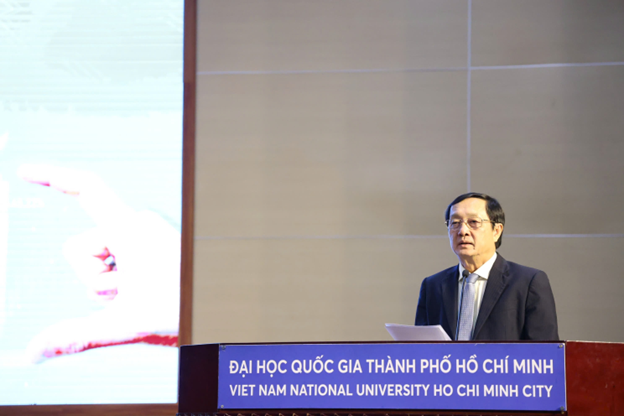
In his presentation, Associate Professor Dr. Vu Hai Quan, Director of the Vietnam National University Ho Chi Minh City, likened scientific and technological information to the "lifeblood" that nourishes scientists and the research community. He argued that to increase competitiveness, Vietnam needs to build an open, interconnected data ecosystem linked to new technologies such as artificial intelligence, blockchain, and aggregated data. Through this, Associate Professor Dr. Vu Hai Quan hoped that scientists would share many practical solutions and recommendations, helping to make the source of scientific and technological information increasingly profound and highly applicable.
Assoc. Prof. Dr. Vu Hai Quan, Member of the Central Committee of the Communist Party of Vietnam, Director of the Vietnam National University Ho Chi Minh City.
In the official session, Assoc. Prof. Dr. Do Van Hung (Faculty of Social Sciences and Humanities, Vietnam National University, Hanoi) presented a paper on behalf of the research group entitled "Building a science and technology information ecosystem for innovation and digital economic development in Vietnam".
The paper analyzes the current state of the data system, noting its fragmentation, limited investment, lack of specialized human resources, and the absence of a widespread data sharing culture. Drawing on international experience, the authors propose a model for a science and technology information ecosystem based on four principles: "openness - interoperability - security - added value".
Accordingly, Vietnam needs to improve its legal framework, build a national integrated data platform, apply AI in analyzing research trends, and promote an open science culture. He emphasized that only when data becomes a "source of knowledge energy" will it create sustainable momentum for innovation and the digital economy.
Assoc. Prof. Dr. Do Van Hung, Head of the Department of Information and Library Science, Faculty of Social Sciences and Humanities, Vietnam National University, Hanoi, and Vice President of the Vietnam Association of Scientific and Technological Information.
The workshop also acknowledged the role of the Vietnam Association for Scientific and Technological Information (VASTI) as a bridge between research institutes, universities, and businesses in proposing policies, building data standards, and promoting an open science culture. The University of Social Sciences and Humanities has actively participated in many of the Association's activities and is also a pioneering higher education institution in training information management personnel, meeting the new requirements for building and exploiting the national science and technology information ecosystem.
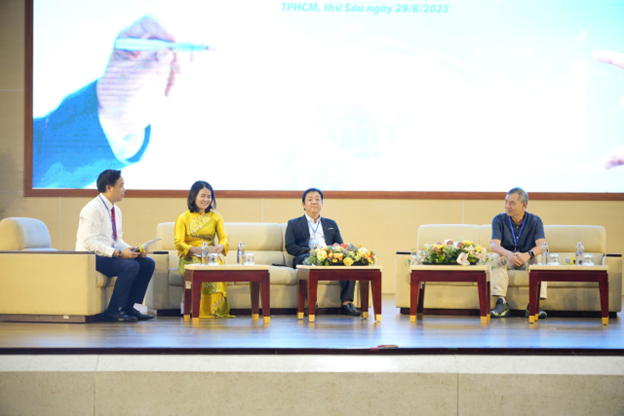
The speakers participated in the discussion session, moderated by Assoc. Prof. Dr. Do Van Hung.
Simultaneously, the conference also included two discussion sessions: Strategic technologies of the era of growth; and the needs and current status of scientific and technological information for the business community, universities, and research institutes. These sessions contributed to policy development and proposed solutions to improve the effectiveness of applying and managing scientific and technological information.
Participants in the workshop pose for a commemorative photo.