
The new recruits, originally students from several universities evacuated to the left bank of the Red River (such as the University of Economics and Planning, the University of Agriculture, the University of Technology, etc.) and staff from several agencies in Hebei (such as the Garment Factory No. 10, the Hebei Fertilizer Plant, etc.), were assembled into a battalion designated D495, belonging to Regiment 568, Left Bank Military Region. The training ground for this battalion was the Ngo Hill area, Mai Siu, Luc Nam district, Hebei province (now Bac Giang). We often referred to our unit as the "Student Battalion," the "General Company," the "University of Technology Company," the "Agricultural Company," etc., and called the training ground "Maisiugrat."
The "Comprehensive Company" (C2) had approximately 150 officers and soldiers, including students from the Chemistry, Biology, Geography, Literature, and Mathematics faculties, who were assigned to Platoons 1, 2, and 3. Of the 8 students from the History Faculty, 5 belonged to Platoon 4 (B4), including Dang Cong Nga and Nguyen Dinh Le in Squad 10, Ngo Dang Tri in Squad 11, and Ngo Ngoc Thang and Le Tat Vinh in Squad 12. Platoon 4 had over 40 soldiers, mostly students in military uniform, originally from the History and Physics faculties of Hanoi University, or from the Pricing Faculty of the University of Economics and Planning, with a few workers from the Garment Factory No. 10 and the Ha Bac Fertilizer Plant…
After three months of training in the basic combat skills required of infantry soldiers, at the end of December 1972, we set off for the battlefield, generally referred to as going to the South. Except for one person, Nguyen Chieu, who was assigned to stay behind to attend squad leader training, the remaining seven were given new military equipment, including mosquito nets, Suzhou-style uniforms, pith helmets, belts, and rubber sandals, and quickly left the training base to march to the front lines.
The entire battalion marched on foot from Luc Nam, crossed Yen Tu, went to Hai Duong, and arrived in Thuong Tin. Here, Battalion 495 joined the North's main supply line to the South, receiving the new designation of Regiment 2004. Regiment 2004, along with many other regiments (battalions) from the North, marched as part of the units reinforcing the southern battlefield, under the direction of military depots under the Ministry of National Defense.
The 2004 group boarded a train at Thuong Tin station to Nam Dinh, then traveled by car to Thanh Hoa and Nghe An. All journeys had to be at night to avoid bombing and interception by American planes; even so, we narrowly avoided casualties from B52 bombings several times. Upon reaching Ha Tinh, we received orders to quickly move south before the Paris Agreement. Cars took us across the Ngang Pass to Quang Binh, then onto barges towed by speedboats up the Gianh River to Phong Nha-Ke Bang National Park, before marching on foot to Laos, following the Western Truong Son Trail south of the 17th parallel...
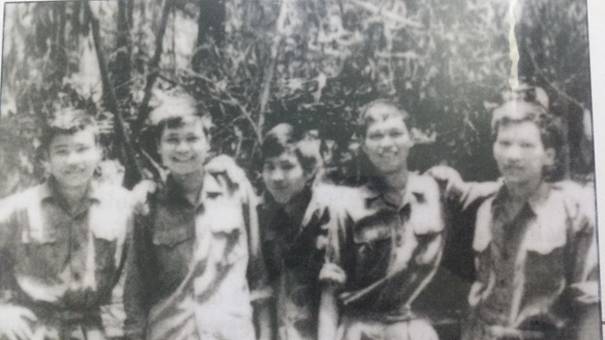
From left to right: Ngo Ngoc Thang (Class of 1915, later Associate Professor, PhD, Director of the Academy of Politics Region 1), Nguyen Dinh Le (Class of 1914, later Associate Professor, PhD, Head of the Department of Modern and Contemporary Vietnamese History, Faculty of History), Le Tat Vinh (Class of 1916, later Director of the Department of Culture and Sports of Hai Phong City), Ngo Dang Tri (Class of 1915, later Associate Professor, PhD, Vice Head of the Faculty of History), Dang Cong Nga (Class of 1913, later Director of the Ninh Binh Provincial Museum).
On January 27, 1973, while already in Laos, along the Western Trường Sơn mountain range, the Paris Agreement was signed. The officers of D495, mostly commanders from platoon to battalion level, were ordered to return to the North to train another batch of new recruits. Their deputies took over, and the unit continued its march.
From February 1973, after the Paris Agreement, just as the song says, "The road to the battlefield is beautiful this season; East Truong Son connects to West Truong Son," and "We will go wherever there are still enemy troops; we will not return until the Fatherland is at peace," not only the 2004 contingent but dozens of other contingents, with tens of thousands of young, strong, enthusiastic officers and soldiers, and light weapons (heavy weapons and food were mainly transported by truck), busily joined the front lines. Along with the troops were many youth volunteer groups, civilian laborers, and civilian officials, as well as cultural troupes and war correspondents, who also flocked to the South.
While in the Eastern Truong Son Mountains, it was drizzly, damp, and windy, while in the Western Truong Son Mountains it was the dry season, hot and sunny, with not a drop of rain. Not only did we experience the weather, but more interestingly, we gained new knowledge about the landscapes and people of the "Land of a Million Elephants," something we had learned when we were history students. We learned about the nomadic lifestyle and burial grounds of the Lao people. Dang Cong Nga, an archaeology student, even found some stone axes while traveling in Laos…
Along the Western Trường Sơn Trail, the marching routes followed a series of supply stations, named in order from North to the end of Laos, such as T1, T2,...T79, T90,... directly managed and logistically supported by the 559th Regiment. Each day, the forces moved from outer stations to inner stations, a distance of 20-30 kilometers, traversing high mountains, deep ravines, and treacherous rocky terrain, while still facing attacks and interceptions from enemy aircraft and commandos. In many sections, the engineers of the 559th Regiment had to build wooden ladders for the troops to ascend and descend steep mountain peaks, construct handrails to navigate precarious cliffs, or build suspension bridges using rattan ropes to cross rivers and streams. At times, the troops had to run continuously to avoid aircraft or enemy interceptions, such as when crossing Highway 9, the Xe Bang Hiêng River, and the Xê Công River...
After a march, upon reaching a new supply depot, the soldiers would stop, disperse along the supply route, find places with water, dig shelters, set up hammocks to rest, and cook their own meals using makeshift stoves with the rice they brought along, salt, wild vegetables, and MSG. After about 7 days of marching, the unit would stop for 2-3 days to replenish rice, salt, and possibly green vegetables or meat, which were produced and distributed by the supply depots. Anyone who fell ill (mainly with malaria) was sent to the infirmary of the supply depots, and upon recovery, rejoined the unit.
Wounded soldiers, cadres, and students from the South who went to the North for recuperation, treatment, or education also followed the routes of the South-North military transport stations. In early 1973, the delegation of Prince Norodom Sihanouk and his wife, visiting the liberated areas of Cambodia, also traveled along the Western Trường Sơn route and were guaranteed safety both on their way in and out.
Because the army's marching route was as the crow flies, while the trucks took winding roads through the mountainous terrain and streams, the soldiers' resting places were often far from the truck transport routes. Therefore, the soldiers often had to take turns going to get rice from warehouses that were quite far and dangerous. The warehouses of the supply depots were only guarded by a few soldiers, while many rows of warehouses contained tens of tons of rice, salt, and weapons, so it was easy for soldiers to take extra rice beyond their rations, and the guards couldn't prevent it (we called it "soldiers stealing"). Food was so scarce that bamboo shoots and sour leaves were all taken by the units ahead, so sometimes the soldiers would use grenades, explosives, or even spearguns to "supplement" their rations.
As student soldiers, we had some unique characteristics, such as still carrying Russian and English dictionaries to study foreign languages, or bringing a guitar to sing when the opportunity arose. The entire company only had one organ radio belonging to the political officer; there were no cameras or newspapers.
Diaries are a form of preserving the past used by some, although sometimes they are fragmented and very brief. In Platoon 4, Hoang Van Due (A12, a student at the University of Economics and Planning) was the most meticulous and complete diary keeper, and Ngo Dang Tri (the first person admitted to the Party in the "General Company") also paid considerable attention to this. Currently, Ngo Dang Tri still keeps two volumes of battlefield diaries titled "Days of Gun Ban (1973-1974)" and "The Southern Road (1974-1975)", which record quite fully his days in the military, especially the period in the battlefields of Cambodia, Tay Ninh, Quang Duc, My Tho, etc.
As students of the History Department, a department that often organized "Department Reunions," with a tradition of close ties between teachers and students, and between different cohorts, and having marched together on the road to the South, we soldiers and the reporters (who went to the South to reinforce the branches of the Liberation News Agency) often sought each other out, inquired about each other's well-being, and encouraged each other.
Along the Western Trường Sơn Trail, upon reaching the "Indochina Tripoint" (the border area between Kon Tum province of Vietnam, Atôpơ province of Laos, and Kratie province of Cambodia), all units had to stop for a period of time while superiors decided which units would be deployed to the Central Highlands (B3), the Southeast and Southwest regions (B2), remain in Laos (Battlefield C), or go to Cambodia (Battlefield K). Therefore, both the main army units and civilian delegations had a considerable amount of time to rest, allowing them to meet fellow countrymen, colleagues, classmates, etc., for reunions.
In mid-March 1973, at Military Post 79 (Atôpơ, at the end of the Boloven Plateau) in the "Tri-border area," we held a "History Department Reunion on the Truong Son Mountains," reminiscing about our time as students of the Department. Stories of teachers and students, friends, and school life were shared, filled with fond and proud memories – from the Me Tri dormitory, the evacuation, and the dike construction… and the longing for the day of return. The reunion was warm and joyful, with a cup of tea brewed in a thermos, rolled cigarettes, and a meal of freshly caught fish, bamboo shoots, and wild vegetables…
The photograph "5 soldiers," or "5 history students," accompanying this memoir of ours was taken by Cao Phong (a K13 student from the History Department, who graduated in 1971), a member of the reporting team that supplemented the Liberation News Agency, at that departmental meeting. Fortunately for us, a rare moment of soldier-student life was captured, and after the war, both the photographer and the people in the photo are still alive.
It should be added that the civilian delegation that marched with us at that time sometimes traveled by car, but several people were killed in a car accident in Laos, including two reporters who were history students. Our "General Company" also lost nearly a dozen soldiers and students. In the "Polytechnic Company" alone, in a single bombing raid by enemy aircraft (at Ca Tum, Tay Ninh) on the afternoon of October 3, 1973, 12 soldiers were killed simultaneously…
The people in the photo "5 History Department Students" at the Indochina Crossroads, March 1973, from left to right are: Ngo Ngoc Thang (K15, from Ha Nam); Nguyen Dinh Le (K14, from Ha Tinh); Le Tat Vinh (K16, from Hai Phong); Ngo Dang Tri (K15, from Ha Tinh); Dang Cong Nga (K13, from Nghe An). The photographer was Cao Phong (K13, recently graduated, part of the Vietnam News Agency's reporting team, deployed to the battlefield to reinforce the Liberation News Agency). The student soldiers were laden with weapons and ammunition, while Cao Phong carried a backpack full of film and 4-5 cameras of various types around his neck. They were all in their twenties, young, optimistic, and proud to be students of the History Department, Hanoi University.
After that Faculty Conference, the five of us History students boarded a canoe and traveled down the Xe Xan River to Krakow province in northeastern Cambodia, then down the Mekong River to Kompong Cham province. The most fascinating thing for us in Cambodia was discovering more about the country and the lives of its Theravada Buddhist people, the palm trees, the mango orchards… of the “Land of Temples” that we had heard about while still in the History Faculty. We also gained a clearer understanding of the Khmer Rouge’s “two-faced” attitude towards Vietnam.
From Cambodian territory, the 470th Regiment of the South Vietnamese Liberation Army Command operated the military supply depots, ensuring logistical support. These Liberation Army depots were designated A1, A2, A3… or K1, K2, K3… following the north-south direction. The soldiers received rice and stewed fish more regularly, and were given allowances in Ria currency to buy hand-rolled cigarettes, tea bags, toothpaste, etc. (company officers even pooled their resources to buy radios, etc.). However, unlike in Laos, we had to endure many B52 bombing raids by the Americans and were constantly on alert for harassment from Khmer Rouge soldiers.
After about three months in Cambodia, with the longest stop in the Sở 3 area of Xi Cận Đan district, Kompong Cham province (which has many rubber and banana forests), on July 6-7, 1973, in the rainy season, with slippery roads, "5 students from the History Department" and the entire 2004 group crossed the Mi Mốt border gate and arrived in the Cà Tum area, Tân Biên district, Tây Ninh province, the base of the Central Committee and the Command Headquarters of the Southern Liberation Army (code name R).
Our offensive on the B front essentially ended in victory. From here, we moved on to the phase of base building, protecting the liberated zone, and preparing to reinforce combat units in the B2 battlefield.
In fact, from the end of November 1973, our unit, which included "5 History Department students," was transported by car northwest, through Dong Xoai and Bu Gia Map, to Quang Duc province, adjacent to Dak Lak province of B3, to reinforce C22, belonging to E271, Group 95, the main force of the Southeast region (officers from company level and above returned to the North to lead other groups into the battlefield). We participated in the fighting to liberate and protect the Bu Bong and Tuy Duc areas, opening up Highway 14 in the Duc Lap, Tuy Duc, and Nhan Co sections...
From then on, the main route for transporting manpower and resources from the large rear base in the North to the Southern battlefield shifted to the Eastern Trường Sơn route (on Vietnamese soil), signaling a new period of development in the resistance war against the US. At the end of 1974, Regiment 95 (E271) was reinforced with troops from the North, divided into two regiments, E271 and E172. Accordingly, Company 22 was also divided into two parts belonging to two different main regiments. The "5 History Department students" were therefore no longer in the same company.
During the Spring Offensive of 1975, soldiers Nguyen Dinh Le and Le Tat Vinh of Regiment 271, part of the 4th Corps, participated in the liberation of Phuong Long town, then Tay Ninh, Hau Nghia, etc. Soldiers Ngo Dang Tri, Dang Cong Nga, and Ngo Ngoc Thang of Regiment 172 participated in the liberation of Gia Nghia town (Quang Duc), then My Tho, Long An, etc.
Although belonging to two different regiments, because we were from the same unit, the two regiments in general, and we students in particular, often tried to keep in touch. The most memorable reunion was when both regiments participated in fighting the enemy in the Nguyen Van Tiep Canal area (Long An province) in April 1975. It's a pity we couldn't organize a "Faculty Reunion" with everyone present, because of intense enemy artillery fire and the rapidly escalating battlefield, forcing us to hastily go in different directions…
The modern Vietnamese war of national defense and liberation was long and glorious, but also involved many sacrifices and losses. During the resistance war against the US, nearly 50 teachers and students from the History Department went to the front lines, some of whom sacrificed their lives, such as the heroic martyr Ca Lê Hiến (poet Lê Anh Xuân), martyr Ngô Văn Sở, etc. In the 15th graduating class alone, 14 people enlisted, and 5 died on the battlefield: martyrs Trần Anh Tuấn (Hanoi), Lê Văn Doan (Thanh Hóa), Phạm Văn Tài (Nghệ An), Nguyễn Văn Toản (Phú Thọ), Nguyễn Văn Tâm (Quảng Bình),…
Following the general policy, after the war ended, the "5 students from the History Department" all returned to the History Department to continue their studies. The efforts and achievements of these "5 students from the History Department" in their new journeys are quite successful and commendable. Ngo Ngoc Thang became Associate Professor and Doctor of Science, Director of the Regional Political Academy 1, Ho Chi Minh National Political Academy; Nguyen Dinh Le became Associate Professor and Doctor of Science, Head of the Department of Modern and Contemporary Vietnamese History, History Department, University of Social Sciences and Humanities, Vietnam National University, Hanoi; Le Tat Vinh became Director of the Department of Culture of Hai Phong City; Ngo Dang Tri became Associate Professor, Doctor of Science, Meritorious Teacher, and Vice-Head of the History Department; and Dang Cong Nga became Director of the Ninh Binh Provincial Museum. The photographer, Nguyen Cao Phong, later became a propaganda officer of the Ministry of Light Industry.
War memories and resistance documents are abundant, but there is also a great deal of forgetting, loss, and misplacement. The photograph "5 HISTORY STUDENTS" on the summit of Atôpơ, at the Indochina Crossroads, in March 1973, was taken and preserved by a war correspondent who was also a former student of the History Department.
Forty-five years have passed (March 1973 - March 2018), and although nothing extraordinary has happened, the photograph captured a real event: "The History Department's Delegation on the Truong Son Road," a rare historical document cherished by those involved, recalled as a memorable moment in the youthful fighting lives of the soldiers-students of the History Department, Hanoi University of Technology. "From school to battlefield and back to school," for them, those were unforgettable years. The History Department, University of Social Sciences and Humanities, Vietnam National University, Hanoi (formerly Hanoi University of Technology) possesses many valuable documents, and the aforementioned photograph of "5 soldiers" can be considered one such document.
Author:Ngo Dang Tri, Nguyen Dinh Le
Newer news
Older news

