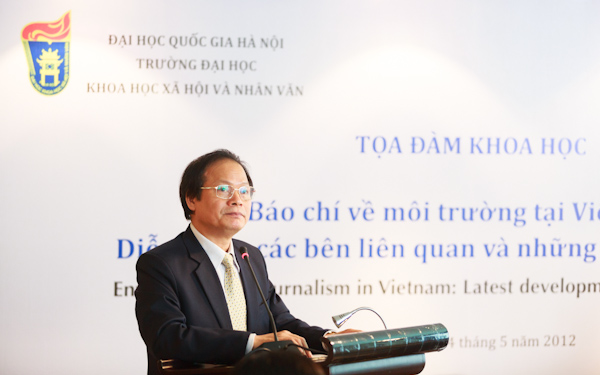
A scientific seminar on the topic "Environmental Journalism in Vietnam: Developments, Stakeholders, and the Latest Issues" was organized by the Faculty of Journalism and Communication, University of Social Sciences and Humanities, in collaboration with the Konrad Adenauer Stiftung Institute (Federal Republic of Germany) on May 24, 2012.The seminar included speakers from environmental management agencies, non-governmental organizations, media outlets, and journalism training institutions nationwide. Professor Dr. Nguyen Van Khanh – Rector of the University – attended and presented the keynote report at the opening session. The seminar focused on discussing the main topics: current pressing environmental issues that the press needs to pay attention to; current forms of media reporting on environmental issues in Vietnam; solutions for training environmental journalists – the necessity, experiences from around the world, and lessons for Vietnam.

Journalism on the environment and sustainable development
The environment and sustainable development issues are among the hot topics attracting the attention of the press and media. At the seminar, Associate Professor Dr. Le Ke Son - Deputy Director General of the General Department of Environment, Ministry of Natural Resources and Environment, stated that to improve the effectiveness of environmental communication in Vietnam, current environmental communication needs to focus on topics and issues such as: the need to unify some basic concepts about the environment, and the need to adjust the approach, methods, content, and communication skills in environmental matters to contribute to the formation of an "environmental culture".

Emphasizing the role of the press in communicating about the environment and climate change, Dr. Pham Thi My (Editor-in-Chief of the Resources and Environment Newspaper) stated that media outlets have considered the environment and climate change as pressing issues; public opinion from the press creates social pressure on competent authorities to address environmental problems. However, according to Dr. Pham Thi My, current communication about the environment and climate change still has limitations: it does not comprehensively reflect all issues related to the environment and climate change; most of the content focuses on condemning and criticizing actions that affect the living environment and ecological environment by specific businesses and economic corporations; and it criticizes the decisions of competent authorities regarding pollution control that are deemed inappropriate. There is a lack of critical articles on policy… Regarding the issue of sustainable development, Professor Dr. Truong Ba Thanh (Rector of the University of Economics, Da Nang University) also believes that it is necessary to emphasize strengthening communication and promotion to the community, and to comprehensively assign responsibilities in environmental awareness campaigns. Currently, the media only focuses on prominent issues and not on issues related to stable and sustainable environmental development. Associate Professor Dr. Nguyen Chu Hoi (Deputy Director General of the General Department of Seas and Islands of Vietnam - Ministry of Natural Resources and Environment) believes that while climate change issues in coastal areas have received more attention, climate change in the global oceans has not received adequate attention. Therefore, it is necessary to focus on communicating about climate change issues in the oceans, because changes in ocean climate also lead to changes in global climate.
Problems and solutions in environmental journalism.
Discussing the challenges in environmental journalism, journalist Hoang Quoc Dung (Chairman of the Vietnam Environmental Journalists Forum) pointed out both tangible and intangible obstacles: obstacles in accessing information, the lack of regulations to support and guide information access; difficulties in accessing justice, and obstacles from the management mechanism. According to journalist Hoang Quoc Dung, the environment is an easy topic to write about, but it is also one of the most difficult topics to write well about. The competence and quality of journalists are also the biggest obstacles in environmental journalism. According to journalist Dong Manh Hung (Director of VOV Television - Voice of Vietnam), the environment is a hot topic but also always a sensitive one. How to effectively disseminate information is something that media organizations must consider. Journalist Dong Manh Hung shared that when doing environmental communication, media organizations must have a strategy. That strategy must closely address major global and national environmental issues today… Journalists, with their passion for writing about the environment, need training not only in professional skills but also in environmental knowledge and climate change mitigation. Ms. Bui Viet Ha (Lecturer at the Faculty of Journalism and Communication), through her case study of the “Clean Coal Production Project from Industrial Waste,” proposed a community-based communication model where community members are both subjects and objects reflected in communication messages. Ms. Bui Viet Ha particularly emphasized that the core issue is that communication must lead the way, based on the urgent needs of the community, so that the community will speak up and demand protection. Only then can environmental protection be maintained effectively and sustainably.

Training Environmental Journalists: Currently, no university in Vietnam offers specialized training programs for environmental journalists. Dr. Huynh Van Thong (Head of the Faculty of Journalism and Communication - University of Social Sciences and Humanities - Vietnam National University Ho Chi Minh City) stated that training professionals specializing in environmental journalism is a "gap" in the curriculum and organizational capacity of Vietnamese universities. Journalism faculties in Vietnam need to proactively collaborate and cooperate to jointly develop a theoretical framework for environmental journalism as a foundation for training and research in this field.

In light of this situation, Dr. Dang Thi Thu Huong (Head of the Faculty of Journalism and Communication - University of Social Sciences and Humanities - Vietnam National University, Hanoi) affirmed: Environmental journalism has emerged and is creating a generation of journalists specializing in environmental writing, effectively informing, analyzing, educating, and guiding the public on the risks and hazards affecting the environment and ecosystems, while also proposing solutions to promote and organize public participation in environmental protection measures. The challenge is that environmental communication requires knowledge and skills, and journalists specializing in environmental writing need professional training. The Faculty of Journalism and Communication, University of Social Sciences and Humanities, Vietnam National University, Hanoi is adjusting its training program and will soon include courses on environmental journalism. According to the training process, students who choose a specialization in environmental studies will be guided to undertake internships and practical training at environmental news agencies or environmental information and communication units. This scientific seminar serves as a basis for the Faculty of Journalism and Communication to learn from experience in order to build a training program framework that meets practical requirements, while also contributing to building a network of cooperation between scientists, environmental journalists, and journalism training institutions.