


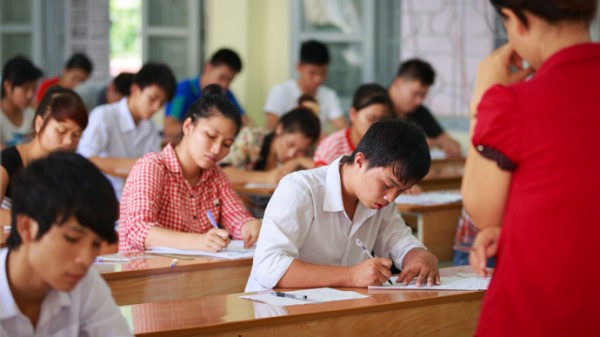
Amidst much debate about whether this year's university entrance exam in Literature for Group C was easy or difficult,Teacher Tran Hinh(A lecturer from the Faculty of Literature – University of Social Sciences and Humanities) shared his perspective.
- Could you please share your assessment of this year's Literature exam for Group C in the university entrance exam?
In my opinion, this year's exam was good. The most fundamental advantage is that it didn't focus on rote memorization, but on understanding. I believe that with this approach, students will learn how to prepare for exams effectively. They'll understand that passive learning, rote memorization, and studying without understanding the material will make it difficult to do well. Whether the exam was easy or difficult depends on each student's learning style. If they learn actively, it will be easy, but if they learn passively, just rote memorization, it will likely be difficult. I've also read numerous student reviews online, and most students found it difficult. That's understandable, as most of them learn passively. Otherwise, I didn't see any questions outside the curriculum. Everything was within the textbook.

- Although essay questions on social issues have become familiar to candidates over the years, the content of the social issues addressed in the exam is still often debated regarding its appropriateness to the candidates' level of understanding. So, how do you assess this year's essay question?
That's right.social commentary essay typeThese topics have been familiar to students for many years. However, every year, the issues chosen for the exam questions are within the understanding of high school students, such as honesty in exams, admiration and infatuation with idols, knowledge from books, hypocrisy, and human indifference...
This year, the exam touched upon a very significant issue: the character and soul of the Vietnamese people. In my opinion, this is a challenge for high school students. I admit, this is a difficult issue for the understanding of high school students.
However, from another perspective, I think that if our methods of teaching and learning Literature changed, and we didn't maintain the one-way, rote-learning, passive approach, then students would easily solve the problems we consider difficult. For example, if in the classroom, the teacher taught students using a dialogue-based method, asking questions and allowing students to answer the issues drawn from the lesson, even allowing students to debate the issues, avoiding a one-way approach, and expanding the lessons from the textbook to real life, then the problems wouldn't be difficult at all!
In short, in my opinion, we need to be decisive in the teaching method of Literature, emphasizing active learning and understanding, rather than rote memorization or memorization as discussed in online news recently. If we do that, I believe all the exam questions, like this year's, are well within the students' capabilities.
- Many candidates shared that although they could answer the optional questions 3a and 3b (the questions that carried the most points in the exam), they lacked confidence because the question format was "unusual" compared to previous years. What are your comments on the way these two questions were formulated?
Let me reiterate this: it's true that this year's exam is not for weak students, those who only know how to learn passively, or even for teachers who have long taught students by only superficially and shallowly grasping the meaning of language, without delving deep enough to find the "ore hidden beneath the words."
Specifically, regarding question 3a, which asks students to express their feelings about the image of the soldier in Quang Dung's poem "Tay Tien," and to comment on two statements ("the soldier embodies the beauty of a warrior during the resistance against the French" and "the soldier has the appearance of the valiant warriors of the past"), I think that students mainly focus on analyzing the image of the soldier in the first statement (the beauty of hardship and heroism, the beauty of romance and gallantry, the beauty of a correct understanding of sacrifice and loss, and the beauty of immortal death), and combine it with further commentary on the second statement (the soldier has the appearance of the valiant warriors of the past). Because Quang Dũng wrote this poem in a very unique style: using many archaic words, evoking the atmosphere of ancient battlefields such as borderlands, ceremonial robes, solitary journeys, distant lands, soldiers viewing death as light as a feather, with some resemblance to the soldiers in Chinh Phụ Ngâm… it easily evokes, to some extent, associations with soldiers of the past, and there is nothing wrong with that. Above all, it is still a modern-day soldier.
Question 3b asks for an analysis of the two characters, Tu and the fisherman's wife, in two different works, but it subtly introduces two opposing viewpoints designed to "trap" students: Tu's forbearance is "not blameworthy, only pitiable," while the fisherman's wife's forbearance is "both blameworthy and pitiable." This question is indeed difficult for a student lacking confidence. It requires not only knowledge from the lesson but also real-world experience. I honestly don't fully understand the question setter's intention, but if I were allowed to answer immediately, I would readily assert: Tu is both blameworthy and pitiable, but the fisherman's wife is only pitiable and not blameworthy. Of course, to fully explain this point, a longer and deeper discussion of the works is needed. And in my opinion, literary figures should be left to readers to express different opinions, as long as they are reasonable, rather than imposing one interpretation or limiting themselves to a single understanding.
- With this exam paper, what do you predict the candidates' scores will be?
In my opinion, the exam scores this year will not be high, at least not higher than last year.
- With the recent improvements in the way university-level Literature exams are designed, moving towards a more "open" approach that encourages students to think critically and express their own opinions, do you think this has a positive impact on evaluating the teaching and learning of Literature in high school?
In my opinion, if the exam format remains the same as it is this year, I don't think it will have a positive impact on the teaching and learning of Literature in high school, as it has been in previous years – some years even had outdated exam questions. I find that having students rely on model essays for exam questions is terrible; it will gradually kill off the subject of Literature!
- What are your personal views on designing a university entrance exam in Literature that accurately assesses candidates' abilities?
Regarding this year's exam, don't repeat clichés, don't ask questions that rely solely on rote memorization. Of course, it all depends on the grading. I also don't have much faith that hundreds of teachers grading tens of thousands of exams in 2 to 3 weeks can provide a fair and objective assessment of the students. One of my long-time teachers keeps repeating the same thing to me every year:My dear, why are my students taking the literature exam so unpredictable – sometimes they're good but fail, while others who aren't so good pass?"And I could never answer my teacher's question either!"