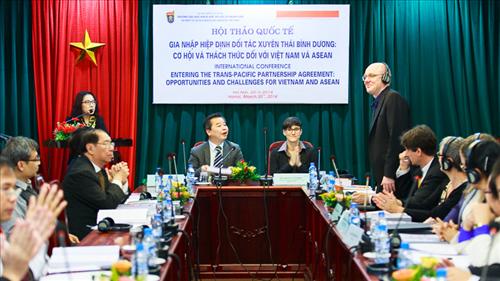
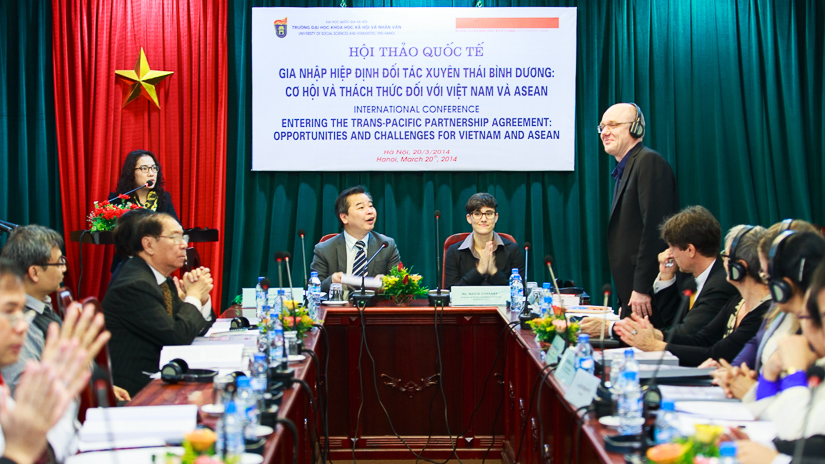
(Photo: Jackie Chan/USSH)
The Trans-Pacific Strategic Economic Partnership Agreement (TPP), officially known as the Trans-Pacific Strategic Economic Partnership Agreement, was initiated by the heads of state of Chile, New Zealand, and Singapore during the APEC Summit in Mexico in 2002. This was a multilateral free trade agreement aimed at establishing a common free trade area for member countries in the Asia-Pacific region. Negotiations began in late 2009 with five member countries, and by 2013, 12 member countries had joined, including Vietnam. With the current 12 members, if signed, the TPP would create a vast free trade area encompassing 800 million people, accounting for over one-third of global import and export trade and nearly 40% of global GDP. The TPP was expected to be a "high-standard" agreement of the 21st century, with deep liberalization and high-level trade principles. For Vietnam, the TPP negotiations are one of the most important trade negotiations, alongside other existing free trade agreements such as those with the EU, South Korea, EFTA, and RCEP.
At the seminar, presentations shared analyses of the significant opportunities for Vietnam when participating in the TPP, including: helping Vietnam balance trade relations with key market regions, avoiding dependence on any single market region; contributing to the improvement of the market economy institutions and the investment and business environment; promoting transparency in management mechanisms and policies, and fostering economic development… Alongside these, the challenges that Vietnam needs to address include: increased competition in both breadth and depth in trade activities; the potential for an unequal distribution of benefits among regions and industries; interdependence between Vietnam and TPP member countries; and incompatibility between Vietnam's legal system and workforce with TPP commitments…
Many other topics were also explored and clarified at the workshop, such as: the TPP and the challenges to ASEAN's central role in regional economic integration in the Asia-Pacific; Vietnam's economic diplomacy strategy and the TPP Agreement; Vietnam-US relations towards the TPP Agreement; neutralizing intellectual property conflicts among TPP negotiating countries; the relationship between TPP and RCEP – opportunities and challenges for ASEAN…
Author:Thanh Ha
Newer news
Older news

