
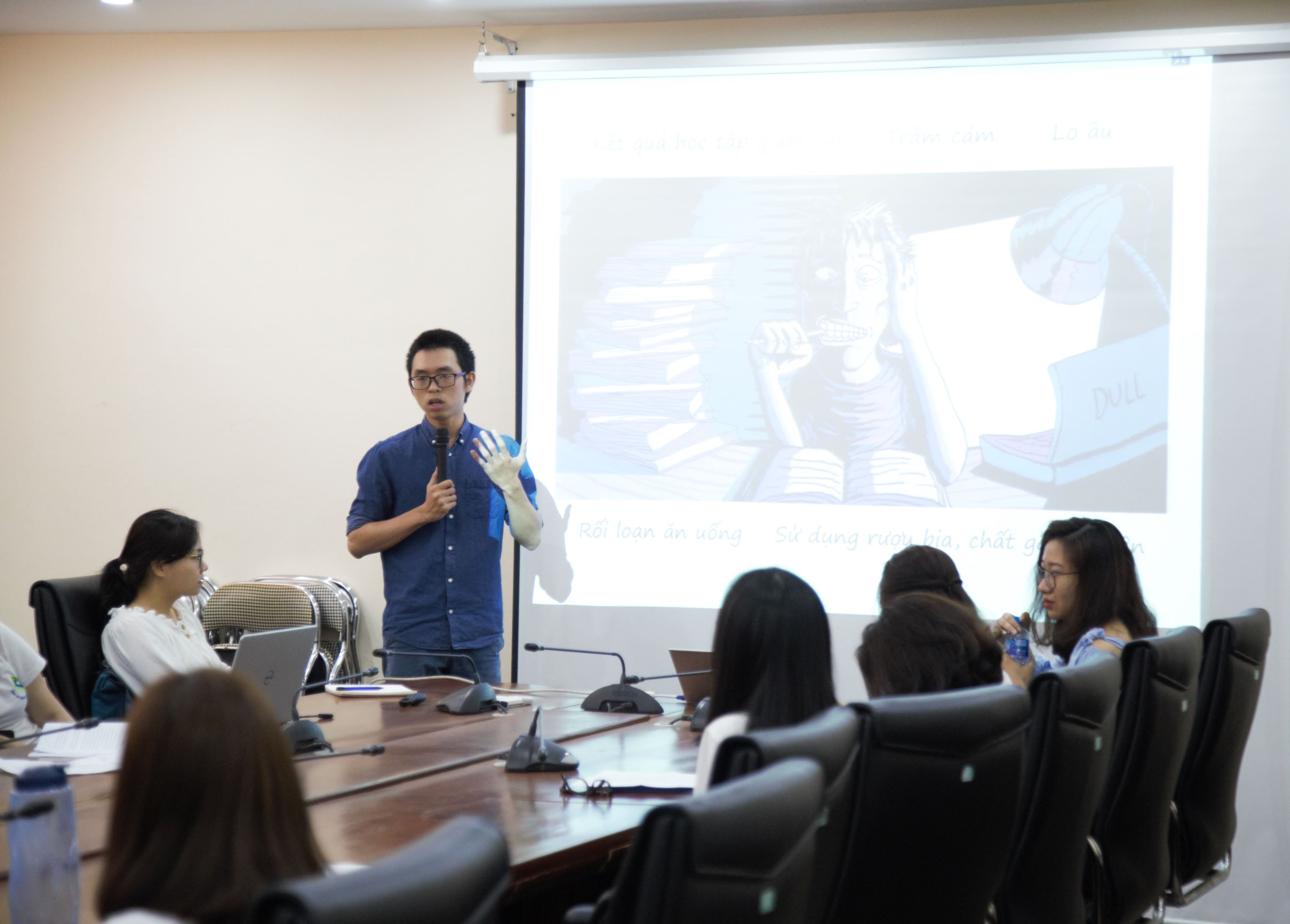
The authors present the report "Coping with Academic Stress in Students".
Academic stress is quite common among students.
One of the two authors of the study, student Nguyen Ngoc Quang, shared the reason for undertaking this topic: “In Vietnam, finding a study on academic stress among students is difficult, and finding a study focusing on coping with academic stress is even more challenging. Meanwhile, academic stress is a perennial problem, and how students cope with it is very important.”
This research was conducted based on the Interaction Theory of Stress to understand the sources of academic stress among students. Through a survey of 157 students at the University of Social Sciences and Humanities, the authors identified 12 sources of academic stress. Of these, 50% of students chose the following as common stress sources: academic results, tests and assessments, and the volume and difficulty of assignments. According to this survey, difficulty adapting to the university environment is a specific source of stress for first-year students. Specifically, this includes not yet adapting to the learning organization methods, teaching methods, or how to prepare for final exams. For third and fourth-year students – those focusing on specialized subjects – the lack of abundant and high-quality resources for essays or research can also cause stress.
The study also noted a high percentage of students who were proactive and positive in coping with academic stress. These coping mechanisms included: regulating immediate emotions, accepting reality, maintaining a positive mindset, and developing strategies for self-improvement. Students in this positive group experienced lower stress levels. Based on their relationship with learning motivation, these students responded with problem-solving strategies leading to higher academic results. Conversely, students who avoided problem-solving experienced higher stress levels and lower academic performance.
Stress isn't just a problem for students.
Authors Nguyen Ngoc Quang and Nguyen Linh Chi also raised the question: Is academic stress a problem unique to students?
The group hopes that their research findings will serve as a reference for developing appropriate training programs for different student groups. Importantly, by specifying the duration and workload each student must complete in a course, the management team can predict and develop a suitable, manageable, and timely learning program. This helps avoid excessive assignments and exams within a short period, which can easily lead to stress.
Furthermore, intervention programs, extracurricular activities, and skill-building initiatives for students should focus on helping them develop stress coping skills, maintain a positive mindset, be ready to change their perceptions, accept reality, and regulate their personal emotions. In addition, the university needs to provide the necessary resources to enable students to develop their problem-solving abilities. Especially for first-year students, the Youth Union and Student Association within the university have been striving to develop programs to help them improve their academic performance and access effective university-level learning methods.
The scientific research project was evaluated by the professors on the judging panel as quite systematic, with clear and professional citations, along with a well-structured research hypothesis and good data analysis. It is known that Ngoc Quang had been contemplating this topic since his first year as a student and completed it recently with the collaboration of Linh Chi. Besides the advantages of effective teamwork, when discussing the difficulties in the research process, Linh Chi stated that finding and understanding foreign-language sources remained a limitation for the group.
The research topic "Coping with Academic Stress in Students" also won an award in the "Outstanding Applied Research" category of the Green Torch Award – an award for student scientific research on practical issues relevant to students and with practical applications. Sharing their thoughts on this, the authors stated that science must serve the purpose of improving the quality of human life, and if this research can contribute in some way to that purpose, then that is the goal the authors are aiming for.
Author:Le Nhan (CMP)
Newer news
Older news

