
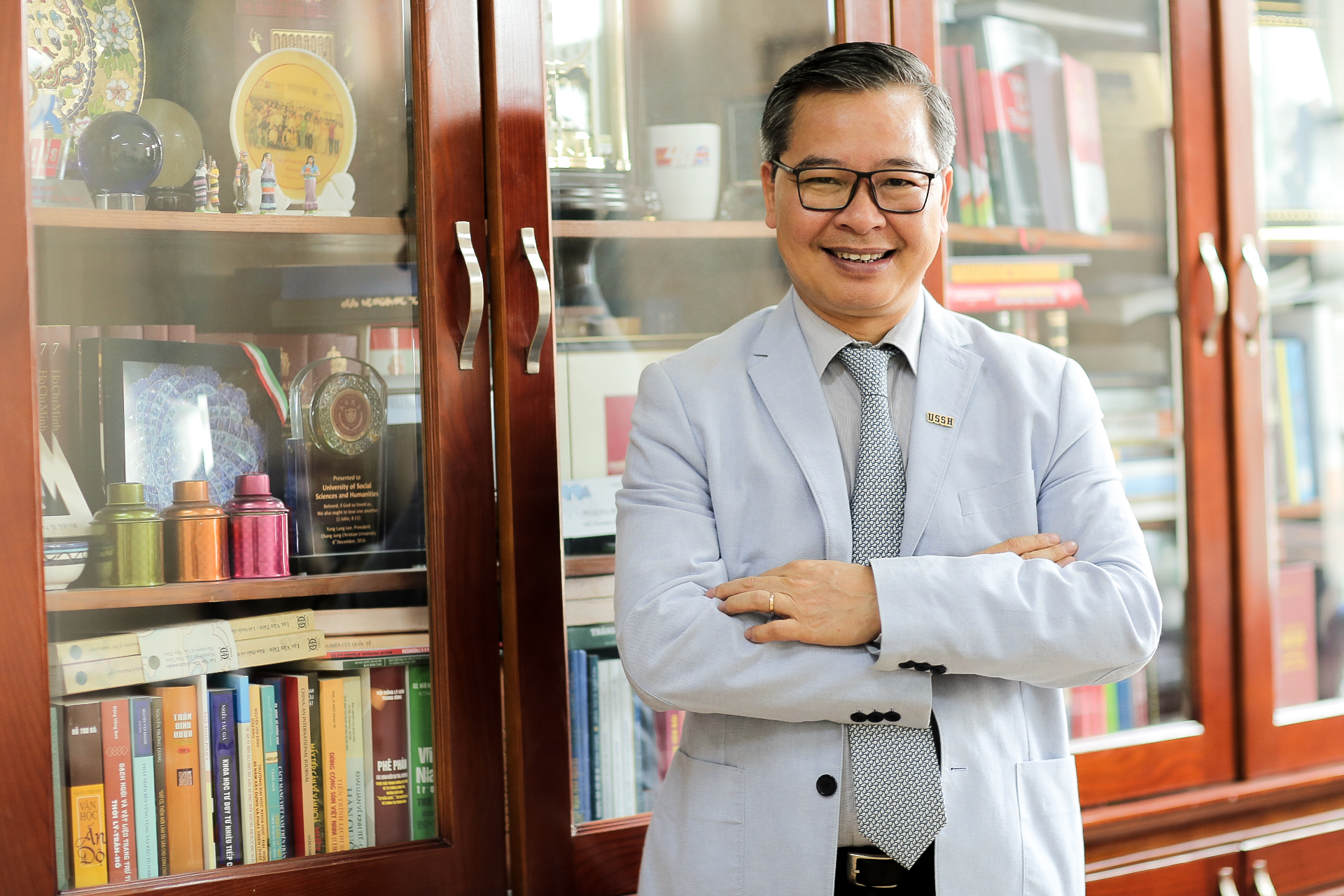
Professor Pham Quang Minh
Many talented students cannot find jobs.
- Recently, the ranking of U21 national education systems by the Institute for Applied Economic and Social Research at the University of Melbourne, published in 2012, ranked the top 50 countries in the world, but Vietnam was absent from all categories. Many people are questioning the quality of higher education in Vietnam. What are your thoughts on this?
We need to look at it from two perspectives, not just from the university's point of view, but also from the perspective of our society and economic institutions.
In a market economy that is still incomplete and in the process of formation, and in a society that does not yet rely on evaluating people based on their abilities, the fault does not lie solely with the universities.
In fact, many of our brightest students still can't find jobs after graduation.
- What consequences will that situation lead to, sir?
It will impact other students. They will ask why they have to study so hard and excel academically when other students don't need to study hard and still get jobs after graduation?
Vietnam's current situation is a mix of both severe shortages and surpluses. There's a shortage of skilled people capable of doing the jobs, and a surplus of people who are incapable.
This has been discussed extensively; some even say that up to three-quarters of those in the public service system fail to meet the requirements. This is due to very low recruitment criteria or other factors (a, b, c).
But it's impossible to remove them from the system. Because they're already civil servants.
University autonomy is a trend we are moving towards, a necessary condition for implementing advanced university governance methods to improve and enhance the quality of education. So, is this a barrier?
I consider that the biggest obstacle. To achieve autonomy, we need to remove those who don't meet the job requirements. However, that's impossible because it violates labor laws. Meanwhile, we can't hire new people either, because it would make the organization too large.
I'm in the same situation; I have 500 employees, many of whom don't meet the requirements. But I can't fire anyone. That's why I think autonomy is still a much-talked-about issue, but it hasn't been fundamentally resolved.
University lecturers must hold genuine doctoral degrees.
- The fact that only 27% of our university lecturers hold a doctoral degree, compared to the average of around 70% in other countries in the region, is quite concerning. Will this also affect the quality of higher education?
This is a big issue. In my opinion, university lecturers must have a doctoral degree. A bachelor's degree is not enough to teach at a university. A master's degree is also not in accordance with regulations.
But they must be genuine PhDs. If those 27% of PhDs were trained seriously, systematically, and with good quality, then the education system wouldn't be so bad. The biggest fear is that among them there are still fake PhDs.
- The story of "paper doctorates" has been discussed extensively. In your opinion, what are the reasons behind this?
Other countries around the world don't have entrance exams for doctoral programs like we do; instead, they are selected by the professors themselves, the heads of the research programs.
For example, when a professor has a research program, they will advertise widely to select graduate students who meet the requirements, resulting in a very high level of competition, both domestically and internationally.
In our system, exams and essays cannot adequately assess the level of research candidates. The committee also gives general assessments according to regulations, rather than truly considering whether the individual has the capacity for research.
Furthermore, universities also need more graduate students to meet their enrollment targets and increase revenue. Therefore, universities often only conduct preliminary interviews and review applications, accepting only those who meet the hard criteria.
- This leads to a difference in the quality of PhDs between Vietnam and the West, sir?
Abroad, from the very beginning of a research project, professors must simultaneously conduct their own research and train graduate students through activities such as experiments, fieldwork, overseas trips, and participation in conferences.
Graduate students will gradually mature. They don't have to pay tuition fees, yet they still have the funds to conduct research and fulfill their professor's requirements. Each completed dissertation is a truly significant scientific work, solving a real scientific problem...
In our country, graduate students have to worry about food and accommodation costs, and their research time is limited... They don't study properly, and after three years, they often present a thesis of low quality, with very little new information.
Every dissertation claims to be a valuable reference source for researchers, managers, and anyone interested, but its actual value is unknown, and it contributes little to academia and life.

Bringing joy and benefit to society doesn't require a degree.
- Fake degrees, the pursuit of degrees by any means necessary, ultimately all stem from our "degree culture," don't they?
This is influenced by Confucian tradition and the examination system that has existed for thousands of years. Accordingly, those who wanted to become officials had to study and pass the examinations of the feudal dynasty.
The government currently recruits people with degrees. Therefore, many officials use fake degrees, doing everything they can to obtain them. Of course, a genuine degree is good, because having an education is an advantage. But many people have abused this.
- And does that also relate to the idea of getting into university at all costs, sir?
That's right. Germany doesn't have famous universities, but they boast some of the world's most skilled workers, producing some of the world's best machinery and automobiles.
The German education system is called a dual education system. From the sixth grade onwards, students are divided into two paths: one for those capable of attending university, and the other for those pursuing vocational and technical schools.
No one is upset about having to attend vocational schools or practical training centers instead of university. And only one-third of students pursue university education, while the remaining two-thirds choose vocational training or practical training.
This is true because human abilities are diverse. Some people have research abilities, some have artistic abilities, some have athletic abilities, some can do manual labor, some can do intellectual work, and so on. That's normal.
But in our country, even those who are poor students try their best to get into university at all costs, because having a university degree makes it easier to find a job.
- A story has gone viral on social media about a top-scoring student who passed the entrance exam to the Foreign Trade University and started selling mixed rice paper snacks. And after graduating, he returned to his old job. What are your thoughts on this story?
I think perhaps that person just wanted to prove they could attend a top university, but the degree itself wasn't really necessary. Because they still find joy in making mixed rice paper snacks. They wanted to prove that someone who makes rice paper snacks can also go to university, but they have no other passion besides making them.
Society views making rice paper as a low-status profession. But I believe that if a profession brings joy and benefit to society, then any profession is noble, and qualifications are unnecessary.
Thank you very much, sir!
According to khoahocdoisong.vn
Author:Mai Loan
Newer news
Older news

