
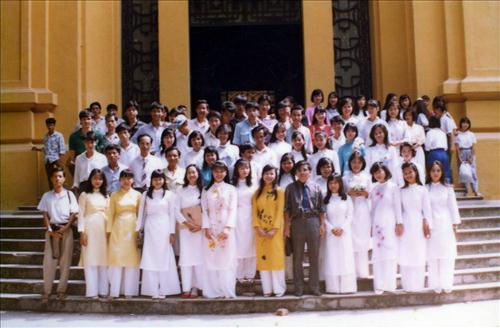
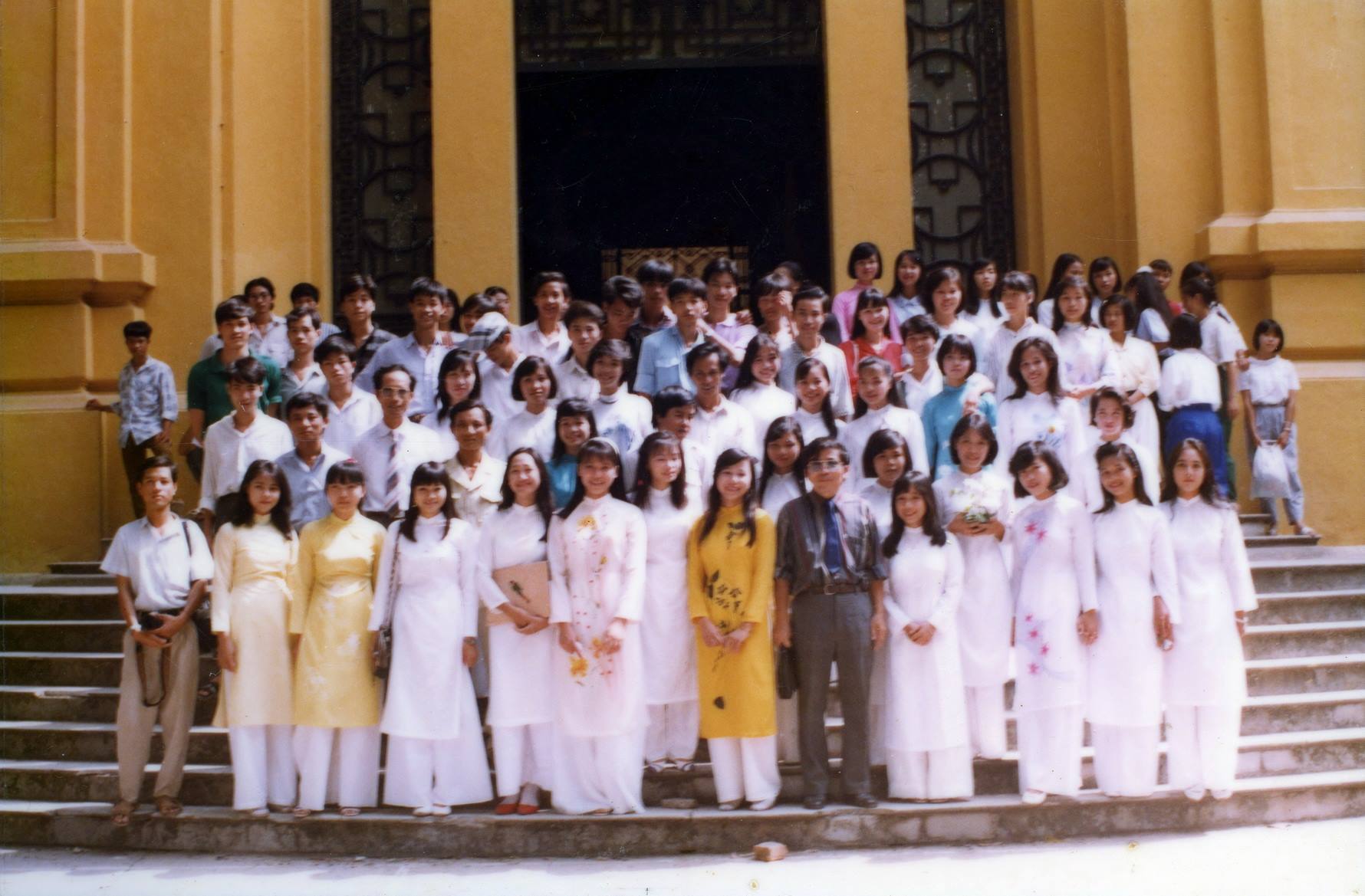
Faculty and students of the Journalism Department take a commemorative photo in the Le Thanh Tong lecture hall.
I vividly remember my first impression of the Journalism department – it was overwhelming because the environment was so dynamic. My classmates, though still students like me, were already working; some in businesses, others as seasoned writers for newspapers, and some even as editors. Stepping into that environment, I felt like I was "behind the times," unsure of what to do and where to begin. But perhaps journalism is one of the professions where solidarity and camaraderie are most clearly demonstrated. With the help of my classmates and my own confidence and eagerness to learn, I took on topics and wrote alongside them. And then my articles were published. The fact that my writing met such high standards was thanks to the knowledge and skills I accumulated from my friends and teachers.
I remember that the curriculum for the first two years of journalism studies was quite demanding and difficult, not only with general subjects but also a lot of literature. Like many students today, I didn't fully understand the importance of those subjects and kept wondering, "Why do I have to study them...?" But once I started working, I realized something profound: what I learned in the curriculum wasn't superfluous at all, but crucial because it formed the foundation for excelling in any professional role. My curriculum back then wasn't just about general and specialized knowledge; it also emphasized "learning by doing." The department invested in the most modern equipment possible for students to practice. I vividly remember the first feeling of holding the department's camera and video recorder, taking my first photos and videos with my own hands. It felt like I was holding a "treasure of the era" in my hands because the equipment in the department was very modern compared to the surrounding environment. After many years, perhaps the curriculum in the department will have changed, but I believe it will always be the most complete and progressive curriculum, closely following the development trends of the times. Surely, after completing that program, future graduates will be very confident in their abilities. What I am most proud of when talking about the Journalism department is that I studied under the teaching of professors and doctors – lecturers who are very profound and insightful in their respective fields, and more importantly, dedicated educators. The lectures of the professors were not only theoretical and specialized knowledge, but also instilled in me the principles of interpersonal relationships in life.
The task of a progressive university is not to provide the right answers, but to ask the right questions.[1]The environment at the University of Social Sciences and Humanities in general, and the environment within the Faculty of Journalism and Communication in particular, is a progressive and highly academic environment. This demands not only breadth but also depth and complexity of knowledge from each student; therefore, self-study and research to meet the requirements of lecturers are very important. I strongly agree with Bill Gates that: “When you are in school, if you encounter difficulties in your studies, there are teachers to help you. However, if at that time you feel that all difficulties are due to overly strict requirements from the teachers, then you shouldn't go to work after graduation. Simply put, if there are no strict requirements from the company, you certainly won't be able to do anything and will quickly become unemployed; moreover, at that point, no one will help you.” Experiencing the scientific, serious, strict, and high-quality academic environment at the faculty has helped me adapt more quickly to the work pressure of newsrooms, even though I was a recent graduate. Thanks to that environment, a very clear characteristic of students in the Faculty of Journalism and Communication is their solid foundation of knowledge, independent research ability, and creativity in their work. This has been proven through the undergraduate classes trained by the Faculty of Journalism and Communication. Observing the groups of students who interned and worked at Vietnamnet, I am quite satisfied because the students grasped the pace and progressed very quickly in their work skills, although they still need some guidance. Compared to my generation, the gap between newly graduated students and working journalists has narrowed significantly.
2015 marked the 25th anniversary of the Faculty of Journalism and Communication, a year to reflect on its proud history and also to embrace new challenges as the ASEAN Economic Community was established and the ASEAN Community was fully formed at the end of 2015. As Vietnam increasingly integrates with the world, an inevitable trend of the times, a new door opens for the faculty's progress, with ever-increasing competition and pressure from human resources in neighboring countries. However, I believe this will be the driving force for the remarkable development of the Faculty of Journalism and Communication because, following Vietnamnet's motto of "accompanying the nation," serving the national interest, Vietnamese journalists, more than anyone else, easily grasp the function of Vietnamese journalism and Vietnamese national culture. However, each individual still needs to selectively learn from advancements in journalism from other countries; therefore, self-improvement in foreign languages, programming languages, access to modern communication technologies, and work ethics is essential for modern journalists.
As a former student of the faculty, and as a senior colleague, I and my fellow alumni at Vietnamnet are always ready to welcome and guide students from the Faculty of Journalism and Communication who come to Vietnamnet for internships and work. Vietnamnet always looks forward to and listens to the comments, suggestions, and ideas of our students – our future colleagues. This is not simply a matter of friendship, but also a sharing of work with the faculty members – the respected teachers to whom I will always be grateful.
Just yesterday, I was like many other students today, joining hands to celebrate the 10th anniversary of the Faculty. Now, 15 years have passed since I graduated, and the Faculty has also celebrated its 25th anniversary. I am proud to be a graduate of the Faculty of Journalism and Communication, proud to have left the University of Social Sciences and Humanities – the cradle of humanities and humanities in our country. I am proud of the university I chose, proud of the path I have taken. Congratulations to the Faculty of Journalism and Communication on its 25th anniversary!
Pham Anh Tuan
Former student of class K41
Editor-in-chief of Vietnamnet online newspaper
Newer news
Older news

