We set off to the echoes of battle songs. But on this journey, we didn't have to put aside anything heavy, nor did we have to put aside our pens and books; we simply left behind the quiet grounds of the Faculty of Humanities, sluggishly waking up on the first day of the holiday. We traveled in a large, imposing, bright red passenger bus, as long as a train carriage. We called it the "drunken train carriage," because we discovered that each person had a bottle of strong liquor in their backpack. We were all in our fifties and sixties, and didn't know how much we could drink, but amidst the joyful holidays, "Who forbids us from getting drunk, even divinely drunk?" Even if it was just "rumbling around," as long as we had liquor to raise and lower, and looked at each other, it was enough to make us happy. The war had receded into the distance, a story from half a century ago.
The delegation of veterans from the University this time included representatives from all branches of the armed forces: infantry, navy, communications, anti-aircraft, and from all battlefields: B, C, and the North-South border. Delegation leader Nguyen Chi Hoa discovered two veterans in the group: Nguyen Long and Tran Xuan Hong, who were still "young and fresh," not yet "veterans." Both had fought on the Southwestern border and then went on to fight to defend the northern border in 1979. The delegation also included two female veterans: Tang Kim Oanh from the Vietnamese Studies department and Lieutenant Colonel Nguyen Hong Phuong – the "lifelong bodyguard" of Dr. Tran Nhat Chinh. The youngest, healthiest, and most attractive person in the group was arguably Mr. Nguyen Van Thuy, Head of the Inspection Committee and representative of the University's militia. The highest-ranking member of the delegation was Mr. Pham Quang Long, former principal and director of the Hanoi Department of Culture. Mr. Long was there because the delegation was going to Quang Tri – a province that has been a frequent destination for decades. Despite making twenty trips to Quang Tri, he still hasn't found the remains of his older brother, martyr Pham Quang Thang, who died in 1970.
Leaving the school gate, the "Drunken Train" merged into the traffic on Nguyen Trai Street. After the campaign to clear away the rows of classic green acacia trees, Nguyen Trai Street became unfamiliar and deserted, reminiscent of a capital city with empty gardens and houses preparing for war. Cars sped along the road like swarms of ants. Someone in the car complained, missing the tree-lined streets, but the atmosphere of departure prevailed. We happily left Hanoi. The joy of the veterans in the car was doubled by an unexpected piece of news: Associate Professor Dr. Vu Ngoc Loan could not leave with the delegation due to an unexpected family matter. But Dr. Loan did not give up; he would make arrangements and catch up later. It was truly rare news. According to the plan, several veterans had registered to participate, but at the last minute, due to health reasons or because their wives and children insisted they go on a family trip, they had to decline and could not attend. The story of Loan chasing after the vehicle reminded me of the time I chased after the convoy of my unit heading south, into the battlefield, years ago.
The train's movement didn't drown out the sounds of laughter and mobile phone conversations. There were calls from school leaders inquiring about our well-being and wishing the delegation a pleasant and successful journey. There were also admonitions, like a wife advising her husband: "Holding a bottle of wine and a handful of spring rolls, don't get so caught up in the fun that you forget everything else…" Ah, so that's it. We, the veteran delegation, always manage to leave an entire carriage behind us whenever we travel. Our hearts are warmed by these family phone calls. At our retirement age, hearing our wives' advice on long journeys naturally brings us joy. But even without a call from our wives, without receiving such care, our fellow travelers still praise us as lucky to be freed from our cages.
Following that logic, my colleagues and I teased Mr. Chinh from the Vietnamese Language department, saying his trip would only be half successful because his wife was accompanying him. Our joke ended quickly thanks to Ms. Phuong's clarification: She was "carrying rice along with her husband" on this trip partly to maintain Mr. Chinh's health, and partly to offer incense to Mr. Dinh – the martyr Tran Nhat Dinh, who rests in peace at Vinh Linh Cemetery… Lieutenant Colonel Phuong's announcement moved everyone, making them realize the spiritual responsibility of the pilgrimage group. The trip became a pilgrimage filled with deep meaning and affection.
At 3 PM, the group arrived in Quang Trach, Quang Binh, a land of fire from the resistance war against the US. My war memories subsided, giving way to a feeling of nostalgia, especially when the bus turned towards Vung Chua – Yen Island. The road to the tomb of General Vo Nguyen Giap was now paved and smooth, with stalls selling incense and flowers for worship visible on both sides. The General's tomb is gradually becoming a spiritual tourist destination.
The days of national mourning for the last great figure of the generation of Ho Chi Minh's students and colleagues have passed. On April 30th, the crowds paying their respects to the General were filled with smiles, without any reproach. Many young couples held chrysanthemums, their faces radiant. After all, the General passed away at a ripe old age. The grief has subsided, and it is fitting to see cheerful, serene faces in commemorative photographs alongside the General. Perhaps, in the eternal heavens above, the General would smile contentedly at this.
Our group of veterans followed one another, each receiving an incense stick from the cemetery caretaker, approaching the tomb. The General's tomb was covered with a crimson velvet cloth. The entire group respectfully offered incense, commemorating their former highest-ranking leader. As we descended the hill, our feet still seemed to linger. Looking back, the General's tomb appeared like a question mark on the platform of colorful flowers. A heavy, somewhat eerie feeling arose in our hearts. We wondered when the elliptical wreath used in Vietnamese funerals first appeared. It seems our ancestors didn't do that. We hoped that one day, when visiting the General's tomb (and also the mausoleum of President Ho Chi Minh), Vietnamese people would carry light, fresh flowers, not these heavy, elliptical wreaths that only evoke the tragic colors of death. Flowers, especially artificial or nylon flowers, when used in funeral wreaths, lose their aesthetic essence. Flowers have always been a symbol of beauty. So, after the funeral days, when the deceased has surely gone to the "world of the righteous," we should bring beauty to the foot of the monument, tombstone, and mausoleum to honor the beauty of the spiritual world. Those fresh, delicate flowers will surely please the deceased more than heavy, intimidating wreaths, sometimes accompanied by artificially sorrowful faces.
Our car gradually moved away from Vũng Chùa. In the distance, Yến Island was devoid of birds. It seemed this island lacked the cliffs suitable for swallows to build their nests. Perhaps it was merely a migratory site for a seasonal species of swallow. Farewell, Quảng Trạch. We hope to return someday and see flocks of swallows soaring over the historical site of the heroic general. Cửa Ông is a coastal area in Quảng Ninh province with a temple dedicated to General Trần Quốc Tảng. One day, a temple might appear there, and Vũng Chùa could have another name: Vũng Ông.
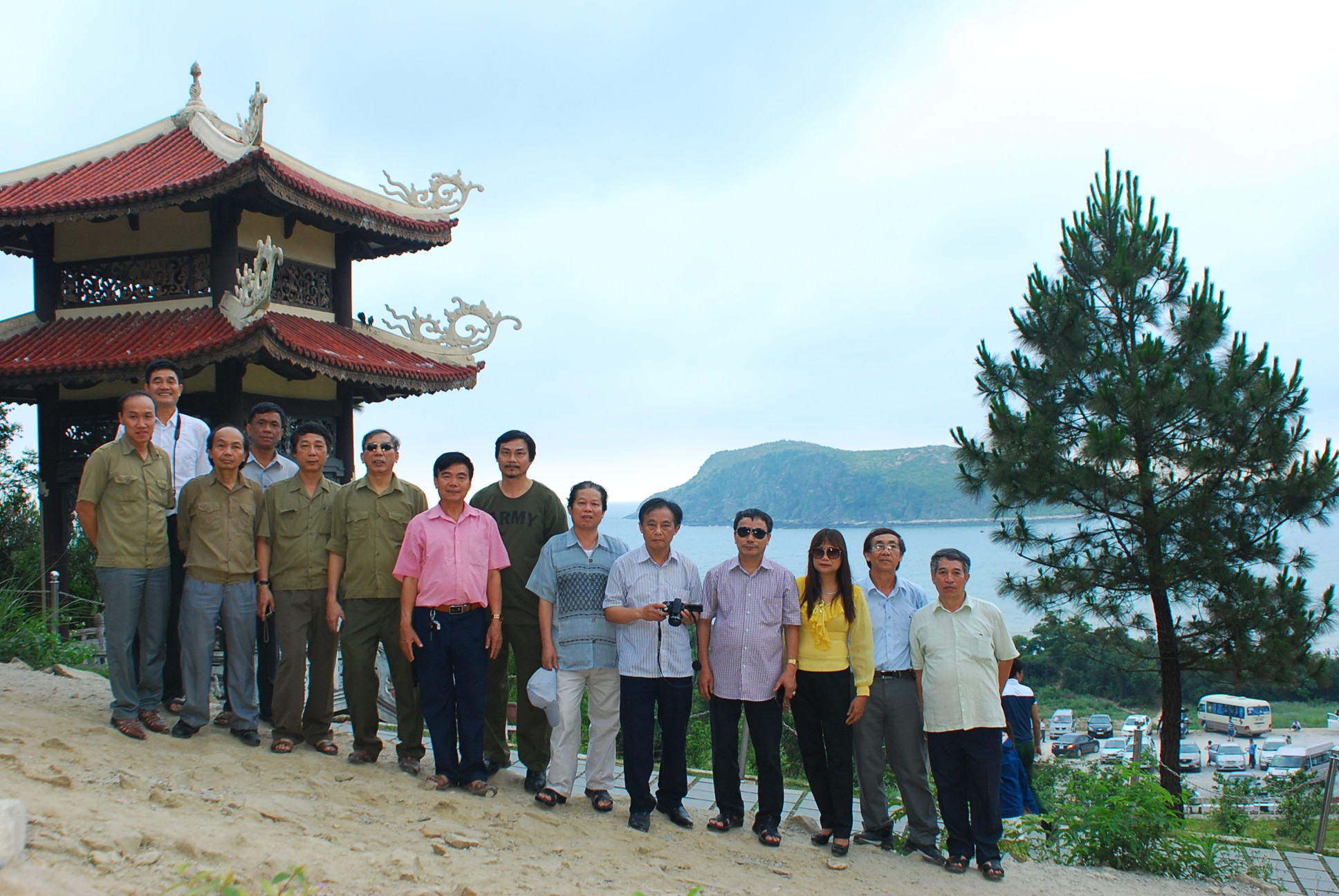
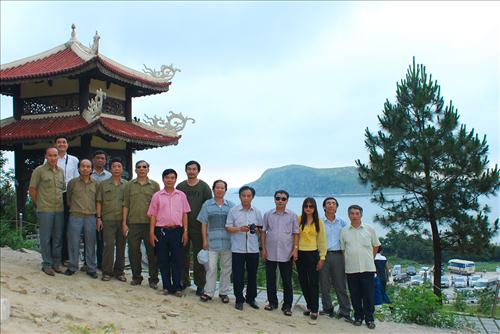
A group of veterans offer incense at Vũng Chùa - the final resting place of General Võ Nguyên Giáp (Photo: Vĩnh Long)
Our first day of the Veterans' Delegation's journey ended on a joyful evening in Dong Hoi city. As the city lights came on, Associate Professor of Mathematics Vu Ngoc Loan rushed in with his suitcase to join the Delegation like a refreshing whirlwind. He arrived with a cheerful face, thanks to a successful chase. We still remember him returning to the university from the army in his sailor uniform. He was also a member of the "No Number" ships, transporting weapons to the South across the East Sea. In 1972, while in his third year of university, this handsome mathematics student from Hai Hau volunteered to go to war. Seeing that he was from a coastal area, the "No Number" ships immediately recruited him. Sadly, after many days of training, he could only swim a few meters. The unit commander, knowing his weakness, utilized him in the engine room for technical calculations and tried his best to prevent him from falling into the water.
During the war, he served in the navy, not as a land-based soldier, so this pilgrimage by the veterans' group was also an opportunity for Mr. Loan to explore and learn about the wartime past. Upon meeting the group, he immediately gave them 5 million dong, a celebratory gift for the 40th anniversary of Reunification. Everyone was surprised and felt sorry for him. He confessed that it was his son's scholarship money that he had saved and sent to "his comrades." However, the 5 million dong wasn't a selfless gift. Along with that, he also asked the group to help him find a daughter-in-law. His son, after six years of studying in Canada and completing his PhD, still knew nothing beyond mathematics. He said that, unlike his father (who knew both mathematics and... love), his son blushed at the sight of a beautiful girl. So, at this joyous gathering, I would like to ask for your help in everything… Out of camaraderie, Vu Ngoc Loan, Vice President of the Association, Pham Dinh Lan, stood up and, on behalf of the Group, happily accepted the money, but… made no promises. Lan explained that the Group has quite a few beautiful young women of marriageable age. If the announcement were made widely, they would compete fiercely, potentially causing internal disunity within the Association…
Our group of veterans arrived at Truong Son Cemetery under the bright midday sun. We offered incense, paid our respects, and conveyed the gratitude of the School's leaders and staff to the spirits of over twenty thousand martyrs. At first glance, the cemetery appeared like fields of pink lotus flowers. Unlike in previous years, this year each martyr's grave had a plastic lotus flower. Looking at the stiff, molded flowers placed beside the burnt incense burners, we felt a pang in our hearts. Mr. Nguyen Van Mao whispered to Associate Professor Trinh Duc Hien about a few verses by Che Lan Vien. That poem, which appeared in the 1950s, is now rarely remembered, but it perfectly reflects our feelings at this moment.
...One day I went to the Truong Son Mountains.
Fall here, and the forest soil will become your grave.
The road doesn't go past there anymore.
The grave lies alone.
The vast plains are filled with the sounds of chickens and dogs.
The image of wife, the image of children, the image of house, the image of home.
The Party branch only meets once a year.
Send people to Truong Son.
Without flowers, spring has no grass.
What do we celebrate on Qingming Festival?
Add a few more mounds of stones.
Oh, the grave of the official!
Even in death, they still make sacrifices.
That's absolutely true; even after death, the soldiers in their graves continue to sacrifice and suffer. In this cemetery, the martyrs' graves are not lonely, but they occupy only a few inches of land, neat and square like a suitcase. Though they died young, should an entire life be confined to such a cramped concrete box? The martyrs seem to be yielding their land to the living. And today, 40 years later, on this important holiday, they are finally given a simple plastic flower. The flowers are all the same because they were molded from the same mold, like a ration of rice or ammunition divided equally among each soldier. May the souls of the martyrs happily accept it, as was customary in the military.
Beneath the legendary Bodhi tree that overshadows the memorial at Truong Son Cemetery, a cemetery caretaker inquired about Mr. Bui Thanh Quat. It turned out he knew Mr. Quat much better than we did. He said: "Once, Mr. Quat stayed with us at the cemetery for a few days, then returned home and decided to leave his family to become a monk…" Apparently, for decades, the cemetery has become an attractive spiritual tourist destination for many young people and students. Groups of young visitors often ask the cemetery caretakers to sleep with them in the courtyard of the memorial, so they can wake up in the middle of the night and witness and experience what are considered mysterious phenomena. They have heard and seen many things: heard soldiers laughing, playing cards, groaning in pain, seen groups of soldiers marching, and legless figures walking around… The cemetery caretakers often reassure the night-time visitors not to be afraid, saying, "The martyrs are just teasing you, they won't harm anyone." The way they call the returning martyrs "benevolent spirits" is accurate, because they all fell in their twenties, the brightest years of their lives. After offering gifts and donations, we thanked the cemetery caretakers and bid them farewell. As we left the memorial, the caretaker's words still echoed in our ears: "If you retire and have some free time, please come and stay with us for a few days."know"However, when spending the night with the martyrs, don't worry about whether you're an idealist or a materialist, and don't choose a philosophical stance before the tens of thousands of heroic spirits scattered across this cemetery."
The Đường Chín Cemetery is less than ten kilometers from Trường Sơn Cemetery. This was the third stop on our veterans' pilgrimage. After two years of renovation and upgrading, the cemetery's reliefs and monuments have become magnificent and impressive. It's inappropriate to call any cemetery a cemetery.PrettySimilarly, in the past, President Ho Chi Minh reminded journalists not to call victorious battles "beautiful battles," but to replace the phrase "beautiful battles."Pretty"turned into a "battle".good"That is a correct and humane aesthetic viewpoint. Because beauty is only connected to life."
Before the Quang Tri citadel, Highway 9 was the first battlefield in the author's military career. In 1972, standing on the high ground of Quan Ngang, I looked down at Highway 9 with a childlike longing. I wished I could set foot on the road to feel the cool sensation on the soles of my feet. Until I was 18, I had never seen such a wide, long, green, smooth, and solid road. The American military road, built at the time, looked like a bayonet from afar, gleaming green in the midday sun, but it meant death. Because along the roadside were anti-tank mines and landmines. If a person appeared on the road, they would become a target for OV10 aircraft or receive a sniper's bullet. After 40 years, this strategic road has lost much of its strategic significance, and especially, even with expansion and upgrading, it has lost the cool surface and the steely green color of the past.

A group of veterans offer incense at the martyrs' monument in the ancient citadel of Quang Tri (Photo: Vinh Long)
This year, on Route 9, I prepared nine offerings of incense at home for nine graves of my fallen comrades. To have enough time to go to Huong Hoa and the Ancient Citadel, I asked the members of the group to light incense for eight martyrs, as they are scattered in different areas. Mr. Chinh, Ms. Phuong, and Ms. Oanh helped me visit the martyrs from Ninh Binh and Thanh Hoa provinces. Mr. Tran Manh Hong, Mr. Bui Duy Dan, Mr. Nguyen Long, and Mr. Vuong Kha Dung helped me visit the martyrs from Thai Binh province.

The group of veterans took a commemorative photo at the memorial monument for the 10 young female volunteer soldiers who sacrificed their lives.Dong Loc Crossroads Cemetery (Photo: Vinh Long)
As for me, I went searching for the martyr Vu Dung – a former student of the K11 Literature Faculty at Hanoi University. Vu Dung died on the gun platform, like a hero. Even though he had been wounded, almost losing an arm, he didn't leave his position as gunner number 2, gritting his teeth and firing until a demolition bomb hit his head, blowing the entire gun platform apart. Only half of his body remained, wrapped in a bag.nylonBuried near Highway Nine, with a hastily made "headstone" from a thin sheet of corrugated iron, the name carved with a dagger... The night of April 23, 1972 – the most tragic night of my short military career – still occasionally startles me. Dũng's parents are gone; he was the youngest in a large but poor family, and the remains of Martyr Dũng remain a mystery. Years ago, the entire Highway Nine cemetery only had the name Vũ Lê Dũng listed in the register, but no inscription was made on headstone number 31, in the "Unknown Martyrs" section. A year later, I saw that grave number 31 had been moved to the "General" section, but the headstone now included the enlistment date: 1965. The "Lê" in his name and the number 1965 discouraged me. His family and classmates (such as writers Le Quang Trang, Nguyen Ngoc Ky, and Nguyen Thi Kim Cuc) all confirmed that the name "Le" never appeared in his school records, files, or pen names before 1970… Not knowing what else to do, I offered incense and prayed to the fallen soldier at his grave. Let me send my prayers to Vu Dung – the artilleryman and poet of the 308th Division. The name Vu Le Dung is a collective name – a group name of the soldiers with the surnames Vu, Le, and Dung who fought and rest in peace on this land. In that decisive battle on the afternoon of April 23rd, if not for a bit of luck, I would have been lying beside them. Forty years have passed; I am now a 60-year-old man, but they still live in my heart as the proud, immortal image of their 20s.
Leaving Dung's grave, I had to loudly remind the children who were leading the way and wandering around the cemetery to stop. When buying offerings, I thought of the fallen soldiers when they were alive and also of the children – the ones who would receive the offerings. I bought pens, candy, and fruit, but not cigarettes, because I didn't want the children to start smoking and become addicted. They could use the pens, and it was something the fallen soldiers and our company dreamed of having when they were alive – a pen with a smooth ink flow, to pass around and write letters… I reminded the children to wait for the incense to burn a little before “asking the spirits.” They listened, stepping aside a bit, but as soon as I turned my back, they rushed back in to grab them. I closed my eyes, pretending not to see, and comforted myself: The fallen soldiers must have urged them to take them. The children here are friends of the fallen soldiers. They were all cheerful, generous, and had been sharing candy with children for decades.
The sky over Quang Tri remains blue and hot, perhaps even hotter than during the war. The faint smell of burnt grass, the lingering stench of decaying corpses carried on the hillside breeze, is gone. After several decades, Nghia Hy village now boasts rows of ancient mahogany trees. The hills once covered in rhododendron and myrtle blossoms are now filled with fields of sweet potatoes and cassava. The strategic hamlets have been transformed into towns and cities. Dong Ha and Cam Lo are green with life, but the faces of the people still bear the marks of hardship and toil.
On August 28, 1972, I was wounded on Hill 132, during a shift change between two battles, near the Thach Han River. After a series of targeted bombing raids hit our position, everyone was relieved to see that I hadn't died. Over the past few years, I've met the person who carried me to the surgical station and identified the administrative location of the battlefield from those days: Hai Le commune, Quang Tri town. A few years ago, I visited Tri Buu village with Bui Duy Dan, where his unit was stationed. I wish that one day, when I have some free time, I could wander with him (or alone) to find the exact battlefield where we fired our guns to catch fish for my birthday, and the dry stream where we shed blood…
On May 1st, our Veterans' Association's pilgrimage split into two routes: West and South, visiting the Quang Tri Ancient Citadel and the Huong Hoa Cemetery. I went with Mr. Pham Quang Long to Huong Hoa to search for traces of Martyr Pham Quang Thang. Mr. Long's mother, Mrs. Pham Thi Tac, became a Vietnamese Heroic Mother because her husband and son were martyrs. Remembering his mother's advice and driven by his longing, Mr. Long had visited Quang Tri nearly twenty times but still didn't know which cemetery his brother's grave was in. One psychic told him that Martyr Thang's remains hadn't been collected and was still lying by the stream. Another psychic claimed that Martyr Thang was among the unmarked graves, numbered...xarrivex + nThe area on the right… Once, Mr. Long hired a raft to travel down the stream searching for traces. The mountains, hills, and streams of Dakrong and Huong Hoa are vast; how could he know where Anh was buried?
Among the district cemeteries, Huong Hoa Cemetery can be classified as one of the greenest, as it offers the most shade. The crape myrtle flowers of Central Vietnam bloom early, a deep purple. We entered the cemetery amidst the buzzing of cicadas. Many newly relocated graves appeared in the burial plots. Some had temporary headstones with hastily written names, dates of death, and hometowns. Mr. Long had repeatedly sent the martyrs' biographies and money for incense to the cemetery caretakers, asking them to call and notify him if they saw any martyrs. After so many years of waiting, so many visits and reminders, Mr. Long still hadn't heard that longed-for phone call.
The cemetery contains a quarter of the martyrs from the Ho family. Thus, Huong Hoa is a land of the Van Kieu and Pako people who followed the Party. The remaining three-quarters of the martyrs are Kinh people, scattered throughout various provinces and cities. We carefully examined each newly inscribed tombstone, hoping for the best. Each tombstone is like the cover of a novel, for each grave represents a life. What else can we do but light incense for all of them?
As noon approached, the cemetery became increasingly quiet, not a bird's song, not a soul in sight. I quickly snapped a few photos of the memorial plaque of the 264th Anti-Aircraft Regiment – a regiment that fought for many years on the Tri Thien front. Suddenly, a gust of wind blew through the cemetery. The two red flags hanging high above the monument fluttered violently. I suddenly remembered a line from the poem "Chinh Phu Ngam" (Lament of the Warrior's Wife):The souls of fallen soldiers are carried away by the howling wind / The faces of warriors are illuminated by the moon's watchful gaze / How many warriors have fallen? / Who remembers their faces, who calls out to their souls?.
…On the fourth morning of our pilgrimage, we set off again from Dong Hoi city. According to the plan of the Association's Executive Committee, we would visit the Vung Ang industrial zone and light incense for the female martyrs of Dong Loc Crossroads. A veteran in the group exclaimed something that saddened everyone: "On Victory Day, the school gives us money, but the veterans don't get to travel or enjoy anything; we just live surrounded by graves and incense smoke forever." Without waiting for his comrades' reaction, Professor Nguyen Huu Thu immediately exclaimed: "It would be best if the whole group went to the beach!"
That was a brilliant idea. We hailed several taxis and rushed to Nhat Le beach. Duong Xuan Son and Nguyen Huu Thu are truly two whales of the open sea, but this year they seemed to be swimming with more caution and care. I criticized Son for aging prematurely and swimming weakly, but he explained: “Swimming in salty water is what makes you strong. Salty water makes your body float easily, your skin tightens and contracts, your lungs need less oxygen, and swimming for a long time is tiring.” Following his advice, I tasted the water. Indeed, the seawater at the beginning of summer is very bland. If you accidentally swallowed a sip, it would be just like drinking brackish water. I admire Son; I don't know how he teaches or writes books, but when it comes to the sea, he's truly insightful.
To make time for dinner, we hurried ashore. In the distance, Bao Ninh village, the legendary village of Mother Suot during the war against the Americans, twinkled with lights. The sea in Quang Binh is getting cleaner and more vibrant every day. The streets are becoming more spacious and greener each year. And it seems that the women of Quang Binh have slimmer and fairer legs this year. I made this observation, and the soldiers in the group agreed: Along with the rest of the country, Quang Binh, after 40 years since the end of the war, has moved past its period of hardship.
We raise our glasses, as we set off again tomorrow!
Lieu Giai, July 7, 2015
Author:Pham Thanh Hung
Newer news
Older news

