I had heard about Professor Nguyen Phu Trong for a long time, but only recently had the opportunity to meet him. His office at the Hanoi City Party Committee headquarters was simple and unpretentious. As a member of the Politburo, Secretary of the Hanoi City Party Committee, and Chairman of the Central Theoretical Council, despite being very busy with preparations for the 10th National Party Congress and countless other city affairs, he still received me openly and sincerely, as if I were an old friend. With his warm, deep voice, he discussed the issues I raised, yet in a way that resembled a profound personal story…
Professor Nguyen Phu Trong was born on April 14, 1944, into a poor farming family in Dong Hoi commune, Dong Anh district, Hanoi. Both his parents were farmers, living honest, kind, and traditional lives. His siblings loved and supported each other.
In 1947, he and his family evacuated to Thai Nguyen. In 1950, he returned to live in the occupied zone, witnessing daily scenes of hunger and hardship, the French searching, surrounding, arresting, and torturing guerrilla and Viet Minh cadres. The villages were constantly filled with fear and anxiety. In 1952, Nguyen Phu Trong began attending school with a village teacher – an old, virtuous but strict teacher. In 1954, after the victory at Dien Bien Phu, his homeland was liberated, and Nguyen Phu Trong was able to attend school in a peaceful and joyful atmosphere. He studied in the second and third grades in his village. When he reached the fourth grade, he had to travel far to school because there was only one class for two villages. In the biting cold, he only had a few thin layers of clothing, went barefoot, and had to burn charcoal in tin cans to keep warm along the way. The classroom was a simple, makeshift room in an ancient temple complex. Fortunately, he was very bright and always ranked among the top students in his class every year.
From 1957 to 1963, he attended Nguyen Gia Thieu Secondary and High School in Gia Lam, Hanoi. His home was far away, separated by the Duong River, so he and his classmates had to leave for school at 3 or 4 in the morning. Summer was manageable, but winter was very difficult; on many rainy days, the ferry wouldn't arrive early, forcing him to be late for class. After a while, he had to live in rented accommodation. A few of them stayed with a local family, providing for their own meals and helping each other with their studies. The food was meager and scarce, and at times he had to work to earn a living while studying. Perhaps this is why Nguyen Phu Trong developed an early sense of independence and a strong will to succeed. From a young age, he loved folk literature and often dreamed of pursuing a career in writing or journalism. Being studious and intelligent, he passed the entrance exam to the Faculty of Literature at Hanoi University (1963-1967) after completing 10th grade. At that time, the university campuses were still scattered. The first year of study was in the Chùa Láng area, the following year it moved to the Mễ Trì area. From 1965 to 1967, Hanoi University was evacuated to Đại Từ district, Bắc Thái province (now Thái Nguyên). That was a period when the resistance war against the US was at its most intense, but the teachers and students of the university still upheld their determination to teach well and learn well. Whenever he recalls those days of studying at Hanoi University, Professor Nguyễn Phú Trọng cannot help but feel nostalgic and proud. He recounted: "One beautiful morning in early September 1963, we gathered in lecture hall 1 on Le Thanh Tong Street (now Le Thanh Tong Street, area 19). Before roll call, I stood in the Tao Dan garden. Looking up at the school gate, I gazed at the words 'Vietnam University' and felt a sense of elation and pride. Meeting each other for the first time was a bit awkward, and we were shy about getting acquainted, but I saw that all my friends were incredibly talented – either top students in Literature in the entire North (at that time, the South hadn't been liberated yet) or top students in their respective provinces…"
In late 1964 and early 1965, amidst the fervent atmosphere of fighting the Americans, young students vied with each other to volunteer in blood to fight in the South, hastily practicing, conducting mock battles, marching, preparing for alerts, digging trenches, and digging tunnels… Some young people from his class went to fight in the South, while others “had to stay behind” to continue their studies – preparing the intellectual baggage to serve the cause of national reconstruction. He belonged to the second group. University gave wings to his dreams. He studied Literature – a field he had always loved. He was particularly passionate about reading and studying folk poetry, folk tales, the poems of Nguyen Du, Tan Da, Nguyen Binh, To Huu… poems deeply imbued with folk spirit. He was an excellent student, a diligent worker, and actively participated in school, class, and Youth Union activities. In 1967, under the guidance of Professor... Dinh Gia Khanh, a fourth-year student at Nguyen Phu Trong University, successfully defended his graduation thesis on the topic: "Folk poetry and the poet To Huu," achieving the highest possible grade in that year. In the same year (1967), he was honored to be admitted into the ranks of the Communist Party of Vietnam, a very rare achievement for students at that time.
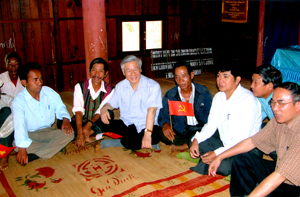
Hanoi Party Secretary Nguyen Phu Trong, a former student of Hanoi University, visited the family that sheltered him and other Hanoi University students during the university's evacuation to Dai Tu, Thai Nguyen.
The school intended to retain him as a teaching staff member. He felt very happy and eagerly awaited the opportunity. But then reality unfolded differently: he was transferred to work at the Journal of Learning (now the Communist Journal) - the theoretical and political organ of the Central Committee of the Communist Party of Vietnam. He was completely surprised and couldn't help but feel worried and anxious, but as a party member, he had to comply with the organization's assignment.
Nguyen Phu Trong began his career at the magazine "Learning" by reading, classifying, taking notes, and doing documentation work. He recounted: "To be honest, in the beginning I felt discouraged because the work was dry and monotonous. I expressed my desire to do research and editing in the field of literature and art, but the leaders replied that whatever I did, I had to do documentation work, starting with accumulating knowledge. I found it reasonable and gradually got used to the work." From then on, along with doing documentation, he set himself the task of writing articles, starting with small thematic articles. Then, after years of gestation and preparation, his first article was born (The article "The Flavor of Folk Songs and Ballads in To Huu's Poetry" published in the magazine "Literature" No. 11, 1968). With the encouragement and dedicated support of his colleagues at the magazine, coupled with his eagerness to learn and improve, he progressed quite quickly. In 1971, following the general policy, he was sent by the agency for a long-term (1 year) field assignment in Phu Lam commune, Thanh Oai district, Ha Tay province. He stayed in people's homes, ate with the villagers, worked alongside them, participated in labor and Party activities as a commune member and Party member.
In 1973, he was sent to study Political Economy at the Nguyen Ai Quoc Advanced Party School (now the Ho Chi Minh National Academy of Politics). As a young student at the Nguyen Ai Quoc Advanced Party School at the time, he faced considerable difficulties because his father was seriously ill from a stroke, his wife had just given birth, and he himself had only recently recovered from a stomach hemorrhage. The most interesting and beneficial aspect for him at that time was the free time he had to focus on studying the classic works of Marxism-Leninism. He spent nearly a year studying "Capital," a rare and valuable opportunity to further his knowledge and lay the foundation for his future career.
In 1981, he was sent to the Soviet Union as an intern, studying and defending his doctoral thesis at the Soviet Academy of Social Sciences (under the Central Committee of the Communist Party of the Soviet Union). He faced a series of new difficulties: a new language, a new field of study; how to simultaneously attend lectures, take exams, complete the minimum requirements on Party building, and write and defend his doctoral thesis within two years. He was genuinely worried and had no choice but to resolutely "take on the challenge." Ultimately, he achieved results worthy of his efforts: passing the minimum requirements with a perfect score and becoming the first person in his department to successfully defend his thesis, two months ahead of schedule.
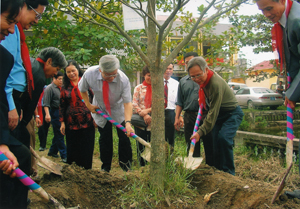
Hanoi Party Secretary Nguyen Phu Trong plants a tree at Van Tho High School (Dai Tu, Thai Nguyen).
In August 1983, he returned to Vietnam and continued working in the Party Building Department of the Communist Magazine. He was promoted to Deputy Head of the Department (October 1983), Head of the Department (September 1987), Member of the Editorial Board (March 1989), Deputy Editor-in-Chief (May 1990), and then Editor-in-Chief of the Communist Magazine (August 1991).
He recalled that during his high school years, his interest in journalism was simply based on intuition, seeing the opportunity to "travel freely" and "see the world." However, as he progressed through practical work, he gained a more complete and profound understanding of journalism, and his love for the profession grew. Nearly 30 years working at the Communist Magazine, Professor Nguyen Phu Trong has undertaken numerous tasks and written and edited hundreds of theoretical articles in various genres, from editorials, essays, commentaries, and short stories to book reviews, practical experience sharing, and criticisms of wrongdoings and negative phenomena… all with his experience and dedication to the profession. He said: "Journalism is a noble profession, but it is extremely arduous and difficult. Journalists must correctly understand and firmly grasp the functions and tasks of the newspaper they serve and collaborate with. Those working at political theory journals like the Communist Magazine must make even greater efforts, have high determination, and truly possess a passion for the profession, a thirst for learning, and especially a correct working method." Professor Nguyen Phu Trong has been closely involved and made many contributions to the building and development of the Communist Magazine, especially since he served as Deputy Editor-in-Chief and then Editor-in-Chief. The magazine has undergone many changes in both content and form. Articles have become less academic, more closely aligned with real-life issues, and contain more information; many articles have delved into practical matters, serving the Party's guidelines, policies, and laws of the State.
In 1992, he was awarded the title of Associate Professor and 10 years later (2002) he was awarded the title of Professor.
In August 1996, Professor Nguyen Phu Trong was transferred by the Central Committee to serve as Deputy Secretary of the Hanoi City Party Committee, concurrently Head of the University Affairs Department, and in charge of the City Party Committee's propaganda work.
In February 1998, he was transferred to the Central Committee to take charge of the Party's ideological, cultural, and scientific and educational work, and served as Vice Chairman of the Central Theoretical Council. From August 1999, he participated in the Standing Committee of the Politburo; directly supervising the drafting of the Party's 9th Congress documents.
In January 2000, he was reassigned to the position of Secretary of the Hanoi City Party Committee. Together with the City Party Committee and its Standing Committee, he proposed many sound policies and led and directed their implementation with a democratic and decisive style, creating significant progress in the capital city. In November 2001, the Politburo assigned him to concurrently serve as Chairman of the Central Theoretical Council, in charge of the Party's theoretical work. From the beginning of 2003, he directly supervised the work of summarizing 20 years of reform, and preparing and compiling the documents for the 10th Party Congress.
Over the past 20 years, Professor Nguyen Phu Trong has participated in researching, summarizing, and editing many important documents of the Central Committee, such as the Party's Platform for National Construction during the Transition Period to Socialism in 1991, the Political Reports of the 7th, 8th, 9th, and 10th Party Congresses; several resolutions of the Central Committee; the Resolution of the Mid-Term National Congress (7th term); the Report summarizing 20 years of Party building work (1975 - 1995); and the Report summarizing some theoretical and practical issues over 20 years of reform (1986 - 2006)...
He was a member of the Central Committee of the Party for the 7th, 8th, and 9th terms; a member of the Politburo for the 8th and 9th terms; and a delegate to the National Assembly for the 11th term. And recently, as this book was being prepared for printing, the 10th National Party Congress had successfully concluded, and he was again elected as a member of the Central Committee and the Politburo for the 10th term.
In the fields of scientific research, theoretical education, and cadre training, Professor Nguyen Phu Trong has directly chaired several state-level and city-level social science research projects and programs; taught several specialized courses to senior leaders, postgraduate students, and university lecturers; and supervised several postgraduate students in successfully completing and defending their doctoral dissertations. From 1990 to the present, he has published more than 10 books and nearly 30 specialized papers in various works. Notable among them are: "The Leadership and Activities of the Party in Market Economy Conditions" (1995); "For a National and Modern Vietnamese Culture" (2002); and "Promoting the Spirit of Thang Long - Hanoi, Building the Capital City to Be Increasingly Prosperous, Civilized, and Modern" (2003). "Building and Rectifying the Party - Some Theoretical and Practical Issues" (2005)... In particular, the book "The Communist Party of Vietnam in the Process of National Renovation" was published in 2002, reprinted in 2005 and translated into many languages.
When I asked about the connection between the theoretical knowledge of Literature, Economics, Politics, and Party Building that he had acquired from school and his current practical leadership work, he said: Since working at the Hanoi City Party Committee, he has had many opportunities to test theoretical issues in practice. Having received relatively systematic and thorough training at school was extremely fortunate for him. Thanks to his Philosophy studies, he acquired a relatively dialectical and coherent method of understanding and theoretical thinking; thanks to his Literature studies, he could express his thoughts more clearly. His knowledge of Economics, Politics, and Party Building greatly helped him in observing reality, identifying problems, and making decisions. Conversely, the rich practical experience of life helped him consolidate and supplement his theoretical understanding, seeing what was "successful" and what was "not yet successful" so that he could make corrections.
Having served for many years in various capacities within the Hanoi Party Committee, Professor Nguyen Phu Trong has witnessed and made significant contributions to the development of the capital city. The orientations and policies he and other leaders of the Hanoi Party Committee have played a crucial role in giving Hanoi a new look. According to delegates at the recent 14th Hanoi Party Congress, many areas of Hanoi's activities have seen promising developments, creating a foundation for the city to continue its progress in industrialization and modernization, leading up to the 1000th anniversary of Thang Long - Hanoi. At this Congress, Professor Nguyen Phu Trong was re-elected as Secretary of the Hanoi Party Committee for the 2005-2010 term with very high confidence.
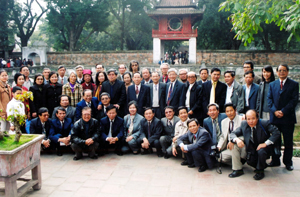
Professor Nguyen Phu Trong and his fellow students at the Temple of Literature, National University.
Hanoi's officials and people cherish and trust him because of his intellect, style, work ethic, humility, and keen flexibility in handling affairs. Many have sent letters expressing their affection and trust in the Party's leadership, including his personal trust. Those who worked with or were close to Professor Nguyen Phu Trong said that he lived a very simple, sincere life, respected and was close to his colleagues, was deeply involved in reality, and always listened to the opinions of the people. He seemed to have no time to rest. On Saturdays and Sundays, he "relaxed" by going to the grassroots, interacting with the people, conducting on-site surveys, or visiting friends. The press has reported extensively on his trips to various locations to investigate, inspect, and resolve pressing issues, such as the Thanh Nhàn "slum," the Sóc Sơn waste treatment plant, the Bus Transport Company, and visits to nursing homes, drug rehabilitation centers, social welfare centers, and families in difficult circumstances. He was a man who consciously upheld his integrity and ethics, never abusing his position for personal gain or that of his family. Even at work, he would often eat lunch in the company's communal kitchen with his colleagues; at class reunions, he would still address his old friends informally, as enthusiastically as he did in his student days. He often said: "Each person has their own destiny; today you do one thing, tomorrow you might do something else. What matters most in life is loyalty and affection." He further confided: "I know there are many things I haven't accomplished, many plans I haven't completed, and many shortcomings in my work; in the position of the leader, I absolutely cannot afford to be complacent; on the contrary, I must strive and make every effort to complete the task."
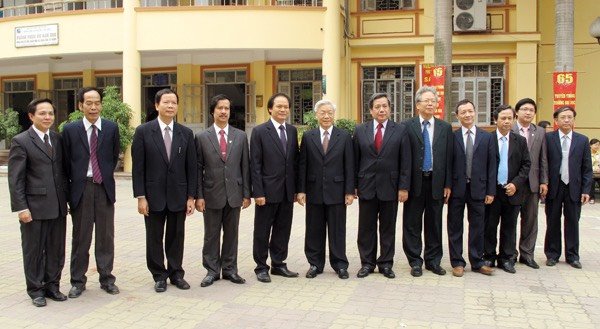
Comrade Nguyen Phu Trong, then Chairman of the National Assembly of the Socialist Republic of Vietnam, during a cordial visit and meeting with the leaders and teachers of the University of Social Sciences and Humanities, Vietnam National University, Hanoi on November 16, 2010.
Nguyen Phu Trong – the student at Hanoi University of Science and Technology – is now a member of the Politburo, Secretary of the Hanoi City Party Committee, and Chairman of the Central Theoretical Council. This is the result of a long journey of striving, continuous learning, and self-improvement. In 2000, Ms. Dang Thi Phuc – a teacher who had taught Professor Nguyen Phu Trong 50 years earlier, when he was in the fourth grade – wrote him a poem with the following lines:
"Who would have thought that little kid from years ago..."
Now a high-ranking official serving society.
Looking at you is like admiring a fresh flower.
All the care since childhood has paid off."
(The little student from years ago)That is the happiness of a "ferryman" like teacher Dang Thi Phuc, and also the happiness of a student "crossing the river" who is tirelessly and devotedly contributing their strength to the country and homeland, like Professor Nguyen Phu Trong!
Documentary: General Secretary Nguyen Phu Trong - A steadfast, wise, and exemplary leader.
General Secretary Nguyen Phu Trong's profound memories with Vietnam National University, Hanoi.
National Assembly Chairman Nguyen Phu Trong: Forever proud of the tradition and brand of the University of Social Sciences and Humanities.