From a student majoring in Literature at the University of Hanoi…Hanoi University, established in 1956, was the first institution for basic science education and training in North Vietnam after peace was restored. Professor Nguy Nhu Kon Tum was the first Rector of Hanoi University and held this position until his retirement (in 1982). In September 1995, the University of Social Sciences and Humanities was established on the foundation of the social sciences and humanities disciplines of Hanoi University, becoming a key member university of the Vietnam National University, Hanoi.
The construction and development of the University is closely linked to the names of renowned professors such as: Dang Thai Mai, Tran Van Giau, Dao Duy Anh, Tran Duc Thao, Cao Xuan Huy, Hoang Xuan Nhi, Dinh Xuan Lam, Phan Huy Le, Ha Van Tan, Tran Quoc Vuong, Nguyen Tai Can, Dinh Gia Khanh, Hoang Nhu Mai, Le Dinh Ky, Tran Dinh Huou, Phan Ngoc, Cao Xuan Hao, Ha Minh Duc, Phan Cu De… This vast team of leading professors and scientists has worked and dedicated their strength and intellect under the roof of this university, not only building, developing, and affirming the core and most fundamental values of Vietnamese science, but also training, guiding, and nurturing generations of outstanding students, making excellent contributions to the cause of building and defending the Fatherland.
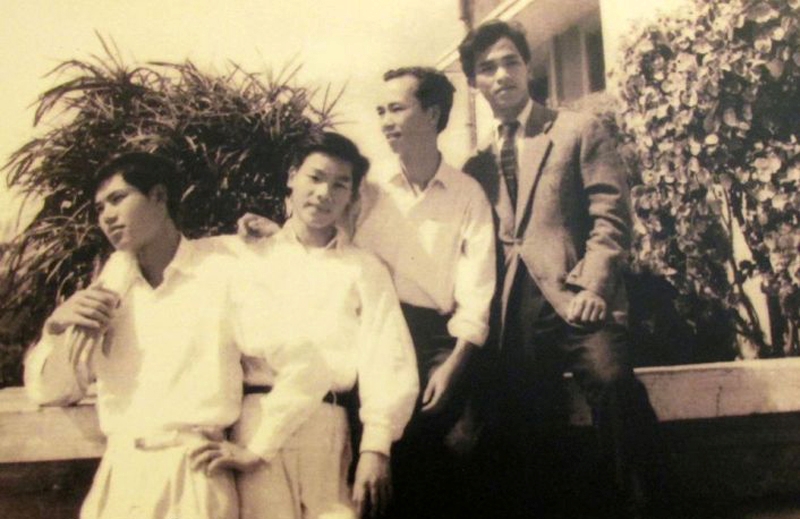
General Secretary Nguyen Phu Trong is a former student of the 8th cohort of the Faculty of Literature, Hanoi University (second from the left, photographed in February 1965 at the Me Tri dormitory).
General Secretary Nguyen Phu Trong was a student of the Faculty of Literature, Hanoi University, from 1963 to 1967, under the tutelage of Professor Ha Minh Duc. In the commemorative yearbook "100 Years of Indochina University - Hanoi National University," he fondly recalled his first day of enrollment: "On a beautiful morning in early September 1963, we gathered in lecture hall 1 - Le Thanh Tong Street (now building 19 Le Thanh Tong). Before roll call, I stood in the Tao Dan garden. Looking up at the school gate, I gazed at the words 'Vietnam University' and felt a sense of elation and pride. Meeting each other for the first time was a bit awkward, and we were all shy about getting acquainted, but I saw that everyone was 'super' – either the top or second best Literature students in the entire North (at that time, the South had not yet been liberated) or at least the top students in their respective provinces…"
At this time, the Vietnamese people's resistance war against the US for national liberation entered a critical phase due to the enemy's intensified bombing of North Vietnam. The war caused schools to be dispersed: the first year of classes was in the Chua Lang area, the following year they moved to the Me Tri area, and from 1965 to 1967, teachers and students of Hanoi University evacuated to Dai Tu district, Bac Thai province (now Thai Nguyen province).
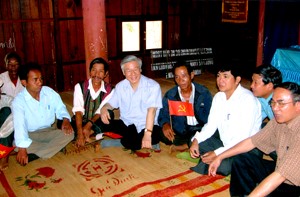
General Secretary Nguyen Phu Trong visited the family that sheltered him and the students of Hanoi University during the period when the university was evacuated to Dai Tu, Thai Nguyen.
During the years of bombing and shelling, despite hunger, cold, and hardship, the teachers and students of the school were determined to teach well and learn well, striving to serve the war effort and production, and resolutely building and developing a socialist intellectual workforce to prepare for the future national reconstruction.
At that time, the Faculty of Literature had over 130 students of diverse backgrounds and ages, but Comrade Nguyen Phu Trong was entrusted by the organization with the important responsibility of being the class's Youth Union Secretary. In 1967, under the guidance of Professor Dinh Gia Khanh, the fourth-year student Nguyen Phu Trong successfully defended his graduation thesis on the topic: "Folk poetry and the poet To Huu," and was the only student in the class to achieve a perfect score. Also in that year (1967), he was honored to be admitted into the Party, a very rare achievement for students at that time.
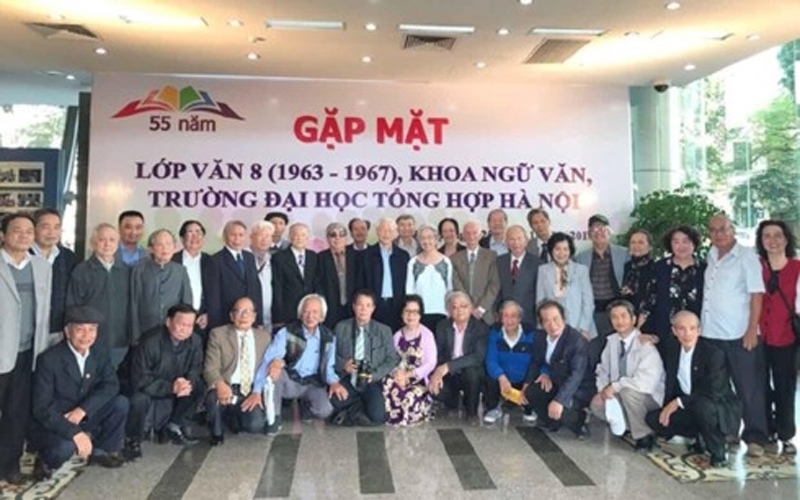
General Secretary Nguyen Phu Trong poses for a commemorative photo at the reunion of the Literature Class of 8th Grade (1963-1967), Faculty of Literature, Hanoi University.
After graduating (1967), the school intended to retain him as a lecturer, but the higher-level organization decided to transfer him to work at the Journal of Learning (now the Communist Journal) - the theoretical and political organ of the Central Committee of the Vietnam Workers' Party (now the Communist Party of Vietnam). During his time there, he was sent by the State to the Soviet Union as an intern, to study and defend his doctoral thesis at the Soviet Academy of Social Sciences (under the Central Executive Committee of the Communist Party of the Soviet Union). Returning to Vietnam in 1983, he continued working at the Communist Journal, successively being promoted to Deputy Head of Department (October 1983), Head of Department (September 1987), Member of the Editorial Board (March 1989), Deputy Editor-in-Chief (May 1990), and then Editor-in-Chief of the Communist Journal (August 1991). He was successively awarded the academic titles of Associate Professor (1992) and Professor (2002) by the State Council of Professors in the field of Party Building.
In 1996, he was transferred by his superiors to serve as Deputy Secretary of the Hanoi City Party Committee, concurrently Head of the University Affairs Department, in charge of the City Party Committee's propaganda work. In February 1998, he was transferred to the Central Committee to take charge of the Party's ideological, cultural, and scientific and educational work, and Vice Chairman of the Central Theoretical Council. In 2000, he was transferred to become Secretary of the Hanoi City Party Committee. Subsequently, he continued to hold many important positions such as Chairman of the National Assembly (2006-2011), General Secretary of the Central Committee of the Communist Party of Vietnam in 2011, and was re-elected in 2016 and 2021…
In 2010, during a visit to the University of Social Sciences and Humanities, Comrade Nguyen Phu Trong, with the sentiments of a former student of the Faculty of Literature, emotionally shared: "I have grown up at this school and will forever be proud of the tradition and reputation that the University has built." For many years before that, while working at the Communist Magazine, Deputy Editor-in-Chief Nguyen Phu Trong frequently lectured on specialized topics for Literature students at the University. He was simple and cheerful, often riding on the back of a bicycle as a young lecturer from the Faculty took him to the school to teach and then back to the Nguyen Thuong Hien neighborhood.
…to the initiator of fundamental and comprehensive reforms in Vietnam's education and training system.General Secretary Nguyen Phu Trong has shown particular interest in the cause of education and training. He personally signed and promulgated Resolution No. 29-NQ/TW on November 4, 2013, on "Fundamental and comprehensive reform of education and training to meet the requirements of industrialization and modernization in the context of a socialist-oriented market economy and international integration." The resolution was issued in the context of the country accelerating industrialization and modernization, and the world entering the era of the Fourth Industrial Revolution. Resolution 29-NQ/TW plays a particularly important role and has historical significance in the revitalization of national education, marking a new stage in the Party's strategic thinking and vision for the development of education and training, demonstrating the strategic determination to reform education for the sustainable development of the country both in the short and long term.
Over the past 10 years since the implementation of Resolution 29-NQ/TW, Vietnam's education and training sector has made significant strides, achieving many important accomplishments and making a substantial contribution to raising the intellectual level of the population, developing human resources, and nurturing talent; shifting from knowledge transmission to the comprehensive development of learners' qualities and abilities; reforming the general education curriculum and strengthening the autonomy of higher education institutions, gradually approaching the educational development trends of advanced countries worldwide.
The number and quality of teaching staff have been increasing step by step, year by year, according to international standards. Ten years ago, the percentage of lecturers with doctoral degrees in universities nationwide was only about 15%; now, this percentage has more than doubled, reaching approximately 32%. At the University of Social Sciences and Humanities, Vietnam National University, Hanoi, the percentage of lecturers with doctoral degrees has approached 80% (of which more than 20% hold the title of Professor/Associate Professor). In 2018, for the first time in the history of Vietnamese higher education, Vietnam National University, Hanoi and Vietnam National University, Ho Chi Minh City were included in the list of the top 1,000 universities in the world according to the Quacquarelli Symonds ranking. Notably, in 2024, Times Higher Education ranked the Social Sciences field of Vietnam National University, Hanoi in the top 501-600 globally.
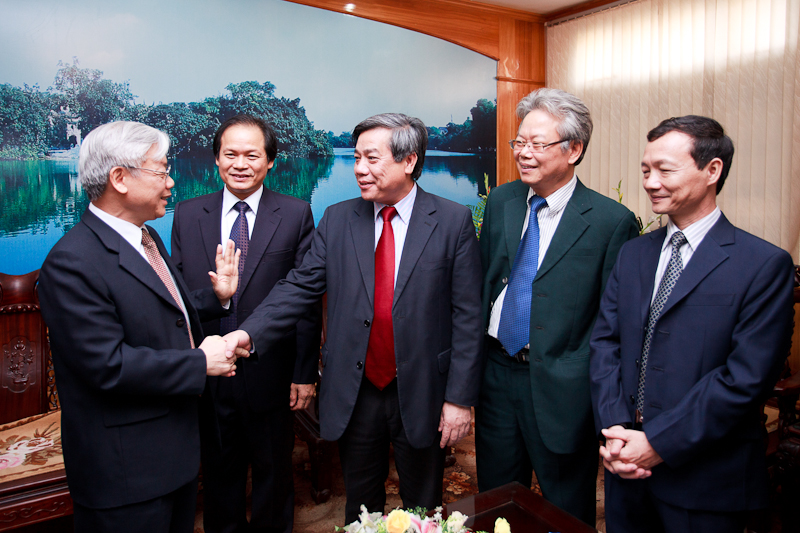
General Secretary Nguyen Phu Trong (then Chairman of the National Assembly) visited the University of Social Sciences and Humanities, Vietnam National University, Hanoi in 2010 on the occasion of the University's 65th anniversary and the awarding of the prestigious Ho Chi Minh Order.
General Secretary Nguyen Phu Trong has always emphasized the particularly important role of Social Sciences and Humanities because it is a field of science about human beings, about issues related to human relationships and human relationships with society. Social Sciences and Humanities help people gain diverse perspectives on the realities of life, providing explanations and interpretations of processes of movement and development, delving into the causes, consequences, relationships, and predicting trends of change in events and phenomena in human life. This helps people anticipate and plan to minimize risks or avoid the severe consequences that change may bring. Social Sciences and Humanities provide scientific insights that help political organizations, the state, and communities find more rational development strategies, and help policymakers build, enact, and implement development policies more effectively at both the macro and micro levels.
During his lifetime, General Secretary Nguyen Phu Trong always reminded the University's leadership to pay special attention to the quality of training, continuing to affirm the reputation of the University as a leading center for training and research in Social Sciences and Humanities in the country, with the mission of leading in training high-quality, highly skilled human resources, conducting research, creating and disseminating knowledge in social sciences and humanities, making a significant contribution to the cause of national construction and defense and international integration. He particularly instructed the University's scientific staff to focus on new, valuable research projects to make practical and effective contributions to policy advice for the National Assembly and other Party, State, and Government agencies.
General Secretary Nguyen Phu Trong – a great intellect and talent of the Vietnamese revolution, a leading thinker, cultural figure, and outstanding leader of our Party and people, and an exemplary alumnus of Hanoi University – has passed away. However, his dedication to the faculty and students of the University of Social Sciences and Humanities will forever remain, serving as a guiding principle for the University's development strategies.
The social standing and professional reputation of the University today are a blend of the "Literary tradition," the "essence of the University," and the "core humanistic values" meticulously cultivated by generations of teachers and students over nearly 80 years of development. Tradition is a resource, an intrinsic strength that needs to be continuously nurtured, multiplied, and promoted to contribute to the cause of national construction and development – as General Secretary Nguyen Phu Trong has affectionately reminded staff and faculty members during his visits to the university.
A heartfelt tribute from the faculty and students of the University of Social Sciences and Humanities to the spirit of General Secretary Nguyen Phu Trong, to continue "Steadily advancing on the path of reform," as the title of one of the works the General Secretary left behind for all Party members and people of all walks of life in Vietnam suggests.
Vietnam Communist Party Online Newspaper: General Secretary Nguyen Phu Trong and his memories with the University of Social Sciences and Humanities.
Vietnam Communist Party Electronic Portal - General Secretary: General Secretary Nguyen Phu Trong and his memories with the University of Social Sciences and Humanities.
Documentary:General Secretary Nguyen Phu Trong - A steadfast, intelligent, and exemplary leader.
Professor Nguyen Phu Trong, from a university student to the Secretary of the Hanoi City Party Committee.
Beautiful memories with the students of Batch VIII (K8) and Mr. Nguyen Phu Trong.
General Secretary Nguyen Phu Trong's affection for everyone.
(VTC1) General Secretary Nguyen Phu Trong - From Literature student to head of the Party and State
A memorable moment with General Secretary Nguyen Phu Trong in Thailand.