
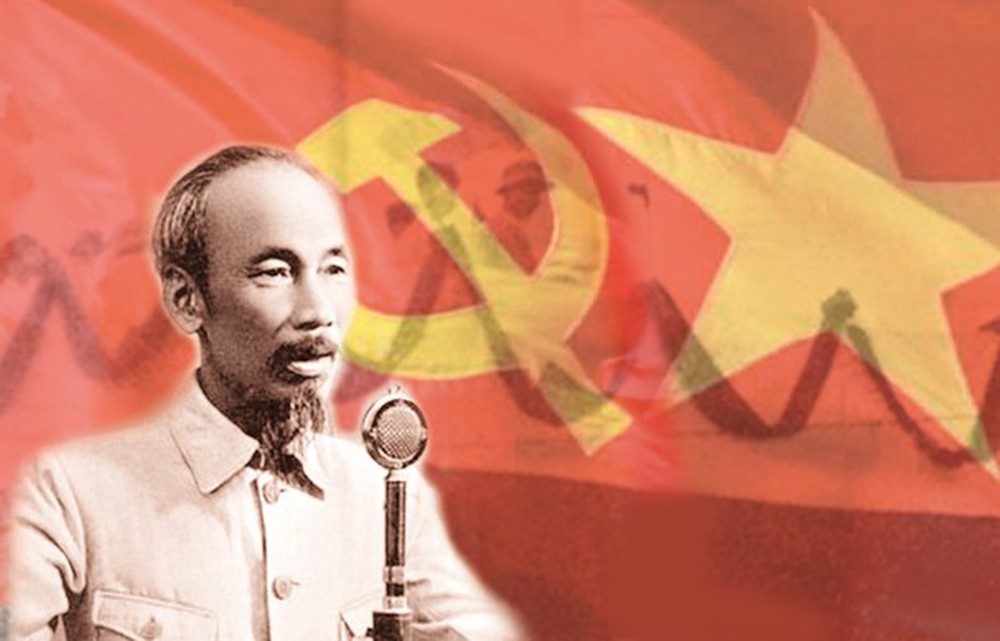
President Ho Chi Minh - a revolutionary, founder of the Communist Party of Vietnam, one of the founders and leaders of the struggle for independence and territorial integrity for Vietnam in the 20th century, and an international communist fighter.
In the mid-19th century, as capitalism began to transition to imperialism, its armies brought cannons to the feudal states of the East. From 1858, the French colonialists attacked Da Nang, beginning the process of invading Vietnam. Nearly 30 years later, the Nguyen dynasty's rulers "allowed the French imperialists to trample on their heads," forcing them to sign the Harmand Treaty (1883) and the Patenotre Treaty (1884), leaving "over twenty million compatriots dying in a death trap."[1]The dark cloud of colonialism hung over all of Vietnam. The entire nation entered a harsh and brutal winter.
However, as the domination, oppression, and exploitation of the nation increased, the national conflict with imperialism deepened, and the struggle for national survival became more intense, fierce in nature, diverse in content, and rich in form. With the spirit of "when one falls, another rises," patriotic movements against the French took place continuously and heroically, but were all brutally suppressed by the French imperialists.
The failure of the Can Vuong movement in the late 19th century demonstrated the incompetence of feudal ideology in solving the task of achieving national independence. In the early 20th century, the influx of bourgeois democratic ideas from abroad into Vietnam led many patriots to sacrifice themselves to save the country, but this also proved unsuccessful, demonstrating that the banner of bourgeois ideology was insufficient to liberate the Vietnamese nation from slavery. The cause of national salvation fell into a "dark situation seemingly without a way out."
In the context of "the era of anti-imperialist revolution, the era of national liberation"[2]Having started his career after the October Revolution, and after about 10 years of crossing oceans to many countries around the world, both in the East and the West, especially developed capitalist countries (England, France, the United States); while simultaneously studying theory and surveying practice, Nguyen Ai Quoc arrived at "First draft of the theses on the national question and the colonial question.Lenin's words moved him "deeply, enthusiastically, enlightened, and confident," and he affirmed: "This is what we need! This is the path to our liberation!"[3]He affirmed the path to national salvation and liberation along the proletarian line, paving the way to resolve the crisis regarding the path to national salvation in the early 20th century.
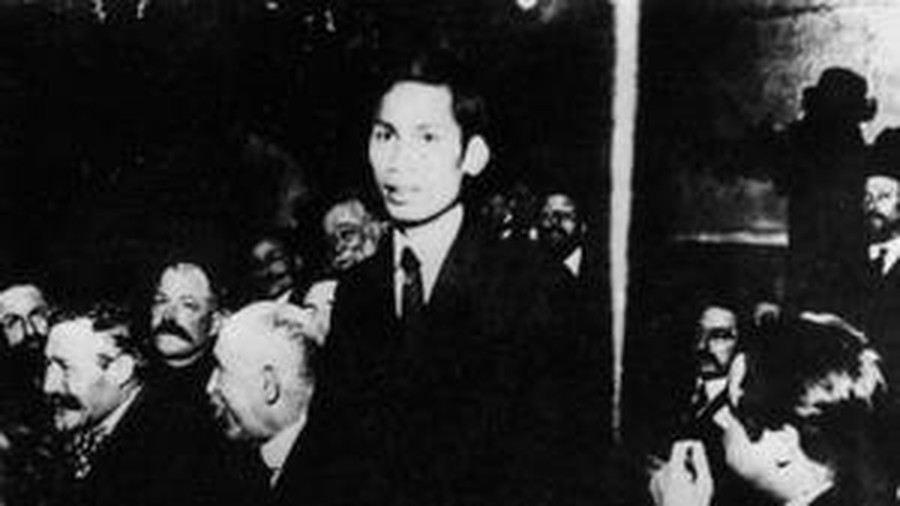
Nguyen Ai Quoc at the French Socialist Party Congress in 1920
Throughout the 1920s, Nguyen Ai Quoc persistently and diligently built and propagated "national liberation theory”[4]At the same time, they actively prepared the ideological, political, and organizational conditions for the birth of a revolutionary political party in Vietnam.
Transcending dogmatic norms, with a spirit of independence, self-reliance, creativity, and scientific acumen, Nguyen Ai Quoc formulated a unique theory of revolution in colonies, because "the venom and vitality of the poisonous snake of capitalism are concentrated in the colonies," and to disregard revolution in colonies is like "trying to kill the snake by its tail."[5].
Historical practice shows that in colonial countries, "class struggle did not unfold in the same way as in the West… The conflict of their interests was minimized. That is undeniable."[6]Stemming from the primary contradiction in colonies—the contradiction between the oppressed nation and the imperialist aggressor and its collaborators—and affirming that "the national revolution is not class-divided," Ho Chi Minh's "National Revolutionary" doctrine strongly emphasized the struggle for national independence. The forces of the "national revolution" encompassed the entire nation, because "scholars, farmers, workers, and merchants are all united against tyranny," with workers and farmers as the "mains of the revolution," the "roots of the revolution," while students, small merchants, and small landowners were "revolutionary allies of the workers and peasants." The colonial revolution did not depend on the proletarian revolution in the mother country, but could achieve victory first, and while eliminating one of the conditions for the existence of imperialism, "they could assist their brothers in the West in the task of complete liberation."[7].
As the guiding banner of the Vietnamese national movement during the period of campaigning for the establishment of the Party, Ho Chi Minh's "National Revolutionary" doctrine became an ideological weapon for all strata of the Vietnamese people, holding a decisive position in preparing the political ideology for the birth of the Party and laying the foundation for building the Party's later political platform.
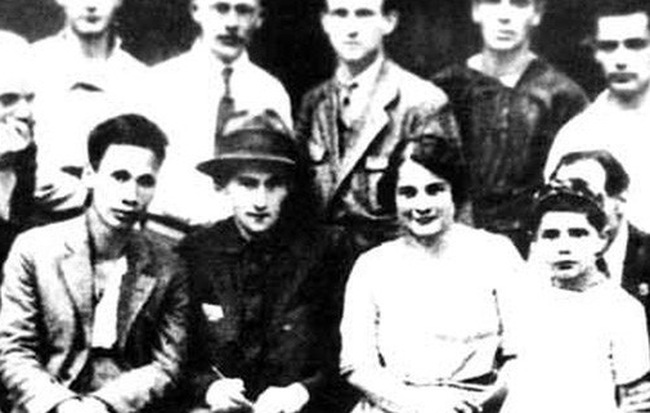
Nguyen Ai Quoc at the Fifth Congress of the Communist International in the Soviet Union in 1924
Along with preparing ideologically and politically, Nguyen Ai Quoc also actively prepared the organizational conditions for the birth of a revolutionary political party in Vietnam. At the end of 1924, he left the Soviet Union and returned to Guangzhou (China); he met with patriotic Vietnamese youth inTam Tam SocietyHe realized they understood nothing about theory, let alone organization. He selected some progressive young men and formed a group.Communist Party(2-1925) as the nucleus for foundingVietnam Revolutionary Youth Association(6-1925). This was a patriotic organization with communist leanings, a transitional step towards the establishment of the Communist Party, a crucial organizational preparation for the later birth of the Party.
By 1929, the patriotic struggle of the Vietnamese people had developed strongly, demanding the leadership of a Communist Party. The role of transitional organizations had come to an end, making way for the establishment of a higher-level organization. This demand impacted...Vietnam Revolutionary Youth AssociationandNew Vietnam Revolutionary PartyThis led to internal struggles and positive transformations within these organizations, forming three communist organizations in Vietnam:Indochinese Communist Party(6-1929)Annam Communist Party(8-1929) andIndochinese Communist Federation(September 1929). This proves that Ho Chi Minh's "National Revolutionary" doctrine had deeply permeated the revolutionary struggle of the Vietnamese people, and the trend of establishing a Communist Party had become inevitable in Vietnam.
However, within a single nation, three separate communist organizations operated independently, thus dispersing the revolutionary forces and strength. This was incompatible with the interests of the revolutionary movement and the organizational principles of the Communist Party. Ending the factionalism among these communist organizations and unifying them into a single party was an urgent requirement. But these communist organizations themselves were unable to unite due to the influence of self-centered, parochial ideologies, a product of a backward and fragmented agricultural economy. The Indochinese Communist Party and the Annam Communist Party "spent much – if not all – of their energy and time on internal and factional struggles." "Both tried to unite, but the more they tried, the more misunderstandings arose, and the chasm between them widened."[8]If that situation is allowed to continue, it will pose a threat to the Vietnamese revolutionary movement.
On October 18, 1929, the Council of Secretaries of the Eastern Countries discussed the draft resolution on the establishment of the Indochinese Communist Party and on the future tasks of the Indochinese communists. On October 27, 1929, the Secretariat of the Eastern Countries finalized the draft resolution with the title:Regarding the establishment of a Communist Party in Indochina, stating clearly, “The most important and urgent task of all communists in Indochina is to establish a revolutionary party of the proletariat's class character, that is, a mass Communist Party in Indochina. That party must be one and the only communist organization in Indochina.”[9].
On October 31, 1929, the document was sent to the members of the Political Bureau of the Communist International for review and comments on revisions "before the Political Secretariat adopted the official resolution."[10]In December 1929, the Communist International adopted a resolution. However,By the end of 1929, not a single communist in Indochina had received this resolution..
Before the Communist International passed its resolution in November 1929, Nguyen Ai Quoc was active in Siam and trying to find a way back to Vietnam when a comrade from Hong Kong informed him about "the disintegration of the Annam Revolutionary Youth Association; the communists had split into many factions." He immediately left Siam for China and arrived there on December 23, 1929.
Acting as an envoy of the Communist International, with full authority to decide on all matters related to the revolutionary movement in Indochina, he convened representatives of the two groups, the Indochinese Communist Party and the Annam Communist Party, to a unification conference in Kowloon (Hong Kong, China). The conference began on January 6, 1930.
Not only was Nguyen Ai Quoc a delegate of the Communist International, but he was also the founder of the former Vietnam Revolutionary Youth Association and a mentor to the patriotic youth of the early 20th century, thus possessing absolute prestige and leading the Conference to success. After hearing Nguyen Ai Quoc speak about the mistakes of division and the task of establishing a Communist Party, the delegates unanimously agreed to unite into a single party named the Communist Party of Vietnam.
Not only did Nguyen Ai Quoc play a decisive role in unifying the organization, but he was also the drafter of the Party's first political platform and charter.first political programThe task of national liberation, fighting against imperialism and its collaborators, was emphasized in both political and economic aspects:political, overthrowing French imperialism and feudalism, making Vietnam completely independent, establishing a worker-peasant-soldier government and organizing a worker-peasant army;economicConfiscate all major enterprises (such as industry, transportation, banking, etc.) of French imperialist capitalists and hand them over to the worker-peasant-soldier government for management; confiscate all land of the imperialists to make it public property and distribute it to poor farmers... While the land confiscation policy was in the hands of the national enemy, the Program raised the issue of "preparing for a land revolution and overthrowing the feudal landlords."[11]The manifesto advocated for the mobilization of the entire nation's forces in the struggle for independence and freedom.
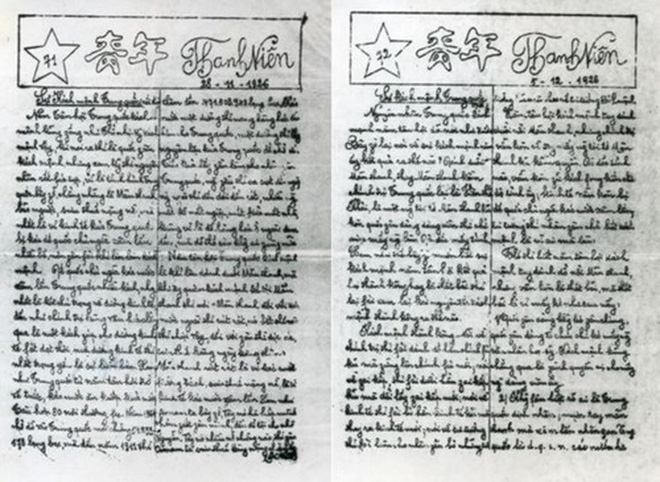
Thanh Nien Newspaper – the first revolutionary newspaper of Vietnam
Combining Marxist-Leninist theory on the Communist Party with the practical realities of the Vietnamese revolution, Ho Chi Minh developed and disseminated a doctrine of national liberation revolution among the Vietnamese people; resolving the issue of the path to national salvation by preparing the ideological, political, and organizational conditions for establishing a revolutionary party that was suitable to Vietnamese reality, closely connected with the people and the nation, wholeheartedly dedicated to serving the Fatherland and the people, and recognized by the people and the nation as its vanguard.
From its very inception, "Our Party immediately raised the banner of revolution, uniting and leading our entire people to advance in the struggle for national liberation and class liberation. The Party's bright red flag shone like the rising sun, tearing through the darkness, illuminating the path and guiding our people to steadfastly advance on the path to victory in the anti-imperialist and anti-feudal revolution."[12]"Despite being young and small, the Communist Party is the best-organized and most active of all the forces."[13], uniting the strength of the entire nation. That is a characteristic and also an advantage of the Party.
Spring 1930 – the spring of the Party's founding – marked a great turning point in the development of Vietnam's revolutionary history, ending the crisis of revolutionary leadership that had lasted for several decades in the early 20th century. "The founding of the Party was an extremely important turning point in the history of our Vietnamese revolution. It proved that our proletariat had matured and was capable of leading the revolution."[14].
[1]Ho Chi MinhComplete, Volume 2, National Political Publishing House, Hanoi, 2000, p. 262.
[2]Ho Chi MinhComplete Collection, Volume 8, National Political Publishing House, Hanoi, 2000, p. 563.
[3]Ho Chi MinhComplete Collection, Volume 10, National Political Publishing House, Hanoi, 2000, p. 127.
[4]Tran Dan Tien:Stories about the life and activities of President Ho Chi Minh, Literature Publishing House, 1956, p. 71.
[5]Ho Chi Minh,Complete Collection, Volume 1, National Political Publishing House, Hanoi, 2000, p. 273.
[6]Ho Chi Minh Complete Works, Volume 2, National Political Publishing House, Hanoi, 2000, p. 464.
[7]Ho Chi MinhComplete Collection, Volume 1, National Political Publishing House, Hanoi, 2000, p. 36.
[8]Communist Party of Vietnam:Complete Collection of Party Documents, Volume 2, National Political Publishing House, Hanoi, 1998, pp. 21 and 35.
[9]Communist Party of Vietnam:Complete Collection of Party Documents, Volume 1, National Political Publishing House, Hanoi, 1998, p. 614.
[10]Communist Party of Vietnam:Complete Collection of Party Documents, Volume 1, op. cit., p. 621.
[11]Communist Party of Vietnam:Complete Collection of Party Documents, Volume 2, National Political Publishing House, Hanoi, 1998, p. 6.
[12]Ho Chi MinhComplete Collection, volume 10, op. cit. p. 3.
[13]Communist Party of Vietnam:Complete Collection of Party Documents, volume 2, op. cit., p. 21.
[14]Ho Chi MinhComplete Collection, volume 10, op. cit. p. 8.
Author:Assoc. Prof. Dr. Vu Quang Hien

