On the sidelines of the international forum on public policy “Strengthening the Comprehensive Strategic Partnership between Korea and ASEAN for a Shared Future Development,” Professor Hoang Anh Tuan, Rector of the University of Social Sciences and Humanities, Vietnam National University, Hanoi, shared that for higher education in ASEAN countries to develop to a new level, the nature of this activity must change from “support” to “cooperation.”
While many achievements have been made, some shortcomings remain.Southeast Asian countries share a common view on valuing education, as evidenced by the formation of regional programs to support educational and training development. The Southeast Asian Ministers of Education Organization (SEAMEO), established in 1965, is a clear example of this. Subsequently, in 1995, the ASEAN University Network (AUN) was established… Along with these official organizations, specific educational and training activities have also been implemented.
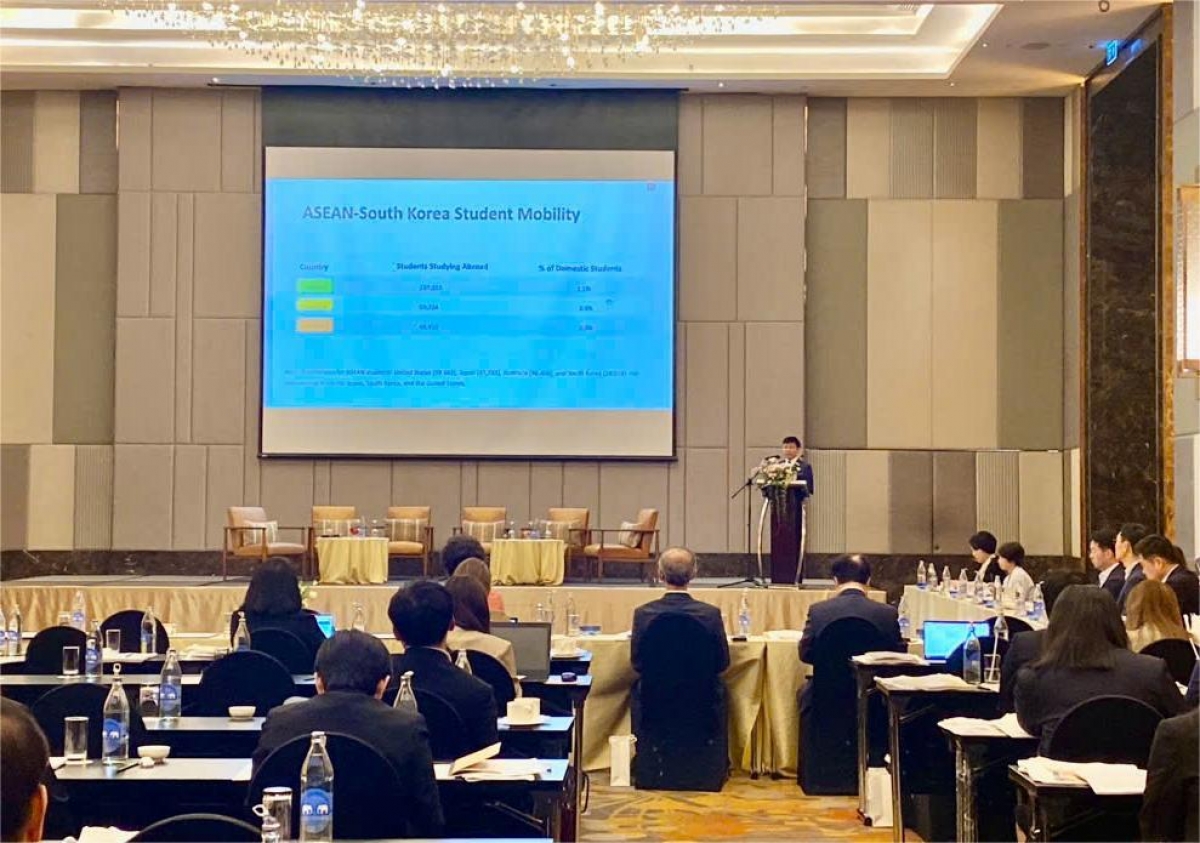
Professor Hoang Anh Tuan, Rector of the University of Social Sciences and Humanities, Vietnam National University, Hanoi, delivered a speech at the international forum on public policy.
Affirming the positive results achieved over decades of higher education cooperation between ASEAN countries and between ASEAN countries and South Korea, Professor Hoang Anh Tuan mentioned the proactive and positive role of universities in developing joint training programs, strengthening international languages in teaching, adjusting existing training programs towards deeper articulation so that students can study across courses and receive credit recognition, and participating in international internships…
However, higher education within the ASEAN community still faces numerous shortcomings. “The existence of several different credit systems among ASEAN universities is truly regrettable as it hinders students from studying abroad and obtaining credit recognition; grading systems also differ; and varying study schedules between countries are also barriers… These are completely unnecessary shortcomings that can be addressed to promote stronger university cooperation within ASEAN,” shared Professor Hoang Anh Tuan.
ASEAN-Korea higher education cooperation is experiencing strong growth.Looking back at history, Professor Hoang Anh Tuan believes that South Korea had an early and proactive vision in cooperating with ASEAN countries when it established official relations in 1995. Over the past 30 years, along with achievements in all fields, the results of ASEAN-South Korea higher education cooperation have also grown significantly. According to 2023 statistics, approximately 100,000 Southeast Asian students are studying in South Korea, with Vietnamese students accounting for the largest number (around 70,000).
Korean educational institutions and funding organizations have provided significant support to ASEAN universities in recent years, contributing to the overall development of higher education in ASEAN. Specifically for Vietnam, Korean educational support funds and organizations have also made substantial contributions.
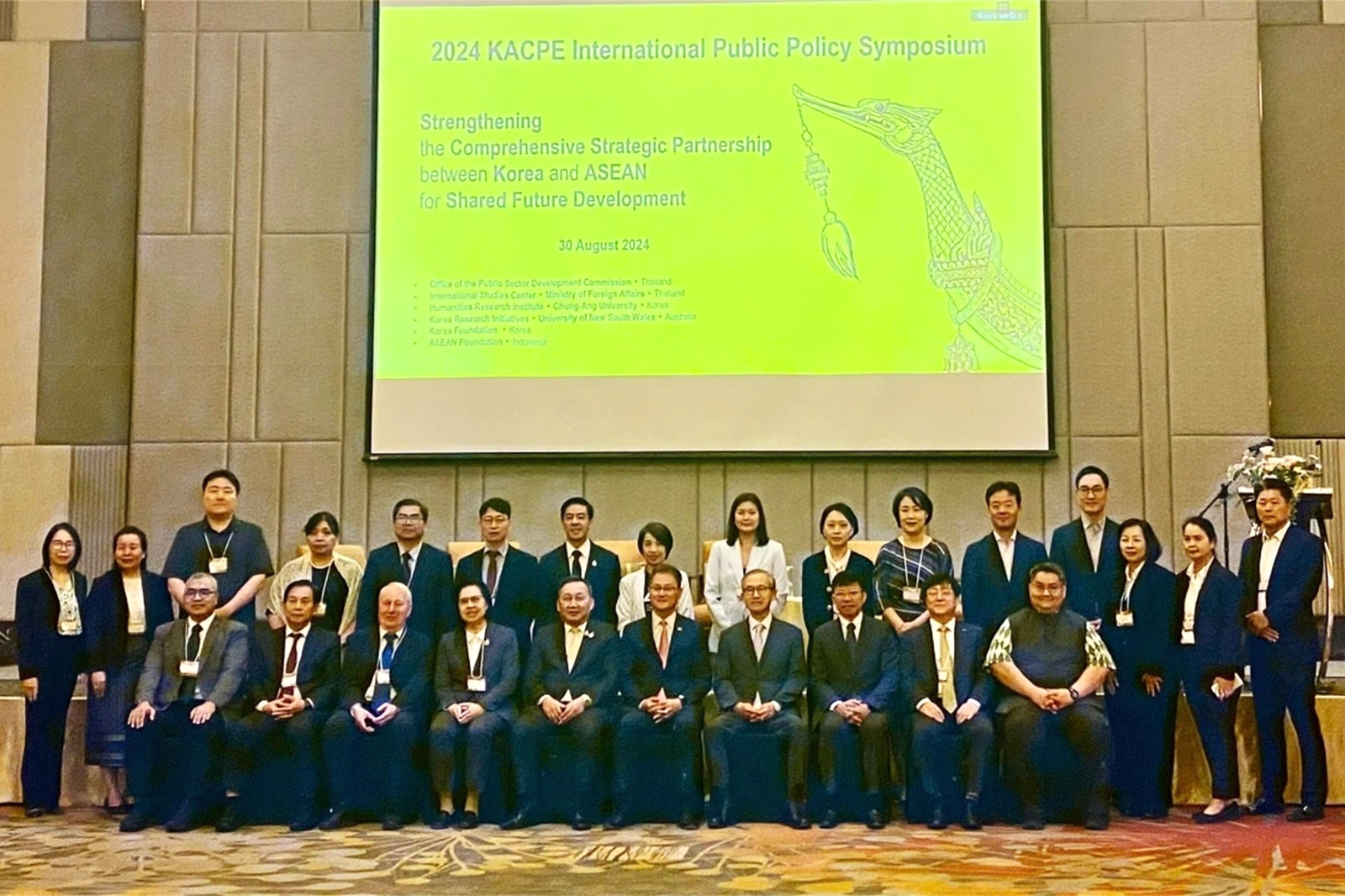
Delegates attending the Public Policy Forum: "Strengthening the Comprehensive Strategic Partnership between Korea and ASEAN for Shared Future Development"
For example, at the University of Social Sciences and Humanities, Vietnam National University, Hanoi, Korean Studies has been taught since 1993, officially becoming an independent major in 1995. The university is one of the first higher education institutions in Vietnam to offer Korean Studies programs. Along with the program, two other important organizations, the Korean Studies Association and the Korean Studies Journal, were also established in connection with the university's Korean Studies program. All three receive strong support from Korean scientific and educational organizations such as the Korea Foundation (KF)...
Subsequently, in 2024, the University of Social Sciences and Humanities also became a co-founder of the Korean Studies Association in Southeast Asia (KoSASA) together with the University of New South Wales (Australia).
However, the reality is that higher education cooperation between South Korea and ASEAN is still heavily reliant on support through science funds or educational programs, thus leaning more towards unilateral rather than bilateral or multilateral approaches.
Korean universities have also not yet developed many collaborative training programs with ASEAN universities, instead relying on short-term exchanges and individual credit transfers.
We need to shift from "support" to "cooperation" as soon as possible.
The "support" aspect, through educational funds or programs, is highly beneficial, quick, and easy to implement. However, it fails to achieve the ultimate goal of sharing training programs comprehensively, holistically, and sustainably, thereby promoting holistic cooperation in higher education.
Therefore, to elevate university relations between South Korea and ASEAN in general, and Vietnam in particular, it is necessary to promote the nature of "bilateral cooperation" instead of "unilateral assistance" as in the past – Professor Hoang Anh Tuan shared.
Based on the strengths of each side, the goal should be to find solutions that involve comprehensive expertise sharing and mutual support in training activities. ASEAN universities can support Korean educational institutions in areas such as language, culture, and country studies, while Korean universities can support ASEAN universities in areas related to Korean studies.
Comprehensive and collaborative cooperation for mutual development needs to be agreed upon and implemented uniformly among higher education institutions in South Korea, Vietnam, and ASEAN countries.