I am deeply honored to have been granted permission by General Nguyen Van Huong and entrusted by Professor Hoang Anh Tuan, the Rector, with the task of reading and introducing this book.
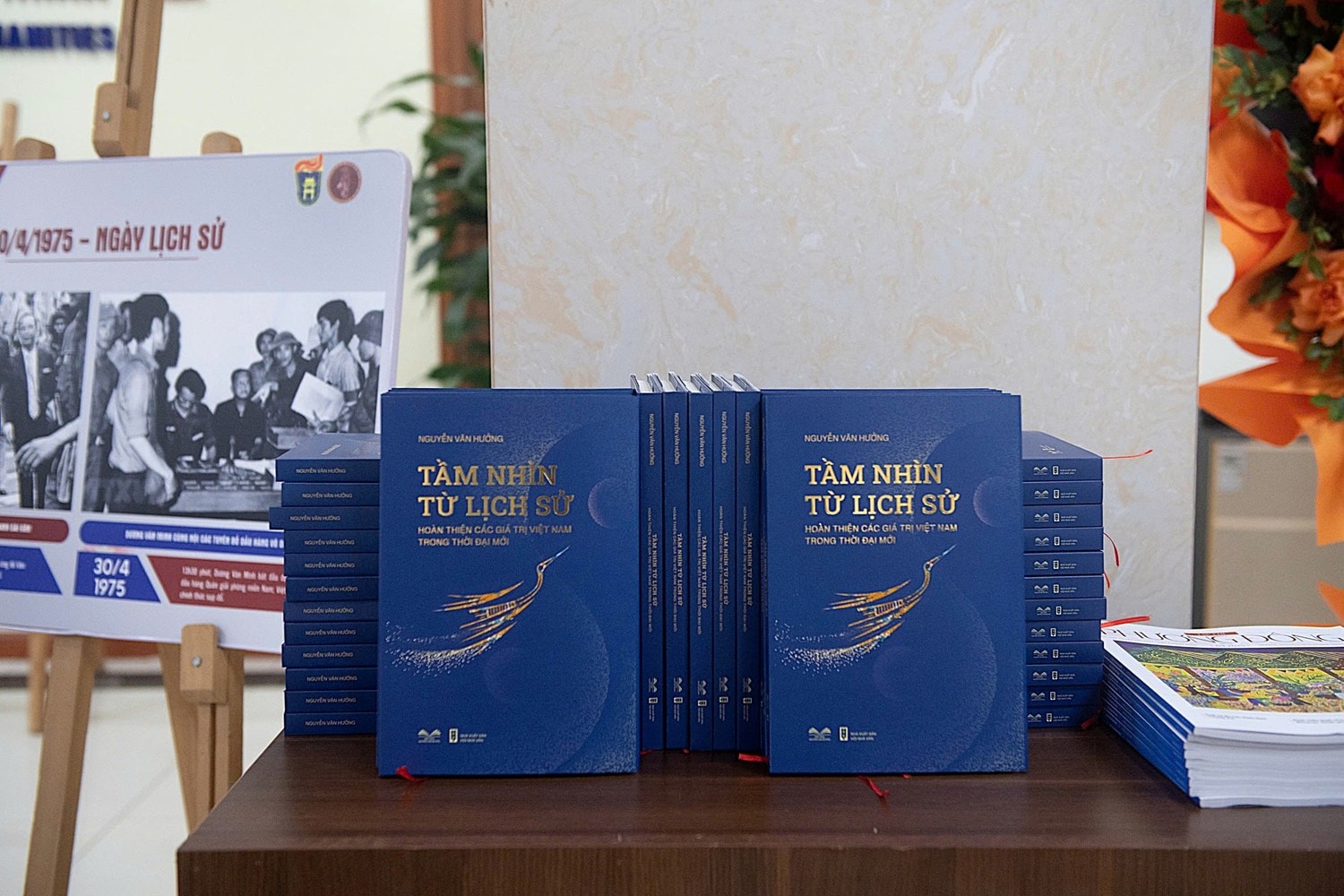
"A Perspective from History - Perfecting Vietnamese Values in the New Era"For faculty and students of the school on the occasion of the 50th anniversary of the Liberation of Southern Vietnam and the reunification of the country, and the 4th anniversary of Vietnam's Book and Reading Culture Day.
The new work by Lieutenant General Dr. Nguyen Van Huong
I remember a few weeks ago, someone from Vietnam Airlines came to ask me about their intention to use the mythical Lac bird depicted on the Dong Son bronze drum as the symbol of Vietnam Airlines. After learning that I fully agreed, they asked what kind of bird the Lac bird was. I explained that it was a mythical bird based on the stork, a typical image of the rice-farming agricultural civilization of the ancient Vietnamese people, and I didn't forget to recite a poem by the poet To Huu written sixty years ago:
"The wings of the white stork flutter in the vast expanse."
Oh, my homeland! Simple yet magnificent!
Dr. Nguyen Van Anh, Director of the Museum of History and Culture of the University of Social Sciences and Humanities, Vietnam National University, Hanoi, sent me a copy of the book to read in advance."A Perspective from History - Perfecting Vietnamese Values in the New Era"By General Nguyen Van Huong, whose book cover depicts a mythical Lac bird flying over the vast "S"-shaped expanse of space, I briefly thought that from the historical origins to the fundamental values of the nation and the all-powerful foundation for the country's takeoff, it's like the Lac bird on the fuselage of a Vietnam Airlines aircraft. Reading the lines printed on the back cover of the book, I believe this prediction has a basis:This book doesn't delve into proposing solutions, but rather aims to present a system of perspectives for national development. In Asian philosophy, to take long strides, one must have a firm footing; to climb a steep hill, one must have sturdy steps. This book was created with the hope that Vietnam will soon perfect its values and enter a new era. What has not yet been achieved must be achieved. What has been achieved but is still insufficient must be further refined. Only then can Vietnam create a solid foundation and launching pad to soar high.”
Dr. Nguyen Van Huong is renowned as a national security strategist. Nearly a dozen books he has published in the last 15 years, and 75 issues of the magazine "Oriental" where he served as Editor-in-Chief, although expanding into many other fields, still reflect a central theme of national and international security issues."A Perspective from History - Perfecting Vietnamese Values in the New Era"The book has become a brilliant summary, an interdisciplinary historical work (that is, a natural, close, and harmonious blend of Geography, History, Cultural Studies, Philosophy, Political Science, Economics, and International Studies). It has been a long time since I have read a historical work that reached such intellectual height and depth of thought, yet was not dry or rigid, but rather light and graceful like a genuine literary work published by the Writers' Association.
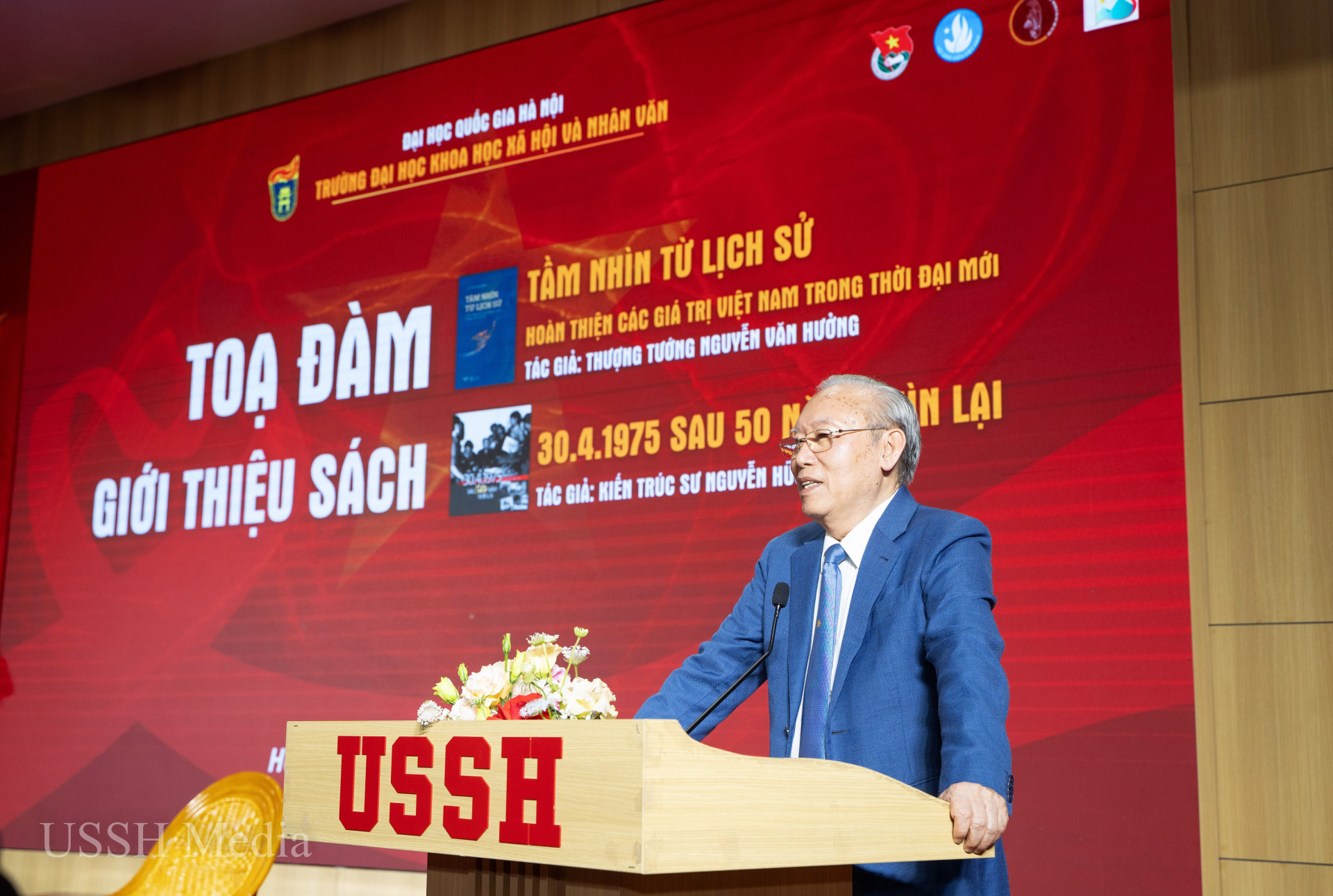
General Nguyen Van Huong shared with faculty and students of the University of Social Sciences and Humanities about his newly published work "Perspectives from History," released just before April 30, 2025.
The author dedicated an entire chapter to discussing the philosophy of yin and yang and applying it to explain Vietnam's diverse topography, arriving at a surprising yet compelling conclusion:
"Vietnam's unique alignment with the theory of the two opposing forces that create the universe shows that the country already possesses a universal value, ready to become a new center of development for the region and the world."While affirming the extremely important role of Geography, the author avoids falling into determinism. According to him:
"Forming all the elements of such a perfectly rounded S-shaped country was a long and arduous historical process of nation-building, in which our ancestors sacrificed so much blood and lives."This is an "introductory" story that allows the author to delve into the main content of the book, which is the process of cultural history.
The surprising and interesting aspect is that a comprehensive and holistic approach to Vietnamese history has just been established, while many professional historians are still struggling to explain specific historical issues. This book has truly mastered it and achieved great success. Recently, some have even used the pretext of "class standpoint" to accuse the Vietnam Historical Science Association of being a group that distorts history, even calling it reactionary and deliberately obscuring the 4000-year history of the nation, or attributing the unification of the country to Nguyen Anh, and the affirmation of Vietnam's sovereignty over the Hoang Sa and Truong Sa islands to the Nguyen dynasty... We highly appreciate and value the convincing scientific analysis and responsible spirit of General Nguyen Van Huong regarding the first era of nation-building and national defense of Vietnam.
"Entering the Iron Age, three major cultural centers formed across our country, leading to the emergence of the first three states: Van Lang - Au Lac in the North; the ancient Sa Huynh - Lam Ap - Hoan Vuong - Champa states in the Central region; and Funan in the South. The Van Lang state was established around 2700 BC, a few centuries earlier than Champa and Funan. However, all three types of early states are collectively classified as part of Vietnam's first nation-building period."For the first time, readers of Vietnamese history see images of the Pre-Sa Huynh site in Ben Ngu, Tho Chau, Phu Quoc, or the newly discovered Dong Son culture site in Cao Bang, included in official historical records. Regarding national sovereignty and territory, the author affirms:
"Vietnam took on its complete form as it is today under the last feudal dynasty, the Nguyen dynasty."(p. 45). And also during the Nguyen dynasty
National leaders have made significant efforts in asserting maritime sovereignty.Such an assessment is truly objective and fair, coming from a scientist and a national strategist with a genuine, insightful mind and high vision.
The author has presented and explained very concisely and succinctly the process of convergence and dissemination, shaping the main current, the changes, the ups and downs, the strengths and weaknesses, the favorable and unfavorable aspects, and both the successes and failures of the Era of Nation Building and Defense, the Era of National Independence, and the Era of National Integration and Development, in order to derive Vietnamese values that serve as the foundation and springboard for the country to rise and soar.
According to the author, Vietnam has a sufficiently strong foundation for development, possessing the right and ripe conditions to establish a new era – an era of a prosperous people and a strong nation, standing shoulder to shoulder with the world's leading powers. The analysis of the increasingly multipolar and complex international context, while inherently a major challenge for all countries, is viewed by the author as a great opportunity and a condition for Vietnam to enter an era of self-improvement. The process of economic development and integration, political stability, combined with an extremely favorable international context, and the genuine values of Vietnam and its people, refined and honed over a thousand years of history, are the necessary and sufficient conditions, providing a solid foundation and strength for Vietnam to enter this era of self-improvement.
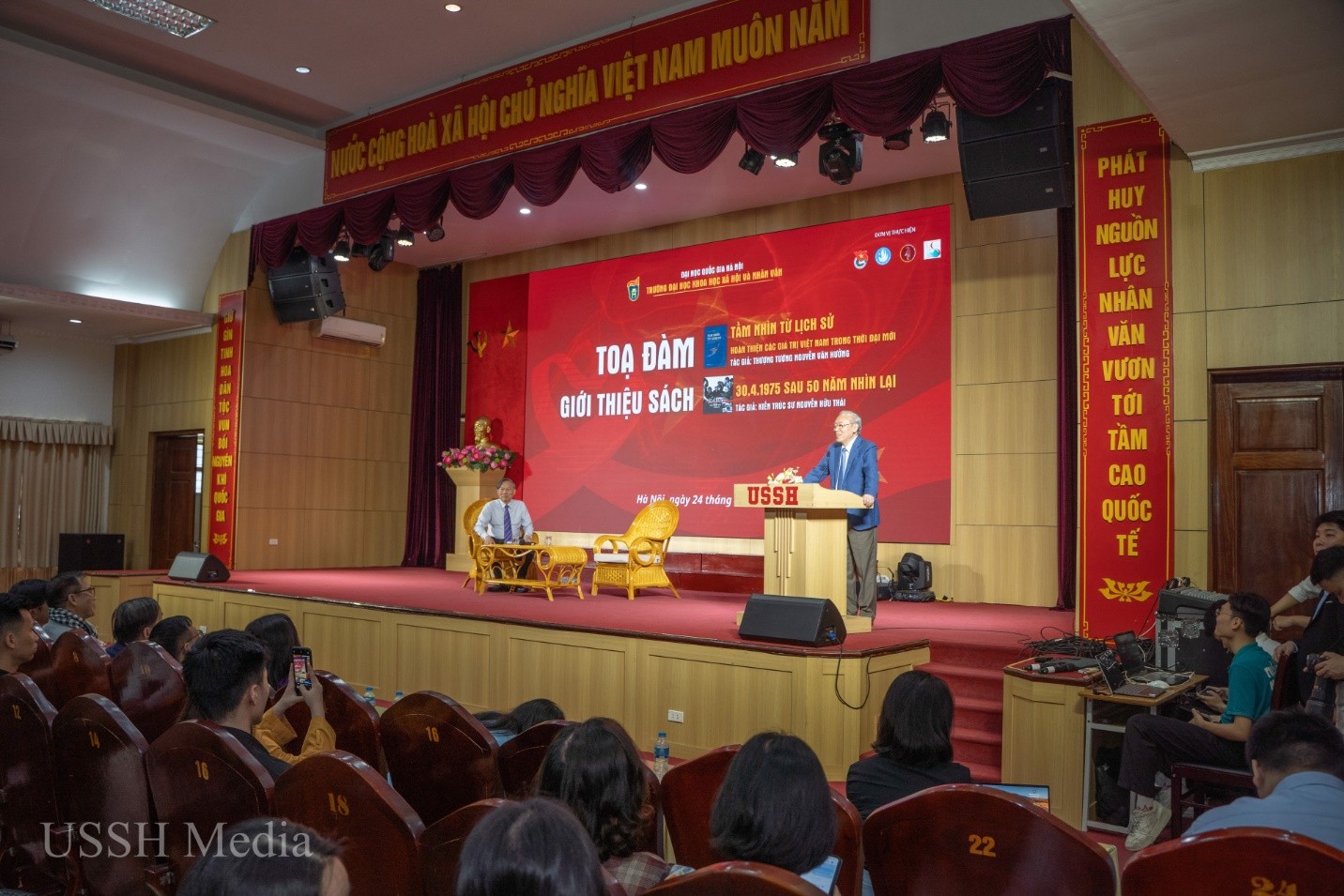
Over 400 faculty members and students attended the book launch seminar.
The purpose of this book is to use a historical perspective to find ways to address shortcomings, perfect values, and build confidence and strength for the entire nation to enter a new historical era. This must first and foremost involve the systematic, synchronized, and decisive improvement of the entire economy. However, economic development will lose its true meaning if areas directly affecting the people, such as healthcare and education, are not improved, and many other social sectors of the country are not perfected. While the country's foreign relations have achieved many successes, the strength of foreign relations in integration needs to be upgraded; cultural values need to be strengthened and perfected; and the people's trust and strategic confidence need to be nurtured to become the greatest and most important resource in making the country a powerful and prosperous nation.
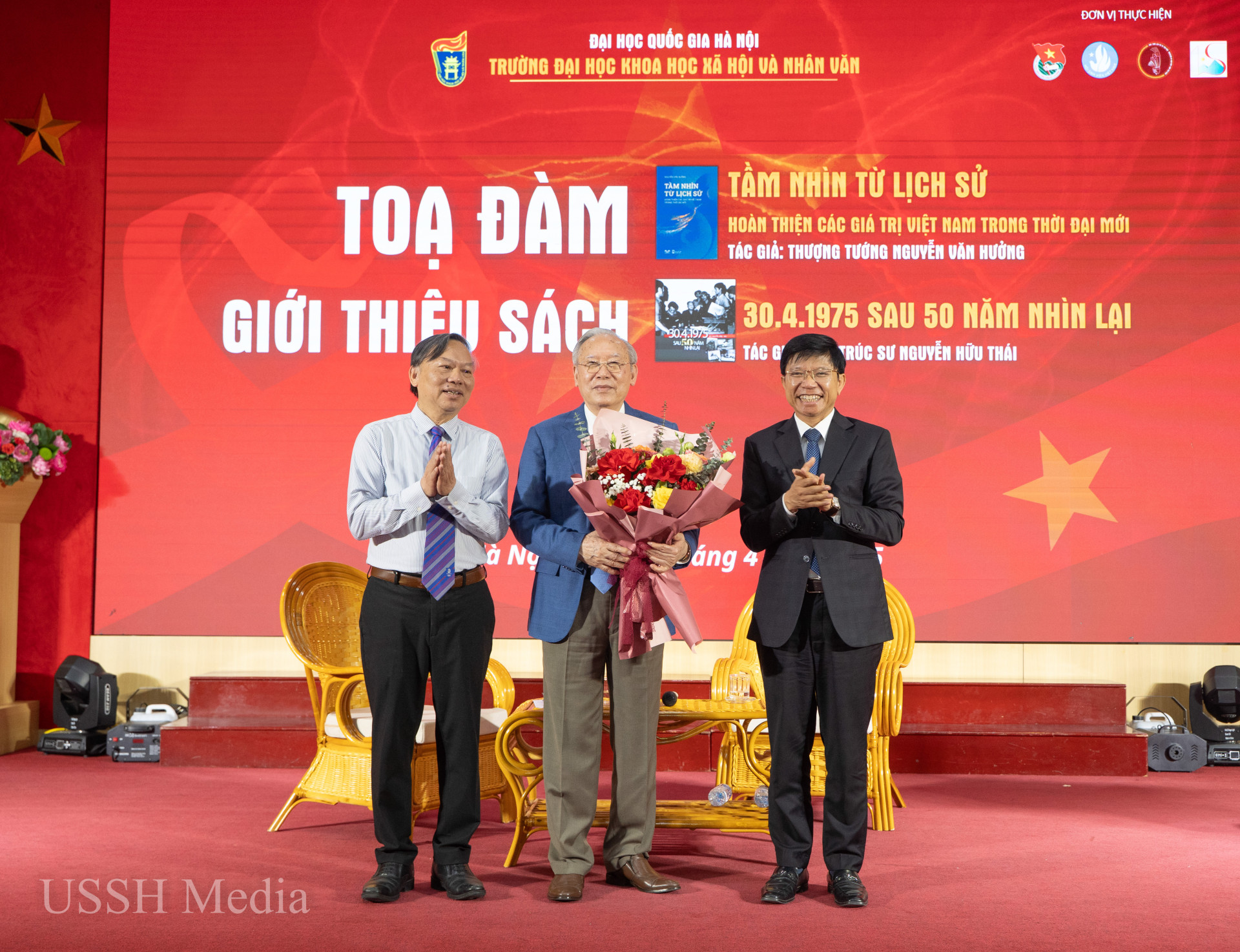
Professor, Doctor, People's Teacher Nguyen Quang Ngoc and Professor, Doctor Hoang Anh Tuan presented flowers to congratulate Lieutenant General, Doctor Nguyen Van Huong.
In the book, the author also dedicates a few pages to writing about Hanoi, the heart of the nation, the place where the national spirit converges, where the essence and spirit of the nation are passed down and expressed. According to the author:
"Whether a country develops or not, in terms of politics, culture, and spirituality, must begin in Hanoi. Restoring the values, heritage, and natural beauty of Hanoi is what creates the spirit and vitality for the country at this time." "Hanoi must not only be the political center but also truly the spiritual and cultural center of Vietnam in the modern era."Hanoi must be the engine, the launching pad for the entire country to enter a new era. In less than five pages sharing his thoughts about Hanoi, I feel as though he has guided the reader to the very depths of responsibility and love.
In September 1945, in a letter to students on the first day of school under the new regime, President Ho Chi Minh expressed his expectations:
"Whether the Vietnamese nation will become beautiful and prosperous, and whether the Vietnamese people will reach the pinnacle of glory to stand shoulder to shoulder with the world's leading powers, depends to a large extent on the academic achievements of our students."Today, exactly 80 years later, the head of the Party and State has realized President Ho Chi Minh's aspirations with the determination to build Vietnam into a prosperous, sustainable, and highly-positioned nation on the international stage; a new era – the era of the Vietnamese nation's rise – is beginning. We respectfully thank General Nguyen Van Huong for his talent and dedication as a national strategist, who has given us a historical vision to contribute to perfecting national values in the new era, to give the University of Social Sciences and Humanities – the heroic university founded by President Ho Chi Minh 80 years ago – more opportunities to grow, and to help each of us understand ourselves better and feel a greater sense of responsibility, contributing to building a beautiful country and a nation that can stand shoulder to shoulder with the world's leading powers.
Related articles:
The University of Social Sciences and Humanities held a photo exhibition and a panel discussion to introduce the book: A Message on the Value of Peace of the Nation.