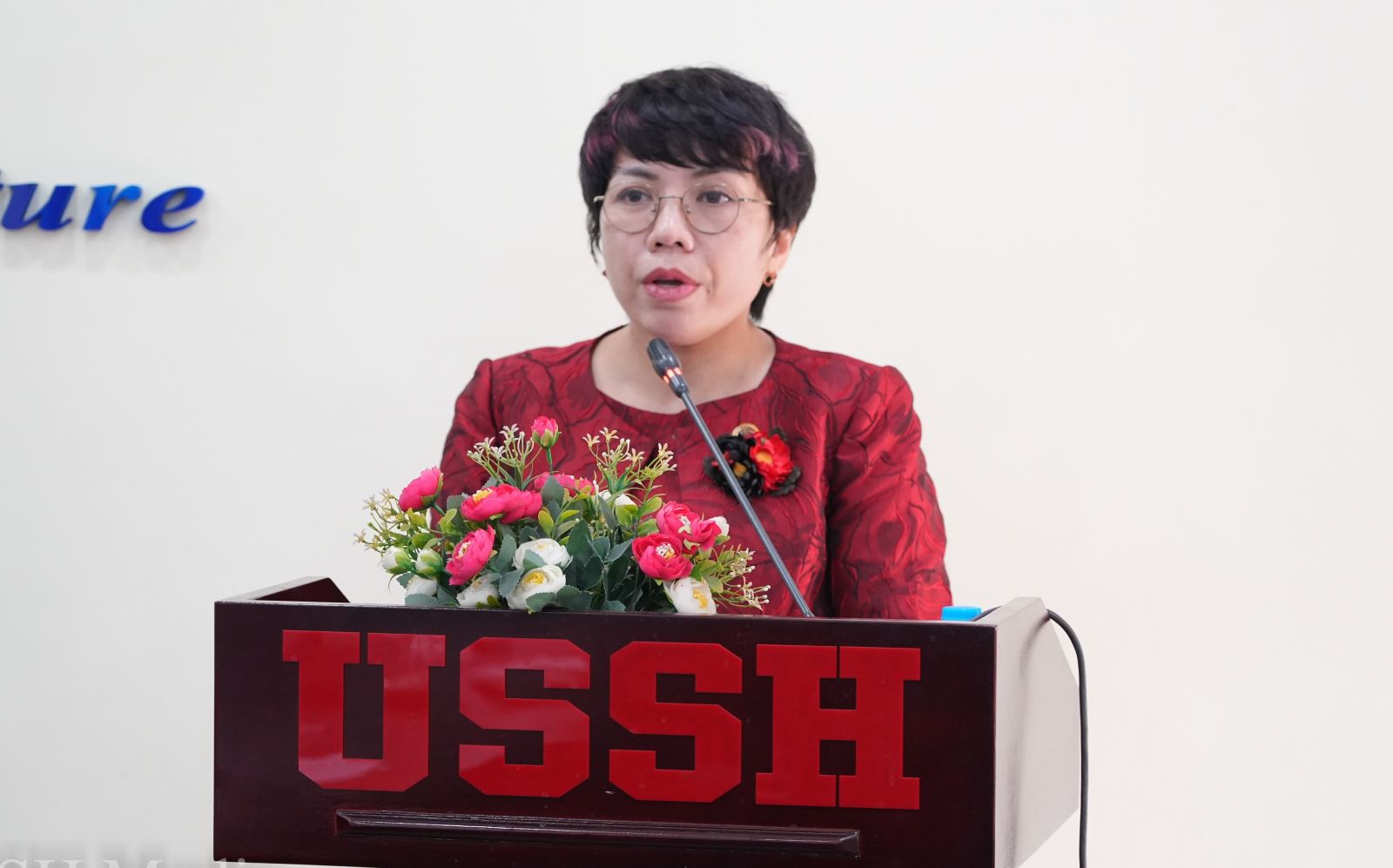
Technology can help businesses develop very quickly, but a humanistic mindset is what enables sustainable growth.
Reporter: Nowadays, digital technology is strongly dominating many aspects of life. In your opinion, Professor, does the role of social sciences and humanities still hold significance in this context?
Assoc. Prof. Dr. Do Huong Lan:As we know, the evolution of society through industrial revolutions and innovation ultimately aims to satisfy the boundless needs of humanity. When people are at the center, the focus must be on human beings and the value chain that serves them. More and more large businesses and organizations around the world are realizing that technology cannot operate independently of the human element. Steve Jobs (American entrepreneur and inventor, co-founder, former chairman, and CEO of Apple) once said: "Only when technology blends with art and humanity can we create products that make our hearts sing." This is not only Apple's philosophy but also the key to success for many large corporations worldwide.
Look at companies like Google, IBM, or Walt Disney; they don't just hire engineers or data analysts, but also recruit anthropologists, cultural scholars, and even historians. These experts bring a humanistic perspective, helping organizations gain a deeper understanding of consumer behavior, local culture, and even the ethical aspects of technology. Currently in the US, large companies are also increasingly hiring personnel trained in philosophy, history, and anthropology. This is why the social sciences and humanities are not only significant but also a core element in the digital age and innovation.
Reporter: There is an opinion that social sciences and humanities are often considered academic fields, sometimes even deemed "detachable from reality." What are your thoughts on this assessment, Professor?
Assoc. Prof. Dr. Do Huong LanThis is a fairly common understanding, but reality is proving the opposite. Today's social sciences and humanities are not just about "research for information" and raising awareness, but also about "research for action." For example, in Unilever's business strategy, anthropologists studied the hygiene habits of people in rural areas of India. As a result, they created compact, inexpensive soap products that met practical needs. This not only boosted revenue but also improved public health. At Google, there are two important philosophies based on human behavior, not technological progress. The first philosophy is about "Building for Everyone," emphasizing the need to combine understanding from social sciences, behavioral sciences, and humanities to design inclusive technology, making it easy and useful for anyone, regardless of their background, culture, or ethnicity. This philosophy places people at the center, thereby creating products that are both socially meaningful and promote sustainable innovation. The second philosophy on human resource development, "Search Inside Yourself," combines emotional intelligence, neuroscience, and mindfulness practices to help individuals develop self-awareness, focus, and compassion, thereby sustainably improving work performance and personal well-being.
In Vietnam, I see that the social sciences and humanities are playing an increasingly important and leading role in researching mechanisms and policies serving socio-economic development, international and regional integration, as well as research serving businesses, such as consumer psychology research, painkillers, and value creators in business models… We need to recognize the social sciences and humanities as a field that contributes to creating practical and sustainable solutions.
Reporter: Professor, could you share more about the role of humanistic thinking in large business organizations today?
Assoc. Prof. Dr. Do Huong Lan:Large organizations understand that while technology can develop rapidly, it is a humanistic mindset that sustains business growth. A prime example is the Walt Disney Corporation under the leadership of Bob Iger, who came from a background in history and theater, giving him a deep understanding of storytelling and audience emotions. Of course, Bob Iger also possessed knowledge of finance, mergers and acquisitions, and corporate governance. This combination of artistic vision and business strategy enabled Walt Disney to expand globally, from film production to the development of iconic theme parks.
Another example is IBM. They have recruited anthropologists to help research how artificial intelligence (AI) technology is used in practice, ensuring that AI systems are not only effective but also aligned with human values and needs.
Many major investors in finance and senior managers at large banks have backgrounds in the arts, aesthetics, and humanities. Studying finance and taking business courses is not difficult, especially if you already have a foundational understanding of people, history, and culture.
Humanistic thinking helps organizations answer crucial questions: Does this technology truly benefit people? Does it create inequality? Technology today is both a driver, a conduit, and a result of the specific shifts in human behavior and psychology in the modern era. These changes require multi-faceted evaluation and interaction. In this way, the social sciences and humanities play a vital role in maintaining a balance between economic growth and the creation of social value.
Social sciences and humanities support startups and innovative organizations.
Reporter: We understand that the University of Social Sciences and Humanities has recently begun to intensify the implementation of social innovation programs. What are your views, Associate Professor, on the role of social sciences and humanities in these innovative trends?
Assoc. Prof. Dr. Do Huong Lan:Social innovation – using technology to create innovative solutions that address social and environmental challenges and contribute to sustainable social value – is becoming a global trend. Social innovation projects that combine humanistic thinking and technology not only bring economic benefits but also contribute to environmental protection, improve quality of life, and address social inequalities.
At the 2023 Global Startup Investment Summit in Israel – the startup nation – with the slogan: “Startups Save the Planet,” startups showcased numerous technological solutions to address social and environmental problems. This conference affirmed a clear trend: technology is not just a tool, but a bridge to solving urgent problems facing humanity and the planet. However, for technology to truly realize its value, it needs to be guided by humanistic and scientific thinking, and technology must serve the well-being of the people. A prime example is the renewable energy startups at this conference, which not only developed advanced technologies like solar energy but also researched the energy usage habits of local communities, thereby implementing culturally and economically appropriate solutions. This demonstrates that technology, when not integrated with social and humanities knowledge, is unlikely to achieve optimal effectiveness.
Reporter: Professor, could you share more about how social sciences and humanities support startups and innovative organizations in sustainable development?
Assoc. Prof. Dr. Do Huong Lan:The social sciences and humanities support startups and innovative organizations in three major areas:
Firstly, a deep understanding of people and society is crucial: sociologists and anthropologists can study consumer behavior, cultural needs, and social conditions in different regions. This helps ensure that technology products are not only relevant but also deliver real value to the community.
Secondly, ethical orientation: Social sciences and humanities raise important questions about the impact of technology, ensuring that innovative solutions do not harm human rights or the environment.
Fourth, enhancing social acceptance: technology only succeeds when it is accepted by the community. Knowledge from the social sciences and humanities helps build trust and support from society for technological innovations, narrowing gaps in cultural competition and development: the wave of technological democratization enables the humanities to proactively conduct experiments and interact with target audiences quickly and directly, without being dependent on other economic factors.
Reporter: Professor, what can Vietnam learn from global trends in social innovation?
Assoc. Prof. Dr. Do Huong Lan:Vietnam needs to make good use of its young workforce and technological advancements, while also paying more attention to social and humanitarian factors in its innovation initiatives. Some lessons we can apply include:
Firstly, interdisciplinary collaboration: combining engineering, technology, and social sciences and humanities to create more comprehensive products and policies.
Secondly, we should encourage the education of humanistic thinking: incorporating humanities subjects into training programs in engineering, business, and management. This will help the younger generation understand that social sciences and humanities are not just theory, but also have immense practical value.
Thirdly, invest in socially innovative projects: The government and businesses need to promote initiatives that not only generate profits but also address social and environmental problems…
The journey to becoming a social innovator.
Reporter: The University of Social Sciences and Humanities is a leading university in Vietnam in the field of social sciences and humanities. Professor, could you share more details about the initiatives of the Institute of Policy and Management in particular, and the University in general, in promoting social innovation, especially how technology and humanistic thinking are combined to support young people who are not tech-savvy?
Assoc. Prof. Dr. Do Huong Lan:Recently, we announced the Road2Social Innovation program of the University of Social Sciences and Humanities, which will be launched in the spring of 2025. This will be an incubation space for future social entrepreneurs. This initiative aims to promote social innovation, based on a core principle of humanistic thinking combined with the application of modern technology. We are collaborating with domestic and international partners to implement activities within this program, such as:
The Young Creators Program scholarship program collaborates with impact-oriented startup funds, founders, and the global technology corporation Zoho to provide a unique scholarship program for faculty and students. This program helps develop no-code products, opening opportunities for non-tech-savvy individuals to create innovative, effective, and easy-to-use solutions.
The "Democratizing Technology" challenge series organizes interdisciplinary challenges for students not only at the University of Social Sciences and Humanities but also for students from other universities. These challenges focus on: researching user behavior in technology; writing and localizing websites or applications for easy access to a wider audience; creating multimedia content; and promoting the idea of "technology for all" to engage the community. Importantly, students will work directly with partner businesses, receive financial support, and gain practical experience.
These are just two of a series of activities promoting social innovation and entrepreneurship for students within the Road2Social Innovation Program. We expect to create good projects that can bring student prototypes abroad, creating opportunities for international learning and opening up access to the global market for social innovation projects.
All activities within the Road2Social Innovation initiative revolve around the philosophy of "humanistic thinking as the core." We aim to inspire students to see that humanistic values are not merely "academic," that humanistic thinking and social knowledge are highly useful and valuable, and that technology is not a distant field, but a tool to realize profound humanistic values and make a positive contribution to the community.
Reporter: Professor, do you have any message you would like to send to Vietnamese entrepreneurs and young people, as well as young people who want to pursue careers in social sciences and humanities?
Assoc. Prof. Dr. Do Huong Lan:I want to tell young people that innovation is not just about technology or profit, but about how we use our creativity to solve the great problems facing humanity and the planet. Humanistic thinking is the core element that helps us not only survive but also thrive in a volatile and complex world.
With their intelligence and boundless creativity, Vietnamese youth are fully capable of becoming "global change-makers"—individuals who not only bring glory to their country but also lead innovative social trends internationally. They not only have the opportunity to learn but also to shape the future of technology, business, and human culture.
Be confident that the social sciences and humanities are not "old-fashioned," "boring," or "outdated." This is where you can gain a deep understanding of people, society, and culture – elements that never lose their value, no matter how the world changes. Those who pursue this field will become leaders and innovators with a humanistic mindset – a quality increasingly valuable in the digital age.
As Steve Jobs said: "Technology alone is not enough; it needs to be combined with art and humanities to create miracles." If Vietnamese youth know how to combine humanistic intelligence with technology, I believe they will not only make Vietnam a shining example of social innovation but also become a symbol of the balance between technological progress and shared human values in the world.
Believe in your own strength and never stop learning. You are the future of a developed, modern, and humane Vietnam!
Thank you for your meaningful and inspiring insights. We hope your sharing will help readers recognize the immense role of social sciences and humanities in the age of technology and innovation.
Vietnam Science and Technology Magazine: Social sciences and humanities in the age of technology and innovation.