
1. Many researchers argue that Vietnamese history is a history of wars. As a predetermined fate, in the long process of national development, Vietnam has had to constantly confront wars of aggression by regional powers and world empires. In the work "Unity in Diversity in Vietnamese HistoryProfessor of history Phan Huy Le once summarized: Not counting the resistance wars against invaders during the Hung Kings era reflected in legends, just from the resistance war against the Qin Dynasty in the 3rd century BC to 1975, the Vietnamese people had to wage 15 wars to defend their homeland. Of these, 12 were victorious and 3 were unsuccessful. The unsuccessful resistance wars led to many serious consequences for Vietnamese history, culture, and society.[1].
From this summary, we see that the resistance against the invading army of Trieu Da failed in 179 BC, leading to a 1,000-year period of Chinese domination, and independence was only achieved in 938 after the Battle of Bach Dang led by Ngo Quyen. The Ho Dynasty's unsuccessful resistance against the Ming Dynasty in 1406-1407 pushed the country into two decades of Ming rule (1407-1427). The Nguyen Dynasty's unsuccessful resistance against the French (1802-1945) and the Can Vuong movement (1885-1896) resulted in the Vietnamese people enduring over 80 years of French colonial rule (1858-1945). These are tragic and dark chapters in Vietnamese history!
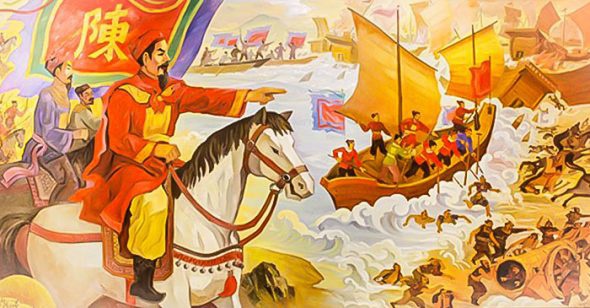
Over a period of 30 years (1258-1288), the army and people of Dai Viet, under the leadership of the Tran dynasty, had to wage three wars of resistance against the expansionist ambitions and invasions of the Mongol-Yuan empire, a powerful and aggressive nomadic force, one of the most formidable in the world at that time. (Image: Internet)
It is noteworthy that, during the period of foreign domination, despite exploitation, oppression, and numerous losses and sacrifices, the Vietnamese people persistently fought to regain national independence and freedom. In total, the Vietnamese people waged more than 200 uprisings and wars of national liberation. The period of resistance against foreign invaders spanned 12 centuries, accounting for more than half of Vietnam's history. Almost every century saw Vietnam's struggle against invasion. For example, in the 13th century, within 30 years (1258-1288), the army and people of Dai Viet, under the leadership of the Tran dynasty, had to wage three wars against the expansionist ambitions and aggression of the Mongol-Yuan empire, a powerful and aggressive nomadic force at that time.[2]In the 18th century, for five years (1784-1789), the Vietnamese people had to simultaneously resist the Qing dynasty in the North and the Siamese invaders in the South.[3]In general, in those wars to defend the homeland, the invading armies were often many times stronger. Many wars also clearly demonstrated the goal of conquest and destruction, the most concrete manifestation of which was the plot to assimilate and destroy cultural heritage. It can be said that, in the history of Asian nations, few countries have had to endure as many harsh political challenges, directly impacting the survival of the nation, as Vietnam. To survive, develop, and to be strong enough to resist foreign invaders, the Vietnamese people united as a single entity, upholding patriotism and the awareness of protecting their territorial sovereignty and cultural identity.[4].
Obviously, Vietnamese history cannot be merely the history of wars. Vietnamese history is also the history of a nation with many cultural innovations; of economic relationships and activities; the history of the formation and transformation of social strata and communities; the history of the elite and the common people, the ordinary individuals... all of whom have contributed to writing the glorious chapters of the nation's history in the cause of building and defending the Fatherland. Vietnamese history is also the history of political and legal systems; of ideological trends and movements; of religious sects and beliefs; and of international and regional relations.[5]...However, war has become a constant threat, even a "typical characteristic" of Vietnamese history. This characteristic has profoundly impacted the psychological life, cultural behavior, and development policies of Vietnam, not only before and during wars but also leaving lasting consequences in the thinking of a nation in post-war periods.
2. Throughout the ups and downs of history, the 20th century can be seen as the century in which our nation had to confront the most intense and fierce political challenges. For nearly the first half of this century, Vietnam had to concentrate all its strength on fighting against the war of aggression and the colonial rule of the French.[6]Vietnam achieved victory in the war of national defense amidst the confluence of World War II, creating favorable conditions for the Vietnamese revolution. In East Asia, the Asia-Pacific War significantly impacted regional political life. In fact, the August Revolution of 1945 not only marked the end of more than eight decades of French colonial rule but also simultaneously ended the presence of Japanese troops in Vietnam.[7]However, in the complex international circumstances of the time, under the guise of allied forces, the French political establishment allowed troops to return to Indochina, followed by British troops and Chiang Kai-shek's forces. Responding to the call to arms...Nothing is more precious than independence and freedom.Following President Ho Chi Minh's call, the entire Vietnamese nation rose up against the invading armies.[8]Throughout that sacred and noble revolutionary career, the outstanding leader Ho Chi Minh emerged as a key figure.The name of President Ho Chi Minh is associated with the most important events in the history of the heroic struggle of the Vietnamese people for freedom and independence. This struggle is an invaluable contribution to the national liberation movement and the world revolutionary process, to consolidating the forces of peace, democracy, and social progress on our planet... Under the banner of President Ho Chi Minh, the Vietnamese people successfully carried out the August Revolution of 1945, dealing a fatal blow to the colonial system of imperialism in Asia. Under the banner of President Ho Chi Minh, the Vietnamese people established the first worker-peasant state in Southeast Asia - the Democratic Republic of Vietnam - and defended that state during the nine-year resistance war against French colonialism.”[9].

President Ho Chi Minh reading the Declaration of Independence, giving birth to the Democratic Republic of Vietnam in 1945. Photo: Internet.
Throughout the period of 1946-1954, alongside the armed struggle, the Ho Chi Minh government also implemented courageous and skillful diplomatic policies to gain international support and recognition. Finally, after nine years of protracted and arduous fighting, with the victory at Dien Bien Phu in 1954, Vietnam restored independence to half of its territory.[10].
According to the Geneva Accords, the 17th parallel, along the Ben Hai River, was designated as the temporary dividing line between North and South Vietnam.[11]The Vietnamese people's resistance against the invasion by the US and its "allies" lasted 21 years (1954-1975) before achieving final victory. However, subsequent wars to defend the southwestern and northern borders took place. For about 10 years, Vietnam endured extremely difficult times in terms of politics, economics, diplomacy, cultural development, and maintaining social stability.
Thus, like the 13th and 15th centuries, the 20th century was a century in which the Vietnamese nation had to confront many harsh political challenges. The survival of the nation was seriously threatened. Never before had so many foreign invading armies appeared simultaneously on Vietnamese territory. And never before had Vietnam suffered so many sacrifices and losses! But, Vietnam stood firm, gradually reviving and developing after the wars. This was a great revival of a nation with strong cultural vitality. In some respects, the harsh challenges of history forged resilience, fostered patriotism, a yearning for peace, and a desire for prosperity in each individual and the entire Vietnamese nation.
War is the most intense and comprehensive challenge to the vitality of a nation. To fight and defeat a fierce enemy, far superior in military strength, the Vietnamese people had to mobilize all resources to the fullest extent for the cause of liberating the South and unifying the country. A "war"People's War”[12], the “Holy War"The resistance movement was organized to protect the most sacred values of the nation. During that heroic resistance, patriotism and the spirit of national independence were highly demonstrated in all aspects of social life. The entire Vietnamese nation was united and determined to protect the cultural values of the country, to protect national sovereignty and national unity. Vietnam garnered strong support from peace-loving people around the world."[13]Throughout those arduous 21 years, the strength of the nation and the strength of the times converged, creating a tremendous force that led to the victory in the Spring of 1975.
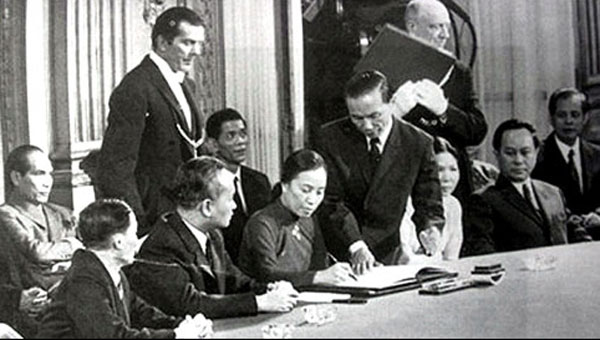
Ms. Nguyen Thi Binh - Head of the Delegation of the Provisional Revolutionary Government of the Republic of South Vietnam (in the middle) signs the Paris Agreement on ending the war and restoring peace in Vietnam in 1973. Photo: Internet.
3. After the fierce challenges of the wars passed, by the 1980s, the domestic and international situations underwent fundamental changes. Recognizing the impossibility of continuing the "traditional" management policies and foreign policy perspectives of the Cold War era, under the leadership of the Party, Vietnam embarked on the Doi Moi (Renovation) process in 1986, with the first breakthrough being the abolition of the bureaucratic subsidy mechanism and the implementation of a socialist-oriented market economy. As a country whose economic potential is primarily based on agriculture, Vietnam implemented many policies to open up agriculture, while simultaneously outlining development trends for various economic sectors, scientific and technological activities, education, and culture.[14]As a result, in a short period of time, from a country constantly facing food shortages and famine, Vietnam was able to fundamentally solve its food problem and become one of the countries with rich food potential, capable of exporting a large quantity of agricultural products to the world market. Along with crude oil and other agricultural products, rice has become an important export commodity, bringing in foreign currency for socio-economic development, stabilizing the lives of over 80% of the rural population, and contributing to the development of several new industries and economic sectors in Vietnam.[15].
Former Deputy Prime Minister and Minister of Foreign Affairs Nguyen Manh Cam (second from the right) with ASEAN Foreign Ministers at the meeting to admit Vietnam into ASEAN in Brunei in 1995. Photo: Internet.
Furthermore, during the implementation of the Doi Moi (Renovation) policy, Vietnam's understanding of the political context and global forces also underwent fundamental changes. Over a period of about 10 years (1986-1995), Vietnam made remarkable efforts to resolve existing problems and obstacles in international relations. From the policy of "We want to be friends with all countries.” to the motto: “Vietnam is ready to be a friend and a reliable partner in the international community, striving for peace, independence, and development.”[16]Vietnam sent a message of peace, expressing its goodwill to build, strengthen, and develop cooperative and friendly relations with the peoples of the world, and in reality, wrote a new chapter in international relations. This peaceful, proactive, and dialogue-oriented foreign policy has enhanced Vietnam's position on the international stage. Implementing an increasingly open foreign policy has led to a better and more accurate understanding of Vietnam by countries in the region and the world. Entering the 1990s, along with the joint efforts of the international community, Vietnam successfully resolved the "Cambodian issue," continued to strengthen its special friendship with Laos, gradually improved relations with ASEAN countries, and, importantly, made significant progress in normalizing relations with China and improving relations with the United States.[17]Regarding China, after many efforts, in March 1991, Chinese Premier Li Peng declared that "Vietnam-China relations have thawed." By November 1991, the leaders of the two countries officially announced the normalization of relations. For the countries in the Northeast Asian region, Vietnam continued to strengthen its special relationship with Japan and in 1992 officially established diplomatic relations at the state level with South Korea.[18].
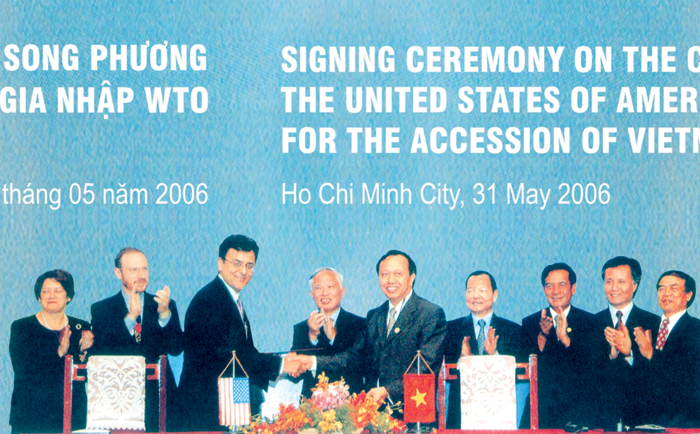
Mr. Luong Van Tu and Mr. Batia - Head of the US delegation - signed the bilateral agreement on Vietnam's accession to the WTO on May 31, 2006, in Ho Chi Minh City. The event was attended by Deputy Prime Minister Vu Khoan, Mr. Le Thanh Hai - Secretary of the Ho Chi Minh City Party Committee, Mr. Le Cong Phung - Deputy Minister of Foreign Affairs, and Ms. Surance - Head of the USTR. Photo: Internet.
In the historical journey since the implementation of the Doi Moi (Renovation) policy, two significant moments have occurred: 1995 and 2006. 1995 marked a turning point in Vietnam's foreign relations. Some commentators consider it a year of great diplomatic success for Vietnam. On July 28, 1995, Vietnam officially became the seventh member of ASEAN. Also in that year, following the lifting of the embargo against Vietnam on February 3, 1994, on July 11, 1995, US President Bill Clinton officially announced the normalization of relations with Vietnam. With these important diplomatic victories, a period of Vietnam's isolation and blockade in international relations ended. In fact, Vietnam gained more favorable opportunities to integrate with the general developments of the region and the world.
A decade later, in 2006, Vietnam achieved two more significant diplomatic victories: becoming a full member of the World Trade Organization (WTO) and successfully hosting the APEC Summit in Hanoi. That year, Vietnam-Japan relations were elevated to a strategic level. Relations with China and the United States also saw significant improvements. With China, the two countries resolved two of the three fundamental sticking points in their bilateral relationship.[19]A new wave of investment has focused on Vietnam, a country rich in resources and human capital. Vietnam has become an attractive investment environment for many entrepreneurs, economic corporations, banks, and major financial institutions worldwide.
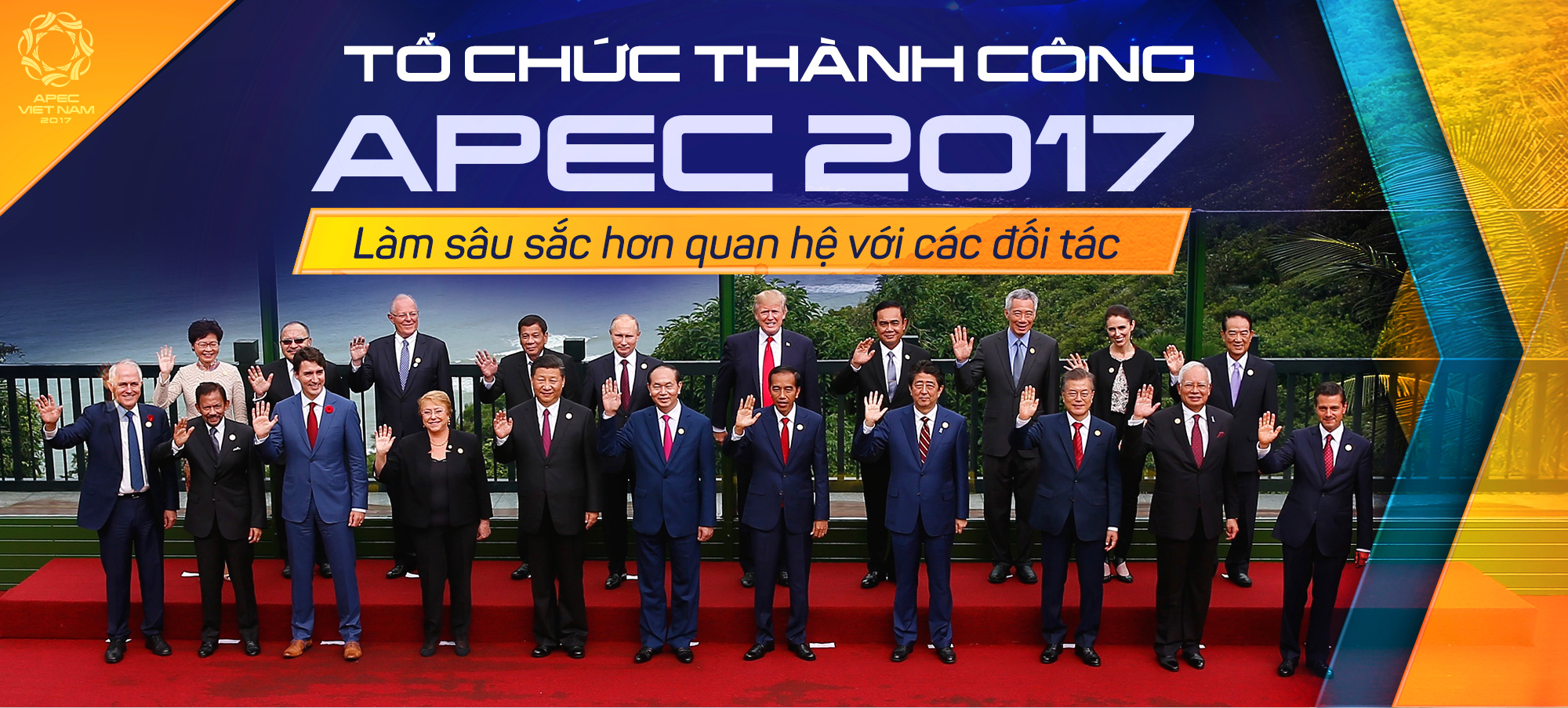
Vietnam successfully hosted the APEC Summit in 2017. Photo: Internet.
From reconstructing the basic appearance and historical developments of the 20th century, several observations and interpretations can be drawn:
1. Vietnam's strategic location
In fact, thoroughly answering the question of how Vietnam's strategic position has played a role and manifested itself throughout different historical periods and in the nation's long historical journey is not an easy task. Like many countries in the world, Vietnam's geostrategic position has both constant and immutable factors, meaning it shifts over time due to domestic, regional, and international influences. It can be seen that, along with the potential and abundant resources of the diverse tropical ecosystem (General ecosystemWith its abundant labor force, relatively large deltas, and numerous trading ports favorable for military defense planning and promoting international trade, Vietnam's strategic location as a transitional hub between Northeast and Southeast Asian countries, and between the continent and the ocean, demonstrates its importance on the regional political map.[20]In the article, “Vietnamese geopolitics viewed from Asia: What lessons can we learn from the Third Indochina War today?Regarding Vietnam, researcher Christopher Goscha stated: "Vietnam has been and will forever remain a country of immense geopolitical importance in the world due to its geographical location on the Eurasian continent and its proximity to the South China Sea." Placing Vietnam within the context of the relationship and the struggle for influence among Asians and the world, we see that, although relatively small in terms of territory, Vietnam has historically held an important position not only for Americans but also for Russians, Chinese, Japanese, and even Indians.[21].
Stretching along the eastern flank of the Southeast Asian peninsula, with a coastline of 3,260 km, Vietnam holds a strategic position between peninsular Southeast Asia and island Southeast Asia, and between Northeast Asia and Southwest Asia. Vietnam is a destination for many migration flows and a crossroads of various cultures in Southeast Asia, as well as between Southeast Asia and China and India. As many researchers have pointed out, historically, while Indian influences reached Southeast Asia through economic, cultural, and religious channels – peaceful paths – the peoples of the region, especially those sharing land borders and strategically important maritime trade positions in East Asia, have consistently faced strong political and military pressure from the North.
As a country situated at the crossroads between two worlds: Northeast Asia and Southeast Asia, Vietnam has consistently been the first to bear the brunt of intense pressure from the North, as well as from certain forces in the South and Southwest. During the expansion of influence southward, Vietnam served as a gateway for many Northern monarchies to Southeast Asia, connecting both land and sea routes. In modern times, Western powers (Portugal, Spain, England, the Netherlands, France, etc.), operating from the southern seas, sought to penetrate the Southeast Asian peninsula and the vast market of southern China, all considering Vietnam a crucial target to conquer. Objectively speaking, Vietnam's geostrategic position has always provided many favorable conditions for the country's economic development, expansion of diplomatic relations, and cultural exchange... but this position also easily turns Vietnam into a target and a battleground for regional and international powers.[22].
2. Regarding the origins and vibrant spirit of the nation.
As mentioned above, from the Qin invasion in the 3rd century BC to 1975, over a period of 22 centuries, Vietnam had to wage 15 wars of resistance to defend its country, and the time spent fighting against foreign invaders amounted to 12 centuries.[23]As an early-forming nation in Southeast Asia, the inhabitants of the Van Lang and Au Lac states were early aware of their living environment, survival space, and distinct culture. Throughout 1,000 years of Chinese rule, along with the process of...Sinicization" is a process of cultural self-defense:de-SinicizationSome authors argue that the process “Sinicization"This influence was strong only among certain upper social classes and concentrated in the Northeast. The density of Han tombs and tombs in the Han style, as well as administrative centers in this area, partly proves this point. Therefore, despite dominating Vietnam for a relatively long time, the influence of Northern culture generally could not extend far beyond the Red River Delta and some areas with indigenous cultural foundations that had shared many influences from Southeast Asian culture. However, over time, through various means and methods, that culture has permeated the cultural life of many social classes. Throughout a thousand years of Northern rule, it is difficult to imagine that Northern culture could not penetrate some rural areas. In fact, some cultural elements, customs, and practices from both the North and the South have gradually permeated and become a part of Vietnamese culture, especially among the lower classes." top of society.
Furthermore, it must be acknowledged that in villages and remote areas, traditional Vietnamese cultural elements, closely related to and sharing a common foundation with Southeast Asian cultures, have been preserved as a stable core structure. Crucially, despite the strong pressure and continuous influence of Chinese culture, it has failed to degrade or break down this traditional structure. A deep awareness of origins, territorial sovereignty, and a unique cultural tradition is the inherent strength and fundamental factor in both localizing external cultural elements and preserving this structure. This structure is also maintained within the close relationships between village members, in shared customs, cultural activities, and a profound sense of community. This awareness is the sacred bond between members of society and can become a unifying factor and driving force for transformation.Nationalism,PatriotismAnd that patriotic spirit is always multiplied many times over when national interests and sovereignty are threatened.
Furthermore, if we consider the process of cultural exchange along the North-South axis and from the perspective of cultural analysis and layering, we can see that the influences from the North on Vietnam can be divided into three basic types or cycles. First, there are the influences from the Southern Chinese cultural region spreading to Southeast Asia and Vietnam. Next, there are the influences from Northern China, and finally, the influences from Northern China that have been "Southern China"In particular, the first cultural sphere was somewhat closer to Southern culture, so when it penetrated Southeast Asian society - Vietnam in general - there were no strong reactions."
Importantly, while resolutely fighting to protect its political independence, Vietnam has not rejected many external cultural values. With this perspective,Without being inferior to China, one is not different from China."(Not inferior to China, not different from China) generations of Vietnamese people have found in the treasure trove of regional culture the capacity for creative development and are ready to embrace that heritage not only to supplement but also to strengthen their necessary resilience. In fact, in Vietnamese cultural traditions, from political institutions, laws, writing, education... there are many imprints of regional culture. In the work..."Some thoughts on Vietnamese history and Vietnamese thought.Historian Ha Van Tan once stated: "In the history of Vietnamese thought, we often encounter the refinement of existing ideological weapons to suit the needs of Vietnam, the greatest and most urgent of which is the preservation of the nation's survival."[24].
It should also be added that the strength of Vietnamese culture is also a synthesis of influences from Indian civilization, especially the humanist ideas and perspectives of Buddhism and Hinduism.[25]Based on its indigenous cultural foundation and profound sense of national sovereignty, Vietnamese culture has absorbed many values and elements from Northeast Asian and Southwest Asian civilizations, and from the 16th to 17th centuries, influences from Western culture to supplement and enhance the value and creative vitality of its own culture.[26]It can be said that Vietnamese culture found its inherent strength and vitality in the process of the struggle for national independence and truly flourished after 10 centuries of Chinese rule. This explains why, shortly after gaining independence, with a belief in the nation's longevity, and with a new position, vision, and vitality, Dai Viet became a powerful nation in Southeast Asia.
Throughout 1,000 years of Chinese rule, and 10 centuries of resistance against foreign invaders, defending independence and sovereignty, and building the nation, the Vietnamese people have demonstrated strong political acumen, a resilient cultural identity, and intelligence. Reflecting on the nation's historical and cultural journey, we can understand:Cultural identity consists of the core, crystallized values of a culture; these values are formed over time, refined through cultural eras, and passed down through generations. It is through this cultural identity that one can recognize the similarities, differences, contributions, unique values, and creative capabilities of a culture within the overall context of human cultures and civilizations..
3. Vietnam - A dynamic nation
Some researchers argue that Vietnam is an agricultural country, and Vietnamese culture is agricultural culture. Agriculture is a characteristic and identity of Vietnamese and Southeast Asian culture. However, on the other hand, we also see that Southeast Asia is not a region or center with a homogeneous natural ecosystem and culture.[27]Southeast Asian culture is complex, and each culture in the region contains and intertwines many different traditions. Vietnamese culture is a unified culture in diversity. The process of territorial expansion and exploration of the central and then the Mekong Delta by the Vietnamese people gradually brought together a multifaceted cultural tradition of the regions with three fundamental foundations: the Dong Son culture in the North, the Sa Huynh - Champa culture in the Central region, and the Oc Eo - Funan culture in the South of Vietnam. The natural conditions of being a peninsula and having a high coastal index are also among the reasons for the dynamic development in the nation's historical journey.[28].
Influenced by a diverse ecosystem and being a multi-ethnic nation, the Vietnamese people practice polytheism. This is a core factor shaping Vietnam's distinctive cultural behavior and traditions. This explains why, when new cultural and religious elements enter Vietnamese society, the indigenous culture naturally accepts them and rarely experiences major, intense cultural conflicts. Cultural tolerance and the ability to translate that tolerance into practical action in cultural behavior are among the unique values of Southeast Asian and Vietnamese culture.
Over the past several decades, there has been increasing discussion about Asian values. These values are expressed and embodied in the thought and philosophy of Buddhism, Hinduism, Confucianism, Islam, and other religions; in the close relationship between humans and their social, cultural, and natural environments; in the characteristics of Asian social structures and community organizations; and in the order and emotional bonds passed down among family members. These values are a synthesis of the finest humanistic values, transcending time and space, and present in the strategies of many nations today that are striving for green and sustainable development.
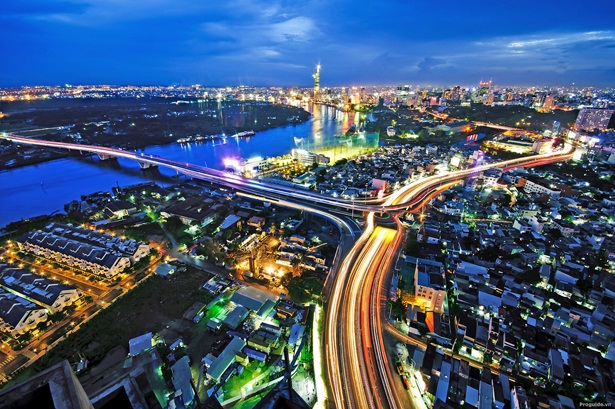
Ho Chi Minh City - one of the most dynamically developing cities in the country. Photo: Internet
Many cultural researchers argue that, in traditional Vietnamese culture, the Vietnamese people are sentimental, even sentimental. I believe that is true, but not entirely sufficient. The Vietnamese also possess a strong practical mindset, valuing practical principles and possessing a high adaptability to specific political contexts. Through their intellect and reason, the Vietnamese organized social forces to build large-scale irrigation systems. They also organized many major battles of strategic significance, employing sophisticated military tactics and achieving important victories against powerful enemies. With their practical thinking, the Vietnamese also resolutely abandoned old economic and social management systems and policies to implement reforms throughout history and the Doi Moi (Renovation) era. Furthermore, with their practical mindset, they have also changed their "traditional" foreign policy, shifting from a unipolar to a multipolar, multilateral approach to international relations, sharing benefits and aligning with global progress. During the Doi Moi (Renovation) period, Vietnam successfully resolved many complex relationships, shifting from confrontation to dialogue for the common prosperity and development of the region. Vietnam cannot (and will not allow) to be pushed into becoming a "battlefield" or a "powder keg" in Asia.[29]In the context of dialogue and cooperation, Vietnam has proactively put aside many painful memories of the past to look towards the future, not missing great opportunities for the cause of national rejuvenation.
In fact, Vietnam's Doi Moi (Renovation) process was not about adjusting or changing certain specific policies, but rather...a comprehensive innovation processThis represents a turning point, defining a new path for the nation. That path aligns with the country's aspirations for progress, its historical realities, and the new international context. A new development model oriented towards integration is being established in Vietnam.[30].
A confident, dynamic, creative Vietnam, adapting to the rapid advancements of human civilization, is becoming a common and inevitable trend. Vietnam is striving to become an innovative and entrepreneurial nation, an active and proactive member in grasping the global trends and the Fourth Industrial Revolution.[31]. Viewing the Fourth Industrial Revolution from a positive perspective, Klaus Schwab, Founder and Executive Chairman of the World Economic Forum, stated: “Shaping the Fourth Industrial Revolution to ensure that it empowers and centers on humanity, rather than divides and dehumanizes, is not the responsibility of any single entity, sector, region, industry, or culture. The profound and global nature of this revolution means it will impact and influence every nation, every economy, every sector, and every person. Therefore, it is urgent that we invest in and dedicate our efforts to multi-stakeholder and interdisciplinary cooperation, transcending academic, social, political, national, and professional boundaries. We need these coordinated and interactive efforts to build positive, inclusive, and hopeful scenarios that allow individuals and groups from all over the world to participate and benefit.” benefit from the ongoing transformations[32].
After more than three decades of Doi Moi (Renovation), Vietnam truly aspires to be a responsible member of the global community, and has been making positive contributions to the cause of peace, strengthening cooperative and friendly relations, and promoting the prosperity of the country as well as of Asian nations and the world in the 21st century.
[1]Phan Huy Le:Unity in Diversity in Vietnamese History, in: Searching for the Roots, Volume 1, The World Publishing House, Hanoi, 1998, p. 495.
[2]Ha Van Tan - Pham Thi Tam:The resistance war against the Mongol invasion in the 13th century, Social Sciences Publishing House, Hanoi, 1970.
[3]Phan Huy Lê - Bùi Đăng Dũng - Phan Đại Doãn - Phạm Thị Tâm - Trần Bá Chí:Some strategic decisive battles in the nation's history., People's Army Publishing House, Hanoi, 2004.
[4]Phan Huy Le:History and Culture of Vietnam - A Partial Approach, World Publishing House, Hanoi, 2012; Vu Minh Giang:Traditional and Modern Vietnamese History, Education Publishing House, Hanoi, 2009.
[5]Nguyen Van Kim:Cultural transformation and integration in Vietnam, National University of Hanoi Publishing House, Hanoi, 2016, pp. 83-119.
[6]Dinh Xuan Lam:The anti-colonial movement in Vietnam, Education Publishing House, Hanoi, 2015; Nguyen Manh Dung:The French invasion of Vietnam from the late 17th to the mid-19th century – Causes and consequences., National University of Hanoi Publishing House, Hanoi, 2016.
[7]During the occupation of Vietnam (1940-1945), along with military actions, the economic policies of the Japanese occupying forces are considered one of the main causes of the disaster that led to the deaths of over 2 million people from starvation. See Van Tao - Furuta Motoo:The 1945 famine in Vietnam - Historical evidence, Tri Thuc Publishing House, Hanoi, 2011.
[8]Vu Duong Ninh:The Vietnamese Revolution on the International Chessboard - History and Issues, National Political Publishing House, Hanoi, 2016, pp. 39-48; Pham Hong Tung:History of the August 1945 Revolution in Vietnam, National University of Hanoi Publishing House, Hanoi, 2013; Multiple authors:Ho Chi Minh - An Asian figure of all time, National Political Publishing House, Hanoi, 2010.
[9] Statement of the International Conference “Vietnam and the World” commemorating the 90th anniversary of President Ho Chi Minh's birth., in: Vietnam and the World, Truth Publishing House, Hanoi, 1981, pp. 202-212.
[10]JC Rome:1954 - A year that changed the course of events.; in the University of Social Sciences and Humanities, Vietnam National University, Hanoi: Dien Bien Phu from the perspective of Vietnamese and French scientists, National Political Publishing House, Hanoi, 2005, pp. 20-26.
[11]Given the complex international conditions at the time, Vietnam was not yet fully capable of making independent diplomatic decisions. In reality, the agreement was a compromise aimed at achieving a balance of power among major powers. Historically, the signing of the Geneva Accords marked the second territorial division of Vietnam (21 years), following the first division during the 114-year Trinh-Nguyen conflict (1672-1786). See Mitchell K. Hall.Because of Their Faith - Calcav and Religious Opposition to the Vietnam War, Columbia University Press, 1990; Larry Berman:No Peace, No Honor - Nixon, Kissinger, and Betrayal in Vietnam, Library of Congress Cataloging-in-Publication Data, America, 2002; Pierre Asselin:A Bitter Peace – Washington, Hanoi, and the Making of the Paris Agreement, The University of North Carolina Press, 2002.
[12]The basic content and spirit of this concept were first put forward by President Ho Chi Minh in his Call to Arms for National Resistance in December 1946. Later, General Vo Nguyen Giap further developed the idea and refined the theoretical basis of this concept.
[13]According to Vietnamese historians, the national spirit and profound awareness of national independence and unity are most clearly expressed in this work.Proclamation to the Soldiersby Tran Hung Dao (1226-1300),Proclamation of Victory over the Wuof the world cultural figure Nguyen Trai (1380-1442) andDeclaration of IndependencePresident Ho Chi Minh's (1890-1969) excellently inherited a number of ideas expressed inDeclaration of Independenceof America in 1776 andDeclaration of Human Rights and Citizen Rightsof the French Revolution of 1791.
[14]Dang Phong:Breaking barriers in the economy on the eve of reform., Tri Thuc Publishing House, Hanoi, 2009; Dang Phong:Vietnamese economic thinking 1975-1989, Tri Thuc Publishing House, Hanoi, 2009; Vu Cao Dam:Paradox and Solution - Discussing the Philosophy of Scientific and Educational Development in Vietnam, World Publishing House, Hanoi, 2014.
[15]Vietnam's food production has steadily increased from 17.5 million tons in 1987 to 34.3 million tons in 1999, doubling in 13 years. From an average of 1 million tons of food imported annually, Vietnam began exporting 1.4 million tons of rice in 1989, and this increased to 4.5 million tons in 1999, ranking second in the world for rice exports, after Thailand. (See Pham Xuan Nam)Socio-economic reforms in Vietnam (1986-2000) - An overview; in: Vietnam in the 20th Century, Volume I, National Political Publishing House, Hanoi, 2001, p. 237.
[16]Communist Party of Vietnam:Documents of the 9th National Congress of Delegates, National Political Publishing House, Hanoi, 2006, p. 119.
[17]By the end of 1989, Vietnam had withdrawn all its troops and experts from Cambodia. Amidst the general trend of détente, the United States also adjusted its policy toward Indochina, ending support for the Cambodian tripartite coalition government and beginning negotiations with Vietnam on normalizing US-Vietnam relations. (See Nguyen Dinh Bin (Cb.))Vietnamese Diplomacy 1945-2000, National Political Publishing House, Hanoi, 2005, p. 334.
[18]The Vietnam-Japan friendship was officially established on September 21, 1973, just eight months after the Paris Agreement on ending the US war in Vietnam was signed (January 27, 1973). See Shiraishi Masaya:Japan-Vietnam relations 1951-1987, Social Sciences Publishing House, Hanoi, 1994, pp. 89-95. Although Vietnam-Korea relations were established relatively late, according to observers, the pace of development of this relationship is extremely rapid and has many prospects for the future due to the cultural similarities between the two countries and Vietnam's favorable and potentially rich investment environment.
[19]Along with signingAgreement on land bordersOn December 30, 1999, and December 25, 2000, the governments of Vietnam and China also signed agreements.Agreement on the Delimitation of the Gulf of TonkinandAgreement on Fisheries CooperationThus, according to assessments, Vietnam has definitively resolved two out of three outstanding territorial border issues with China, including: the land border, the demarcation of the Gulf of Tonkin, and the South China Sea issue.
[20]Herodotus:The Importance of Vietnam's Geopolitics, National Political Publishing House, Hanoi, 2018, pp. 48-53.
[21]Herodotus:The Importance of Vietnam's Geopolitics, National Political Publishing House, Hanoi, 2018, p. 26.
[22]Robert D. Kaplan:Sselfbrightdefinition of geography(Translated by Dao Dinh Bac), Vietnam Writers Association Publishing House, Hanoi, 2017, pp. 72-74.
[23]Phan Huy Le:The process of formation and development of the Vietnamese nation; in: Searching for Our Roots, World Publishing House, Hanoi, 1998, p. 465.
[24]Ha Van Tan:Some thoughts on Vietnamese history and Vietnamese thought.; in: Approaching the History and Culture of Vietnam, Vietnam Writers Association Publishing House, Hanoi, 2005, p. 50.
[25]Tran Van Giau:Traditional spiritual values of the Vietnamese people, National Political Publishing House, Hanoi, 2011, pp. 121-125.
[26]Phan Huy Le:Cultural contact with France and the West during the modernization process in Vietnam., in: History and Culture of Vietnam - A Partial Approach, The World Publishing House, Hanoi, 2012, pp. 1004-1016; Trinh Van Thao:Three generations of Vietnamese intellectuals (1862-1954), World Publishing House, 2013; Nguyen Van Khanh (Editor):Vietnam's Intellectual Resources: History, Current Status, and Prospects, National Political Publishing House, Hanoi, 2012.
[27]Tadao Umesao: An Ecological View of History - Japanese Civilization in the World Context, Trans Pacific Press, Melbourne, 2003; Arnold Toynbee: A Study of History - A New Edition Revised and Abridged, 1972.
[28]You might want to check out Keith Weller Taylor:The Birth of Vietnam, University of California Press, 1983, p.7 and the insightful analysis by Professor Tran Quoc Vuong on the adaptability of the factor.WaterFor example, a construction project:A distinctive feature of Vietnamese culture: the ability to adapt.; in: Vietnamese Culture: Exploration and Reflection, National Culture Publishing House, Hanoi, 2000, pp. 41-49.
[29]University of Social Sciences and Humanities, Vietnam National University, Hanoi:Vietnam in the process of national reunification, reform, and integration., National University of Hanoi Publishing House, Hanoi, 2005;Vietnam after 30 years of Doi Moi (Renovation) – Achievements and prospects, Hong Duc Publishing House, Hanoi, 2017; Vu Duong Ninh (Editor):Vietnam in a changing world, National University of Hanoi Publishing House, Hanoi, 2017; Nguyen Quoc Hung:With the 20th century, World Publishing House, Hanoi, 2016.
[30]Phung Huu Phu - Le Huu Nghia - Vu Van Hien - Nguyen Viet Thong (Dong Cb.):Some theoretical and practical issues concerning socialism and the path to socialism in Vietnam over 30 years of reform., National Political Publishing House, Hanoi, 2016.
[31]Vu Van Phuc - Pham Minh Chinh (Cb.):International economic integration: a look back at 30 years, National Political Publishing House, Hanoi, 2015, pp. 9-23, 280-292; Dao Thanh Truong (Editor):The science, technology, and innovation system in Vietnam in the context of international integration., The World Publishing House, Hanoi, 2015, pp. 55-70, 71-78.
[32]Klaus Schwab:Fourth Industrial Revolution, The World Publishing House, Hanoi, 2016, pp. 12-13.
The article was published onCommunist Magazine, sNo. 923 (8-2019), pp. 53-59.
Author:Prof. Dr. Nguyen Van Kim

